The ICT taxonomy, as instruments
The ICT and smart-money vocabulary describes checkable geometry and then rarely states its parameters, which is how the same word comes to mean different things on different charts. This line does the opposite. Every instrument implements a frozen, stated definition — the same definition set this estate's measurement campaign runs — and every claim built on those definitions gets a row in the ledger below, where its verdict renders honestly: computed, or not yet.
No instrument here ships a signal or advertises an edge. Each one draws defined objects under parameters you can read, and each ships with its calibration certificate when the measurement layer computes it — whatever the certificate says. Until release, every product page carries its build state in plain words and a waitlist that records interest against that exact instrument.
What ICT trading is
ICT stands for Inner Circle Trader, the name under which Michael Huddleston teaches a vocabulary for reading price charts. Its core objects each have an entry in this site's glossary: the liquidity sweep of a prior high or low, the break of structure, the change of character and the market structure shift, the fair value gap, the order block, displacement and the kill zones. Smart money concepts is the wider label the same vocabulary travels under.
ICT trading is the practice built on those objects. The taught sequence runs from a sweep of resting liquidity to a shift in structure, then to an entry where price returns into a gap or a block, taken inside a kill zone. Every object in that sentence has a checkable definition. Whether the sequence works is a separate question, answerable only by measurement, and it is the question the claims ledger on this page is built to hold.
The vocabulary, in the order it is taught
Thirty-seven terms, each defined in its own glossary entry and grouped into eight steps that follow the taught sequence: time, levels, liquidity, structure, imbalances, blocks, range, and models. Every entry links the terms at its own step and the terms either side of it, so the vocabulary reads as one path from any page on it. Smart money concepts (SMC) is the wider label the same terms travel under.
01Time
The hours the method watches.
- Kill zones (ICT)Named intraday time windows — Asian, London open, New York open, London close — defined on the New York wall clock, inside which the ICT methodology concentrates its setups.
- ICT macro timesShort windows on the New York clock, twenty to thirty minutes long, which ICT teaching singles out as the minutes price is most expected to run for liquidity or turn.
- ICT weekly profilesTemplates for when in the trading week the week's high and low form, such as a Tuesday low in a bullish week or a Thursday reversal after a quiet start. ICT teaching uses them to anticipate the rest of a week from its first days.
02Levels
The opens, gaps and ranges a session is measured from.
- New week opening gap (NWOG)The price range between a market's last close before the weekend and its first open after it — in ICT teaching, Friday's 17:00 close and Sunday's 18:00 open in New York time — kept on the chart with its midpoint for weeks.
- New day opening gap (NDOG)The price range between the close before a daily trading halt and the open after it — in ICT teaching, the 17:00 close and the 18:00 reopen in New York time that futures markets take on weekday evenings.
- Opening range gap (ORG)The price range between one day's regular-session close and the next day's 09:30 open on United States index products, measured in regular-session prices while the futures keep trading overnight; ICT teaching marks its edges and midpoint for the New York session.
- Central bank dealers range (CBDR)The price range traded between 14:00 and 20:00 New York time, usually measured on candle bodies, which ICT teaching uses to project the next day's high and low in multiples of the range's own height; also written central bank dealing range.
- IPDA (interbank price delivery algorithm)ICT's name for the premise that price is delivered by an interbank algorithm between pools of liquidity and imbalances, and for the part of it that can be computed: the highs and lows of the last 20, 40 and 60 trading days, treated as the levels that delivery references.
03Liquidity
The resting orders, and whether price has taken them.
- Buy-side and sell-side liquidityThe ICT names for resting orders on either side of price: buy-side liquidity is the buy orders assumed to sit above prior highs, sell-side liquidity the sell orders assumed to sit below prior lows.
- Draw on liquidity (DOL)The pool of resting orders price is expected to reach next, such as an old high or low or an unfilled gap. ICT uses it as the destination a directional bias points at.
- ICT daily biasThe direction a trader expects the day to take, stated before the session from higher-timeframe structure, the nearest imbalance and the next draw on liquidity; in ICT teaching, a call on whether the day is more likely to reach the liquidity above the previous day's high or below its low.
- Liquidity sweepPrice trading through a prior swing high or low — or a cluster of equal highs or lows — and then closing back inside the old range, read as a run on the stop and entry orders resting beyond the level.
- InducementA minor liquidity pool swept shortly before a move toward a larger opposing pool — the taxonomy's name for the small raid that precedes the real one, cast as bait for early entries.
- Judas swingA session-open counter-move: the first directional push after a declared open that sweeps a resting pool and then gives way to a move the other way — named for the betrayal.
- Turtle soupA fade of a failed breakout: price trades beyond a prior multi-period high or low, the break fails to hold, and the trade is taken back the other way. Named for the Turtle traders, whose breakout entries it bets against.
- Candle range theory (CRT)A reading of a single higher-timeframe candle's range: when the next candle trades beyond one end of that range and closes back inside it, the theory expects price to travel toward the opposite end.
- SMT divergenceA disagreement between correlated instruments at time-aligned swings: one takes out its prior high or low and the other does not, a refusal the ICT method reads as a sign that price is about to turn.
04Structure
Whether the swings have turned, and with what force.
- Break of structure (BOS)A close through the most recent qualifying swing point in the direction of the prevailing trend — a new structural high in an uptrend, or a new structural low in a downtrend.
- Change of character (CHoCH)The first break of a swing point against the prevailing direction — the moment an uptrend prints a close below its last higher low, or a downtrend a close above its last lower high.
- Market structure shift (MSS)A counter-trend break at an intermediate or higher swing tier — the change-of-character event graded up by the significance of the swing it takes, often required to arrive with displacement before it counts.
- DisplacementA candle or short run of candles whose bodies dominate their ranges — price delivered aggressively in one direction, with little trade against it, often leaving imbalances behind.
05Imbalances
The bands price crossed one-sidedly and is expected to revisit.
- Fair value gap (FVG)A three-candle imbalance: the wicks of the first and third candles fail to overlap, leaving a price band the middle candle crossed with one-sided trade. Bullish when the third candle's low sits above the first's high; bearish in mirror.
- Consequent encroachment (CE)The midpoint of a fair value gap, halfway between its two boundaries, which the ICT method treats as the gap's balance point; the same fifty-percent line drawn through a wick carries the same name.
- Inverse fair value gap (IFVG)A fair value gap that price has closed through decisively, after which the taxonomy expects the zone to act in its flipped role — a failed bullish gap treated as resistance, a failed bearish gap as support.
- Balanced price range (BPR)The band where a bullish and a bearish fair value gap overlap, left when price crosses the same prices one-sidedly in both directions within a short span. ICT reads the overlap as a zone the two opposing imbalances have balanced.
- Liquidity VoidA moment in which resting orders are withdrawn faster than they are replaced, leaving stretches of the price axis with nothing to trade against, so that price traverses them in near-vertical jumps.
- Volume imbalanceA gap between the bodies of two consecutive candles whose wicks still overlap: the second candle opens beyond the first candle's close, so the band between that close and that open traded only inside the candles' wicks. Bullish when the second candle opens above; bearish in mirror.
06Blocks
The candles that mark a return zone, and what became of them.
- Order blockThe last candle closing against the direction of a subsequent qualifying move — taught as the footprint of positions built before the move, and drawn as a zone expected to react on revisit.
- Breaker blockAn order block consumed by a move that first swept a prior extreme and then broke structure — after which the taxonomy expects the failed zone to act in its flipped role.
- Mitigation blockA failed order block reborn in the opposite role after a failure swing — the same flip construction as a breaker block, minus the liquidity sweep that defines the breaker's origin.
- Rejection blockA zone drawn from the wick of a candle at a swing high or low, between the candle's body and the tip of its wick, where price reached and was refused, and where the ICT method expects it to be refused again.
- Propulsion blockAn order block that forms while price is trading back into an earlier order block: the candle that revisits the older zone, holds it and drives price away. ICT treats it as a continuation zone whose midpoint is expected to hold.
07Range
Where in the dealing range an entry sits, and at what retracement.
- PD arrayShort for premium and discount array: any of the reference zones ICT reads as places price may react, sorted by which half of the dealing range it sits in. Arrays in the discount half are read as buying areas, and arrays in the premium half as selling areas.
- Optimal trade entry (OTE)The retracement band between 62% and 79% of a reference leg — with 70.5% as its midline — where the ICT methodology stages entries in the direction of that leg.
08Models
The steps composed into named setups.
- ICT 2022 modelThe entry sequence taught in ICT's 2022 mentorship: a sweep of a prior high or low, a displaced market structure shift that leaves a fair value gap, and an entry on the return into that gap. The silver bullet is the same model restricted to three one-hour windows.
- ICT unicorn modelAn ICT entry setup in which a breaker block and a fair value gap, both left by the same move through structure, overlap; the entry zone is only the prices they share. Named for how rarely the two line up.
- Market maker model (MMXM)ICT's map of a price campaign in two halves: price moves away from an original consolidation in stages to a higher-timeframe array, turns there in a smart money reversal, and returns through the same stages. The buy model runs down then up; the sell model up then down.
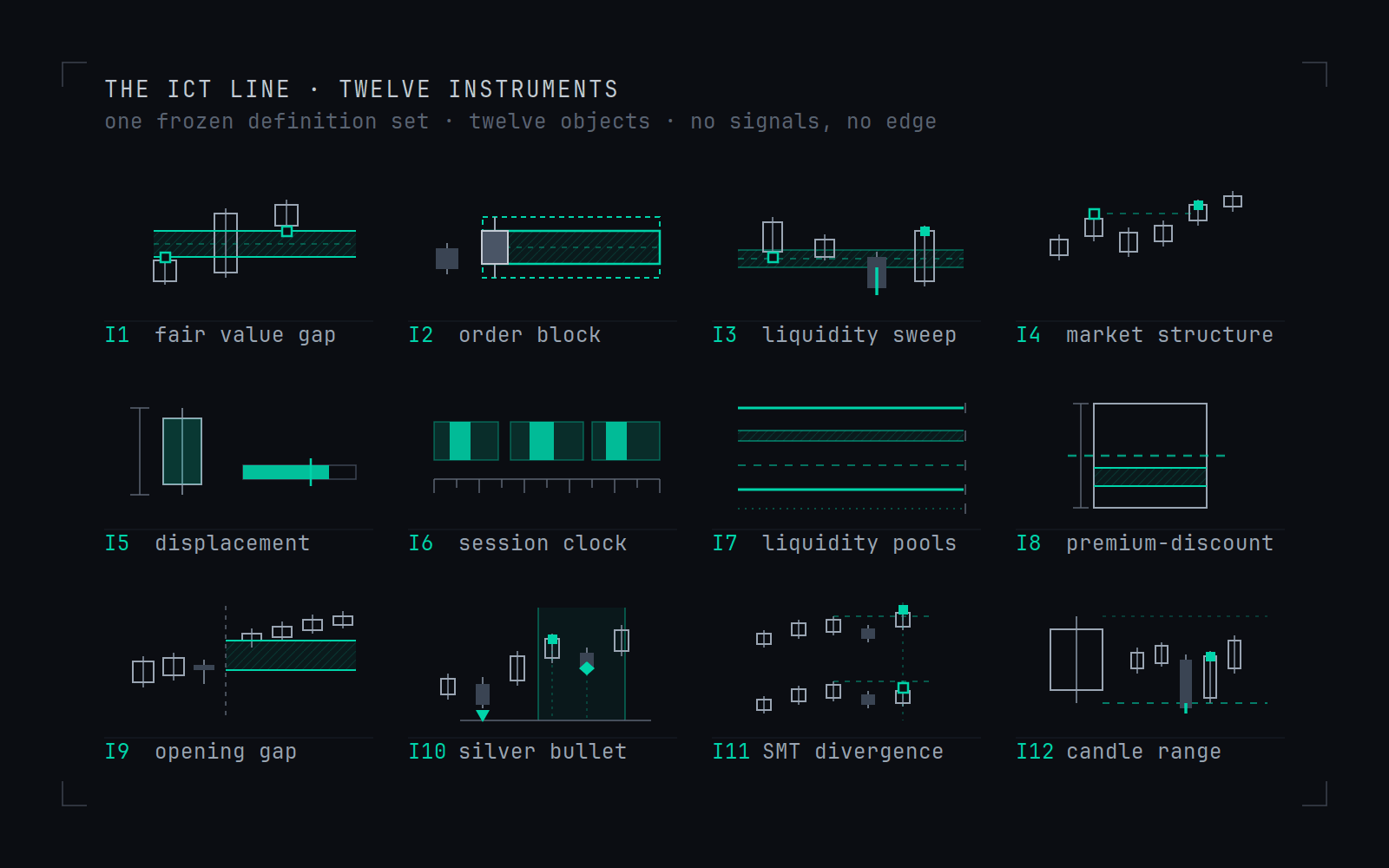
The line, whole. Twelve instruments, twelve defined objects, one frozen definition set. Each panel draws that instrument's own geometry.
Drawing an object establishes what an instrument marks. It does not establish that any of these objects predicts anything.
The twelve instruments
- I1W1.5 · W2.8 · W2.9in build
Fair Value Gap Indicator
Every gap the definition admits from the size floor up, with states — nothing it refuses.
- I2W2.1 · W2.2 · W2.3 · W2.4 · W2.5in build
Order Block Indicator
The last opposing candle, selected by a stated validation-ladder rung — reproducibly.
- I3W1.13 · W1.12in build
Liquidity Sweep Indicator
Trade-through and reclaim at prior extremes, flagged under one stated test — not by eye.
- I4W1.10 · W1.11in build
Market Structure Indicator
BOS, CHoCH and MSS from one swing engine — the full hierarchy, every election printed.
- I5W1.9in build
Displacement Indicator
Body-dominant delivery flagged per bar and per leg, at thresholds you can actually read.
- I6S0.1 · W1.15 · W1.16in build
Session & Killzone Clock
One wall-clock authority — sessions and killzones, DST handled once, edges editable.
- I7W1.12 · W1.14in build
Liquidity Pools Indicator
The standing pool map — old highs and lows, equal extremes, session marks — one registry.
- I8W3.1in build
Premium-Discount & OTE Indicator
The dealing range with its equilibrium, and the committed 62–79 band — leg rule stated.
- I9W1.1 · W1.2 · W1.3in build
Opening Gap Indicator
NDOG and NWOG drawn from the census of real halts — sized, tracked, and honestly scoped.
- I10W2.10 · W2.11 · W2.12 · W2.14in build
Judas & Silver Bullet Models
The named model sequences as composed events — sweep, shift, window — with full lineage.
- I11W3.14in build
SMT Divergence Indicator
Swing non-confirmation across pairs, same-candle aligned — sample honesty on show.
- I12W4.5in build
Candle Range Theory Indicator
Reference-candle sweeps at the higher grain, flagged by rule — the CRT event, checkable.
Every datasheet declares its target platforms. What those platforms are to this estate — capture paths, with the capability states and the NOT YETs written out — is the platform register: entries for cTrader, the declared target on every datasheet, and for TradeLocker, Match-Trader and DXtrade, where the honest state today is NONE and the entry says so.
The claims ledger
Seventy-two drivers, transcribed from the detector campaign's frozen definition document — every concept the taxonomy teaches, mapped to the driver that measures it. The status column says what is true today: each definition exists, frozen, with its test design pre-declared. The verdict column is the point of the page. It reads NOT YET COMPUTED on every row, because the campaign admits no live reading before a driver recovers a planted effect through its measurement harness — and when readings land, the rows fill in here, at this address, with family-corrected verdicts and their artifacts. A ledger that could not say "not yet" could not be trusted to say anything else.
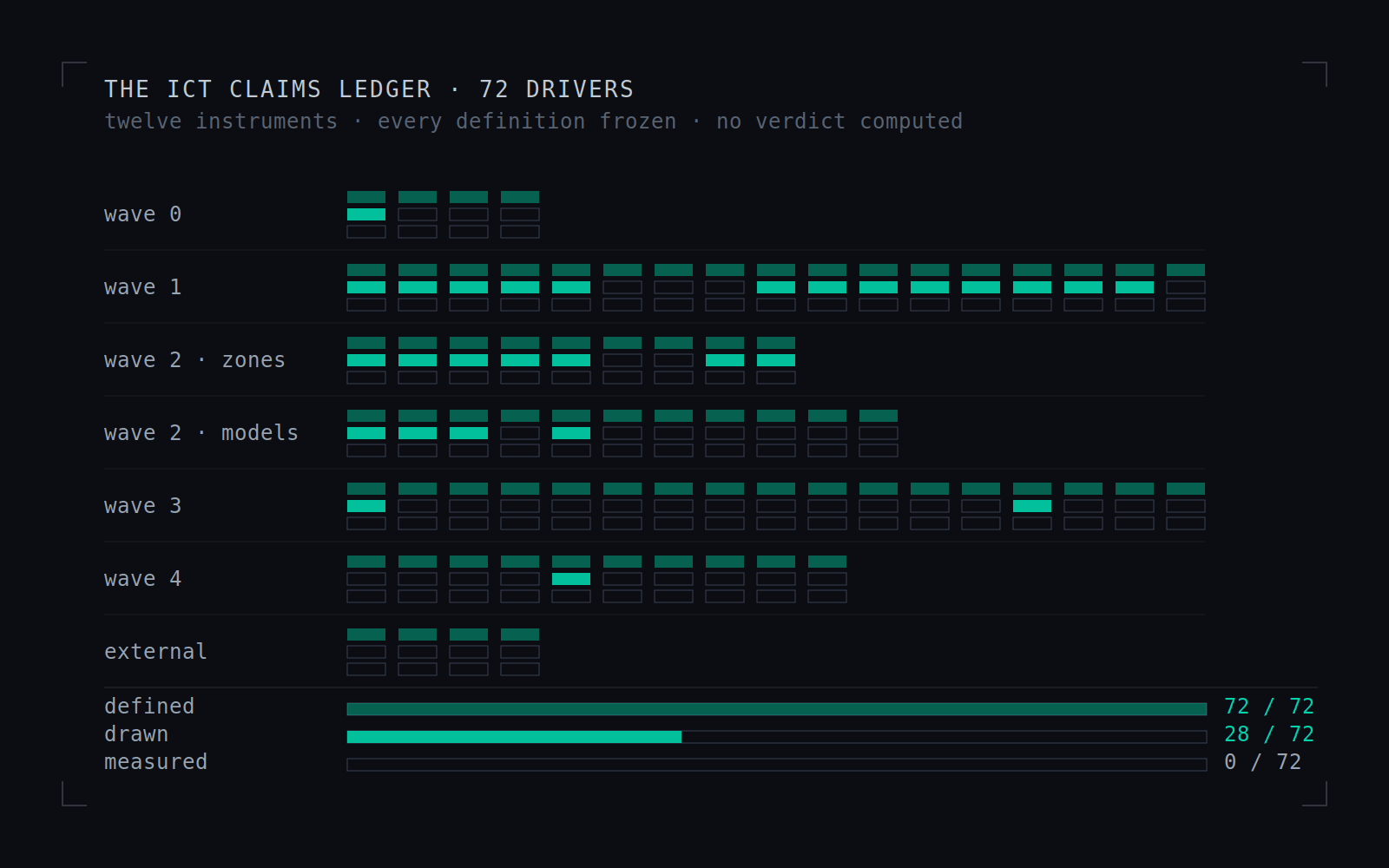
The ledger, whole: seventy-two drivers across the campaign's bands, every definition frozen, twenty-eight of them drawn by one of the twelve instruments, and not one verdict computed. The bottom row is hollow on every cell without exception, and that uniformity is what the drawing is for — the third track runs full width with nothing in it, because the honest zero is a result, not a gap.
Rendering the ledger establishes its composition today. It does not advance any row toward a verdict, and the instruments are the visible fraction of the campaign, not the whole of it.
fef054a611…8fd8adVerifyDate2026-08-30The plate's summary, as a table. The full ledger below — every row, with its wave, concepts and links — is the authoritative version, and both derive from the same exported register the digest above names.
| Ledger state | Count |
|---|---|
| DefinedEvery definition frozen before any data contact | 72 |
| Ships in an instrumentSpread across all twelve | 28 |
| Verdict computedEvery row reads the campaign’s honest state; the rows fill in here as readings land | 0 |
Wave 0 — substrate
Four drivers — one of them ships in the Session & Killzone Clock.
| Driver | Answers | Status | Verdict | Defined at · shipped in |
|---|---|---|---|---|
| S0.1 session_clock | One wall-clock authority; versioned session and killzone window tables | DEFINED | NOT YET COMPUTED | ict kill zones · I6 |
| S0.2 seasonality_baseline | Hour-of-day and day-of-week base rates — the incumbent every time-window claim must beat | DEFINED | NOT YET COMPUTED | — |
| S0.3 swing_engine | Swing highs and lows; the STH/ITH/LTH fractal hierarchy | DEFINED | NOT YET COMPUTED | — |
| S0.4 harness | Planted-effect recovery before any first live reading — the entry bar itself | DEFINED | NOT YET COMPUTED | — |
Wave 1 — primitive detectors
Seventeen drivers — thirteen of them ship in seven instruments: Opening Gap Indicator, Fair Value Gap Indicator, Displacement Indicator, Market Structure Indicator, Liquidity Pools Indicator, Liquidity Sweep Indicator, and Session & Killzone Clock.
| Driver | Answers | Status | Verdict | Defined at · shipped in |
|---|---|---|---|---|
| W1.1 gap_census | Which halts and gaps actually exist per instrument | DEFINED | NOT YET COMPUTED | I9 |
| W1.2 ndog_gaps | New Day Opening Gap events and their fill states | DEFINED | NOT YET COMPUTED | new day opening gap · I9 |
| W1.3 nwog_gaps | New Week Opening Gap events, retention-windowed | DEFINED | NOT YET COMPUTED | new week opening gap · I9 |
| W1.4 org_gaps | Opening Range Gap for cash-session instruments | DEFINED | NOT YET COMPUTED | opening range gap · I9 |
| W1.5 fvg_ledger | Fair value gaps: three-candle imbalance, states to inversion | DEFINED | NOT YET COMPUTED | fair value gap · I1 |
| W1.6 volume_imbalance | Body-to-body gaps with wick overlap | DEFINED | NOT YET COMPUTED | volume imbalance |
| W1.7 liquidity_voids | Runs of one-directional bars leaving thin traversal | DEFINED | NOT YET COMPUTED | liquidity void |
| W1.8 vacuum_blocks | Single-bar void variant | DEFINED | NOT YET COMPUTED | liquidity void |
| W1.9 displacement_flags | Body-dominant delivery per bar and per leg | DEFINED | NOT YET COMPUTED | displacement · I5 |
| W1.10 structure_events | BOS, CHoCH and MSS off the shared swing engine | DEFINED | NOT YET COMPUTED | break of structure · I4 |
| W1.11 cisd_flags | Change in state of delivery: close beyond the prior opposite leg’s open | DEFINED | NOT YET COMPUTED | market structure shift · I4 |
| W1.12 pool_registry | Equal highs/lows, PDH/PDL, PWH/PWL, session and monthly extremes | DEFINED | NOT YET COMPUTED | buy side and sell side liquidity · I7 |
| W1.13 sweep | Sweep-and-reclaim at pool references — pre-existing engine, reused | DEFINED | NOT YET COMPUTED | liquidity sweep · I3 |
| W1.14 anchor_opens | True-day, 08:30, 09:30, weekly and monthly opens with side-of-open state | DEFINED | NOT YET COMPUTED | I7 |
| W1.15 killzone_windows | Killzone occupancy flags against the named windows | DEFINED | NOT YET COMPUTED | ict kill zones · I6 |
| W1.16 macro_windows | Minute-scale macro window occupancy | DEFINED | NOT YET COMPUTED | ict macro times · I6 |
| W1.17 ce_mt_levels | The 50% line of every zone: consequent encroachment and mean threshold | DEFINED | NOT YET COMPUTED | consequent encroachment |
Wave 2 — zones
Nine drivers — seven of them ship in the Order Block Indicator and the Fair Value Gap Indicator.
| Driver | Answers | Status | Verdict | Defined at · shipped in |
|---|---|---|---|---|
| W2.1 ob_zones | Order blocks with the validation ladder and mean threshold | DEFINED | NOT YET COMPUTED | order block · I2 |
| W2.2 propulsion_blocks | Partially retraced blocks price drives off | DEFINED | NOT YET COMPUTED | propulsion block · I2 |
| W2.3 reclaimed_ob | Violated blocks later re-respected | DEFINED | NOT YET COMPUTED | order block · I2 |
| W2.4 breaker_blocks | Swept-then-broken blocks in the flipped role | DEFINED | NOT YET COMPUTED | breaker block · I2 |
| W2.5 mitigation_blocks | Failure-swing block flips, no prior sweep | DEFINED | NOT YET COMPUTED | mitigation block · I2 |
| W2.6 rejection_blocks | Wick-defined rejection zones | DEFINED | NOT YET COMPUTED | rejection block |
| W2.7 unicorn_zones | Breaker-and-gap overlaps after a shift | DEFINED | NOT YET COMPUTED | ict unicorn model |
| W2.8 ifvg_zones | Inverted fair value gaps acting in the flipped role | DEFINED | NOT YET COMPUTED | inverse fair value gap · I1 |
| W2.9 bpr_zones | Balanced price ranges: opposing-gap intersections | DEFINED | NOT YET COMPUTED | balanced price range · I1 |
Wave 2 — composite models
Eleven drivers — four of them ship in the Judas & Silver Bullet Models.
| Driver | Answers | Status | Verdict | Defined at · shipped in |
|---|---|---|---|---|
| W2.10 sequence_composer | The sweep → shift → array grammar, with component lineage | DEFINED | NOT YET COMPUTED | I10 |
| W2.11 model_2022 | Sweep of prior extreme → displaced shift → gap-retrace entry | DEFINED | NOT YET COMPUTED | ict 2022 model · I10 |
| W2.12 silver_bullet | The model restricted to its three one-hour windows | DEFINED | NOT YET COMPUTED | ict 2022 model · I10 |
| W2.13 turtle_soup | Failed sweeps of N-session extremes, both parameterisations | DEFINED | NOT YET COMPUTED | turtle soup |
| W2.14 judas_swing | The session-open counter-move variant | DEFINED | NOT YET COMPUTED | judas swing · I10 |
| W2.15 smr_events | Smart-money-reversal: sweep plus shift at a higher-grain array | DEFINED | NOT YET COMPUTED | smart money concepts |
| W2.16 bread_butter | London-open continuation configuration | DEFINED | NOT YET COMPUTED | — |
| W2.17 osok_selector | One-shot-one-kill: the single highest-grade composite per day | DEFINED | NOT YET COMPUTED | — |
| W2.18 scalp_variants | The grammar at the smallest grains, counted as its own family | DEFINED | NOT YET COMPUTED | — |
| W2.19 inducement_flags | Minor-pool sweeps preceding moves toward larger opposing pools | DEFINED | NOT YET COMPUTED | inducement |
| W2.20 sponsored_candle_flags | Displacement inside macro and killzone windows | DEFINED | NOT YET COMPUTED | — |
Wave 3 — context and state
Seventeen drivers — two of them ship in the Premium-Discount & OTE Indicator and the SMT Divergence Indicator.
| Driver | Answers | Status | Verdict | Defined at · shipped in |
|---|---|---|---|---|
| W3.1 dealing_range_state | Premium-discount occupancy and the OTE band | DEFINED | NOT YET COMPUTED | optimal trade entry · I8 |
| W3.2 cbdr_projections | Central bank dealing range and its SD projections | DEFINED | NOT YET COMPUTED | central bank dealers range |
| W3.3 asian_range_projections | Asian range projections, shared engine | DEFINED | NOT YET COMPUTED | — |
| W3.4 flout_range | The fallback composite window for wide-CBDR days | DEFINED | NOT YET COMPUTED | central bank dealers range |
| W3.5 fib_extensions | Symmetrical projections and SD extensions off declared legs | DEFINED | NOT YET COMPUTED | — |
| W3.6 adr_state | Average daily range consumption and remainder | DEFINED | NOT YET COMPUTED | — |
| W3.7 expansion_state | Contraction and expansion flags | DEFINED | NOT YET COMPUTED | — |
| W3.8 ipda_ranges | The 20/40/60-day lookback extrema | DEFINED | NOT YET COMPUTED | ipda |
| W3.9 erl_irl_state | External versus internal liquidity rotation state | DEFINED | NOT YET COMPUTED | draw on liquidity |
| W3.10 path_resistance | Low- and high-resistance run scoring toward a target pool | DEFINED | NOT YET COMPUTED | — |
| W3.11 dol_nominator | Draw-on-liquidity nomination with its resolution ledger | DEFINED | NOT YET COMPUTED | draw on liquidity |
| W3.12 pd_array_matrix | The array registry and the measured versus published ordering | DEFINED | NOT YET COMPUTED | pd array |
| W3.13 iofed_scanner | The top-down drill as a confluence score | DEFINED | NOT YET COMPUTED | — |
| W3.14 smt_flags | SMT divergence: time-aligned swing non-confirmation across pairs | DEFINED | NOT YET COMPUTED | smt divergence · I11 |
| W3.15 numeraire_baskets | Synthetic per-currency indices for basket-SMT and correlation state | DEFINED | NOT YET COMPUTED | — |
| W3.16 htf_alignment | Structure agreement across grain pairs | DEFINED | NOT YET COMPUTED | — |
| W3.17 daily_bias_scorer | Composite daily and weekly bias with a resolution ledger | DEFINED | NOT YET COMPUTED | ict daily bias |
Wave 4 — cycles, profiles, aftercast
Ten drivers — one of them ships in the Candle Range Theory Indicator.
| Driver | Answers | Status | Verdict | Defined at · shipped in |
|---|---|---|---|---|
| W4.1 weekly_profiles | Weekly extreme formation timing; the 12-template taxonomy as labels | DEFINED | NOT YET COMPUTED | ict weekly profiles |
| W4.2 daily_profile_labels | End-of-day profile classification and its predictive form | DEFINED | NOT YET COMPUTED | — |
| W4.3 po3_amd | Power of three: open-relative geometry, phases as time fields | DEFINED | NOT YET COMPUTED | — |
| W4.4 quarterly_partition | Session, 90-minute and 22.5-minute partitions with true opens | DEFINED | NOT YET COMPUTED | — |
| W4.5 crt_events | Candle range theory: reference-candle sweeps and follow-through | DEFINED | NOT YET COMPUTED | candle range theory · I12 |
| W4.6 seasonal_map | Month-of-year and day-of-month base rates, era-stratified | DEFINED | NOT YET COMPUTED | — |
| W4.7 stop_hit_rates | Barrier-touch rates at pool references versus random-walk floors | DEFINED | NOT YET COMPUTED | — |
| W4.8 mmxm_phases | Market-maker model phases as a state machine with completion ledger | DEFINED | NOT YET COMPUTED | market maker model |
| W4.9 grain_replication | Effect-size consistency across grains — the fractality module | DEFINED | NOT YET COMPUTED | — |
| W4.10 execution_geometry | Stop and entry conventions, realized R per convention pair | DEFINED | NOT YET COMPUTED | — |
External-data drivers
Four drivers — none of them ships in an instrument.
| Driver | Answers | Status | Verdict | Defined at · shipped in |
|---|---|---|---|---|
| W5.1 cot_positioning | Commercial net positioning percentiles | DEFINED | NOT YET COMPUTED | — |
| W5.2 oi_filter | Open-interest deltas at key-level interactions | DEFINED | NOT YET COMPUTED | — |
| W5.3 commodity_filter | Commodity legs as a currency-bias input | DEFINED | NOT YET COMPUTED | — |
| W5.4 rate_differentials | Policy-rate differential levels and changes | DEFINED | NOT YET COMPUTED | — |
The vocabulary itself is defined in the glossary, term by term, with each definition separated from the claims built on it. The measured work already published in this family is in the research — including the order-block study and its hash-verified artifact. What this estate refuses to publish at all is recorded at refusals, and hypotheses that died by their own registered criteria are in the kill ledger — the standard every row above will be held to when its number arrives.