94 / 110
Smart money reversal (SMR)
Written SMR throughout.
Working definition
ICT's name for a turn at a higher-timeframe array: inside a zone such as a fair value gap or order block drawn on a larger timeframe, price sweeps a prior high or low and then shifts structure the other way. The market maker model turns at one. The name is a label; the chart does not show who traded.
A turn can print anywhere on a chart, and the smart money reversal is ICT’s name for one that prints at a place marked in advance: a sweep and a structure shift inside an array drawn on a larger timeframe.
The construction
Three parts, in order, each defined on its own page. The location is a higher-timeframe array: a fair value gap, an order block, a rejection block or an old high or low, drawn on a larger timeframe than the one the rest of the sequence is read on. The sweep happens there: price trades beneath a prior swing low inside the array and closes back above it within a stated window, a liquidity sweep by that entry’s test. The shift follows: within a stated number of candles, a market structure shift the other way, a close through the last qualifying lower high, delivered with displacement where the definition requires it.
That is the bullish form, which ends a decline, and teaching looks for it at an array in the discount half of the dealing range, in the terms of the PD array entry. The bearish form ends a rally at an array in the premium half: a swing high inside it is swept, and the shift breaks the last higher low. The detector campaign registers the event as a sweep plus a shift at an array from a larger timeframe, in its own row of the claims ledger.
Where the name comes from
The name carries the account of large participants that ICT teaching shares with the smart money concepts vocabulary. In its account of the turn, the sell orders resting beneath the swept low, the stops of earlier buyers and the entries of breakout sellers, give large buyers the other side of their trades, and the shift is read as that buying showing on the chart. Candle data records none of it, only a trade beneath a price, a close back above it and a break of a swing; who traded, and why, is not in the data. The name is kept because readers search for it, and nothing in the definition depends on the account being true.
Pages that rank for the term use it more loosely: one for any sweep followed by a shift, another for any turn it reads as large participants changing sides, confirmed with volume or momentum readings. This entry keeps the narrower meaning the market maker model entry and the campaign’s row share, because the location fixed in advance is what separates the reversal from sweeps and shifts everywhere else.
A worked case
Constructed numbers, with the elections stated first and made for the example, not as defaults: arrays are four-hour fair value gaps; the sequence is read on fifteen-minute candles; the sweep’s extreme must lie inside the gap and its candle must close back across the swept low; and the shift must close through an intermediate swing, a short-term swing flanked by lesser short-term swings as the market structure shift entry grades the tiers, with displacement read as a body of at least 0.60 of the range and a range of at least 1.5 times ATR(14), within eight candles of the sweep.
On GBP/USD a four-hour bullish gap spans 1.2640 to 1.2655, from the first candle’s high to the third candle’s low. Days later price declines into it. On the fifteen-minute chart a swing low prints at 1.2651, inside the gap, and the bounce from it prints short-term highs at 1.2663, 1.2672 and 1.2667, so 1.2672, flanked by lower short-term highs, is an intermediate high under the stated rule. Price then trades down to 1.2644, seven pips beneath the low and still inside the gap, and that candle closes at 1.2657: the sweep. Four candles later a run of candles that each pass the displacement election closes at 1.2680, above 1.2672: the shift, inside the window. Under these elections the sequence is a bullish smart money reversal, and its extreme is 1.2644. A later trade beneath 1.2644 voids the reading. What price does after the close at 1.2680 is part of no definition.
The bearish mirror
Every direction reverses, and the timeframe pair moves up to daily arrays and hourly candles, the other elections unchanged. On EUR/USD a daily bearish gap spans 1.0890 to 1.0905, from the third candle’s high to the first candle’s low. On the hourly chart price rallies into it, prints a swing high at 1.0897 inside the gap, and pulls back through short-term lows at 1.0881, 1.0874 and 1.0879, so 1.0874, flanked by higher short-term lows, is an intermediate low.
Price then trades up to 1.0902, five pips above the high and still inside the gap, and that candle closes at 1.0893. Three candles later a displaced run closes at 1.0868, beneath 1.0874: a bearish smart money reversal, with its extreme at 1.0902. The numbers are constructed again, and a reversal on one timeframe pair is a different event from one on another.
The elections
Each part carries its own page’s parameters, and the reversal adds six. The timeframe pair: which larger timeframe supplies arrays for which smaller one. The array list: which types count; the wider it is, the likelier some array sits near any turn.
The location rule: the sweep’s extreme inside the array, or within a stated distance where the array is a single price such as an old high. The array’s life: whether a gap already traded through, or an array reached once before, still qualifies. The window between sweep and shift. And the shift’s grade: which swing tier qualifies, a close or a wick through it, and whether displacement is required. Change one election and a different set of events exists, which is why a count of reversals travels with its elections.
Inside the market maker model
The market maker model is the campaign drawn around this turn: a first half that leaves an original consolidation in stages and ends at a higher-timeframe array, the smart money reversal there, and a second half back through the earlier pauses. Read alone, the reversal sets no objectives. Inside the model it is the state at which objectives are named, nearest pause first, and its extreme marks the model failed if price trades back beyond it before the consolidation is reached. On a lower timeframe the turn often has the shape of the ICT 2022 model.
Identifying one, step by step
- Declare the pair and the list: the larger timeframe for arrays, the smaller for the sequence, and the array types that count.
- Draw arrays as their candles close on the larger timeframe, and keep only those still live under the stated rule. A four-hour gap does not exist until its third candle closes, and a record that uses it earlier has look-ahead bias.
- Mark the swings inside an array once price reaches it: the swing lows of a decline, or the swing highs of a rally, on the smaller timeframe.
- Flag the sweep: a trade beyond one of those swings, with its extreme inside the array and a close back across the swing within the reclaim window.
- Flag the shift: a close through the last qualifying swing the other way, within the window and at the stated grade.
- Record the sweep’s extreme at once, because a reading that names nothing that would void it cannot be scored.
Trading it, as taught
Teaching treats the reversal as a trigger. The entry is usually taken on a return into the gap or block the shift’s move left, with the stop beyond the sweep’s extreme and the objective at resting liquidity on the far side: a draw on liquidity or, inside the market maker model, the nearest earlier pause. One guide also grades reversals by the swept level’s significance, the force of the move away and whether the sequence finished inside a kill zone. Each is an election, and a grade chosen after the outcomes are known sorts a record by its results instead of forecasting them.
What it is not
Not a sweep alone: a sweep inside an array that no shift follows stays a sweep. Not a shift alone: a break with no sweep before it, or far from any array, is only a shift. And not a reversal in the ordinary sense, which is a verdict about later travel: the sequence is complete when the shift prints, before any later travel exists, and the name borrows the verdict’s word for it.
Common mistakes
Drawing the array after the turn, by searching the larger timeframe for whichever zone sits nearest the low. Reading the array and the sequence on the same timeframe, which removes the location condition the definition depends on. Changing the array list from one analysis to the next. Counting the sweeps at arrays that turned while forgetting the ones price passed straight through. And writing that smart money reversed the market, when what printed was a sweep and a break on stated candles.
What the reversal does not settle
The sequence is checkable: an array, a sweep inside it and a shift after it, which two readers with the same elections mark identically. The forecast attached to it is a separate claim: that the sequence at a higher-timeframe array is followed by travel in the new direction more often, or further, than the same sweep and shift away from any array, and than an array reached without them. Testing it takes those counts, marked as each reversal prints, with every reversal voided beyond its extreme counted beside every one that travelled. The smart money reversal driver has a row in the claims ledger, where that verdict renders, and the two lenses keep the sequence apart from the forecast.
Where it sits in the ICT sequence
The ICT vocabulary in the order the method is taught, with a step for each kind of object.
- Step
- 08 of 08 Models: the steps composed into named setups
- Also at this step
- Power of three (PO3), ICT 2022 model, ICT unicorn model, Market maker model (MMXM), One shot one kill (OSOK)
- Before it
- ICT unicorn model
- After it
- Market maker model (MMXM)
The shape, drawn
The smallest arrangement the definition admits. It is a drawing of a rule, not a reading of a market — nothing here is measured, and the table below it is the authoritative version.
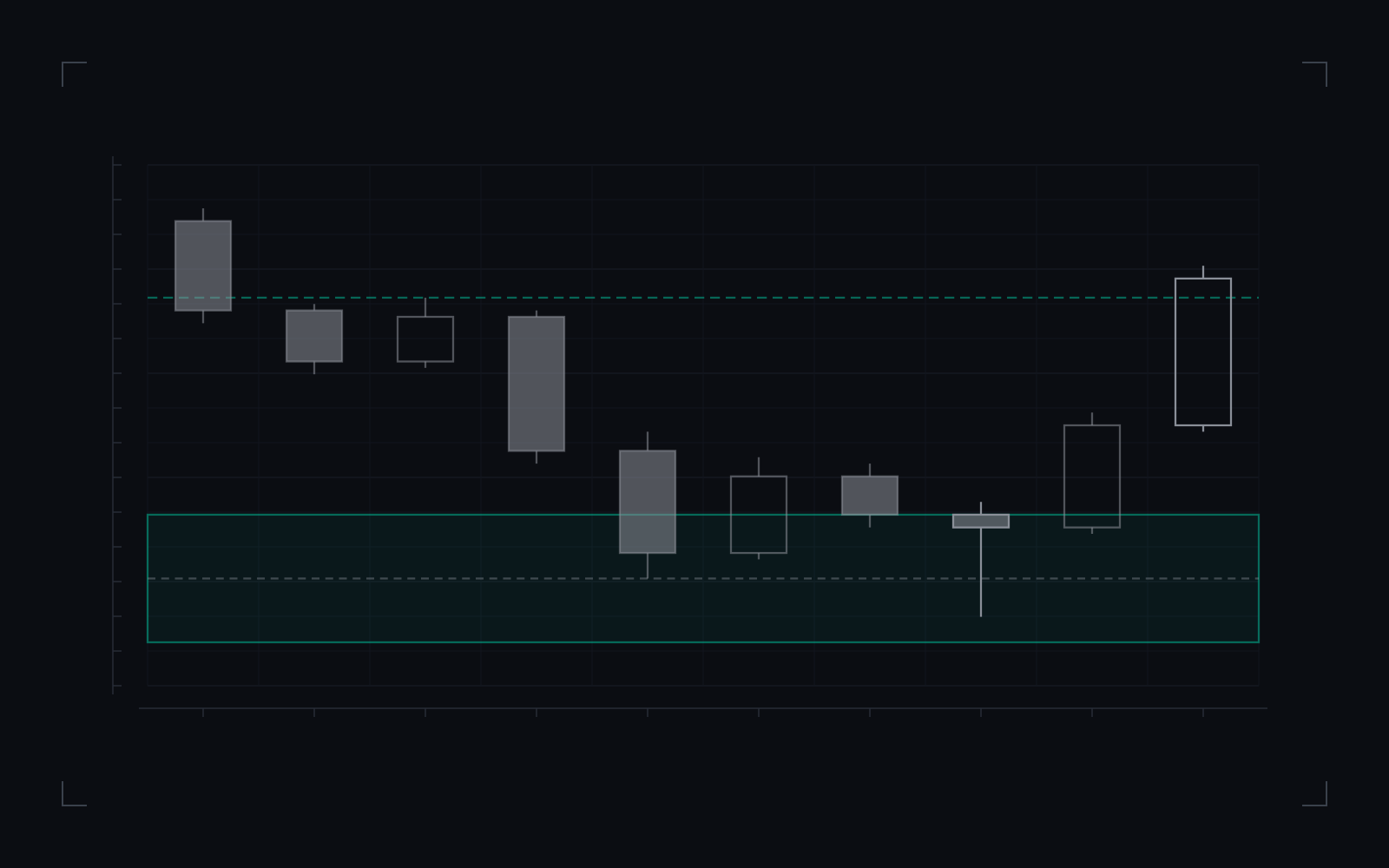
- The location: a fair value gap drawn on a larger timeframe, registered before price reaches it.
- Falling candles: the decline into the array.
- The swing low inside the array.
- The sweep: a candle trades beneath that low, stays inside the array, and closes back above the low.
- The last lower high of the decline, the swing the shift must close through.
- The shift: a displaced candle closes through that high, within the stated window.
- Rising candles: the bounce before the sweep and the move after it.
A bullish smart money reversal: a decline reaches a fair value gap drawn on a larger timeframe, a swing low inside the gap is swept and closed back above, and a displaced candle then closes through the last qualifying lower high.
The drawing establishes the three parts and their order. It does not establish that price travels further after a reversal at an array than after the same sweep and shift away from one.
Smart money reversal (SMR): what the definition states, in full.
| Element | What the definition states |
|---|---|
| Location | An array drawn on a larger timeframe than the sequence. |
| Sweep | A trade beyond a prior swing inside the array, closed back across it within the reclaim window. |
| Shift | A close through the last qualifying swing the other way, within a stated number of candles. |
| Timeframe pairWhich larger timeframe supplies arrays for which smaller one. | election pending |
| Array listThe wider the list, the likelier some array sits near any turn. | election pending |
| Not established | Whether price travels further after the sequence than after the same sweep and shift away from an array. |
Commonly confused with
Neighbouring concepts that get used interchangeably, and the distinction that actually separates them.
- Liquidity sweep
The sweep is one event, at any price. The smart money reversal requires it inside a higher-timeframe array, followed within a stated window by a structure shift the other way. Every smart money reversal contains a sweep; a sweep with no array or no shift is only a sweep.
- Market structure shift
A shift is one structure event, and it can print anywhere. The reversal places it after a sweep, within a stated window, at an array from a larger timeframe. A shift can exist without a reversal; a reversal cannot exist without a shift.
- ICT 2022 model
The 2022 model is an entry sequence of sweep, displaced shift, fair value gap and return, with no condition on where it happens. The smart money reversal adds the higher-timeframe array and ends at the shift. On a lower timeframe the reversal often has the 2022 model's shape.
- Judas swing
Both are a sweep followed by a shift the other way. The judas swing is anchored to a clock, the first push after a declared open. The smart money reversal is anchored to a place, an array drawn on a larger timeframe. A session-open turn inside such an array can satisfy both.
How to measure it in your own data
A definition you cannot test is a definition you have to take on trust. This is the shortest honest route from the concept to a number you computed yourself.
- Records you need
Candle data at two declared timeframes, a larger one for arrays and a smaller one for the sequence; the rule for each admissible array type; the swing rule and reclaim window for the sweep; the tier, break rule and displacement election for the shift; the candles allowed between the two; and a rule for when an array stops counting.
- What you compute
Register arrays on the larger timeframe as their candles close. On the smaller timeframe, flag each sweep whose extreme lies inside a live array and that is followed within the window by a shift the other way. Record whether price then travels stated distances before trading back beyond the sweep's extreme, and compare with the same sweep and shift away from any array, and with arrays reached without them.
- What the answer tells you
A decline into a gap or block drawn on a larger chart, a brief trade beneath a low inside it that closes back above, then strong candles through the last lower high; mirrored at highs. The picture is easy to find after the fact, because the wider the list of arrays, the likelier some array sits near any turn.
Questions and answers
What is a smart money reversal (SMR)?
ICT's name for a turn at a higher-timeframe array. Inside a zone drawn on a larger timeframe, such as a fair value gap or an order block, price trades beyond a prior high or low, closes back, and then breaks structure the other way. The market maker model places one at its turning point. The name describes a sequence on a chart, not anyone's orders.
How is a smart money reversal confirmed?
By all three parts printing under stated rules: price reaches a qualifying higher-timeframe array, sweeps a prior high or low inside it, and shifts structure the other way within a stated number of candles. A sweep that no shift follows stays a sweep. Confirmation completes the sequence; it does not say what price does next.
What is the difference between a smart money reversal and a liquidity sweep?
The sweep is one part of the reversal. A liquidity sweep, a trade beyond a prior high or low that closes back inside, can print anywhere; the smart money reversal requires it inside a higher-timeframe array, followed by a structure shift the other way within a stated window.
Does a smart money reversal show that institutions are trading?
No chart can show that. The name carries the smart money account, which holds that large participants fill against the orders resting beyond the swept level before the turn. Candle data records a trade through a price and a break of a swing; it does not record who traded or why, so the name stays a label.
Does the smart money reversal work?
The sequence can be checked on any chart; the forecast attached to it needs a count. The count marks each reversal as it prints, under stated elections, and records how often price travels a stated distance before trading back beyond the sweep's extreme, against the same sweep and shift away from any array. The smart money reversal driver has a row in the claims ledger.
Related terms
Derived from the links this entry makes and the entries that link back to it.