48 / 97
Judas swing
Working definition
A session-open counter-move: the first directional push after a declared open that sweeps a resting pool and then gives way to a move the other way — named for the betrayal.
Every session opens somewhere, and the judas swing is the taxonomy’s standing accusation that the opening direction is a lie.
The construction is a composition of parts this glossary already carries, plus a clock. After a declared open — midnight New York in the strictest telling, the London open in the most common one, inside the corresponding kill zone — the first directional push runs a qualifying pool: typically the overnight or Asian range’s high or low, the obvious resting orders of the early day. The push trades through, fails to hold, and closes back inside — a liquidity sweep by that entry’s stated test — and then, within a declared window, an opposite-direction structure event arrives: the market structure shift that the method reads as the day’s true direction announcing itself. Open election, pool rule, push window, reversal window: four parameters, and a judas flag that states none of them is a campfire story about a chart.
The name earns a paragraph because it does the arguing. Calling the opening move a betrayal presumes the deception is the norm — that the first push exists to collect the early orders before the real move goes the other way. That presumption is a base rate wearing a costume: how often the first directional push after a given open marks the day’s opposite extreme, rather than its direction, is a plainly measurable frequency. The label assumes the answer flatters the setup; nothing on this page is entitled to that assumption, and the two lenses apply to named characters exactly as to anonymous ones.
The term’s neighbours locate it. It is the concrete event inside the manipulation chapter of the power-of-three session narrative; it is a false breakout with a casting requirement — the failure must be the opening act; and where an opening-range method counts the same failure as its losing trade, this vocabulary counts it as the setup. One picture, three framings, and the framing is not evidence. What would be: the base rate, measured against the clock and the pool rule, era by era — which is a driver’s job, not a glossary’s.
Where it sits in the ICT sequence
The ICT vocabulary in the order the method is taught, with a step for each kind of object.
- Step
- 03 of 08 Liquidity: the resting orders, and whether price has taken them
- Also at this step
- Buy-side and sell-side liquidity, Draw on liquidity (DOL), ICT daily bias, Liquidity sweep, Inducement, Turtle soup, Candle range theory (CRT), SMT divergence
- Before it
- Inducement
- After it
- Turtle soup
The shape, drawn
The smallest arrangement the definition admits. It is a drawing of a rule, not a reading of a market — nothing here is measured, and the table below it is the authoritative version.
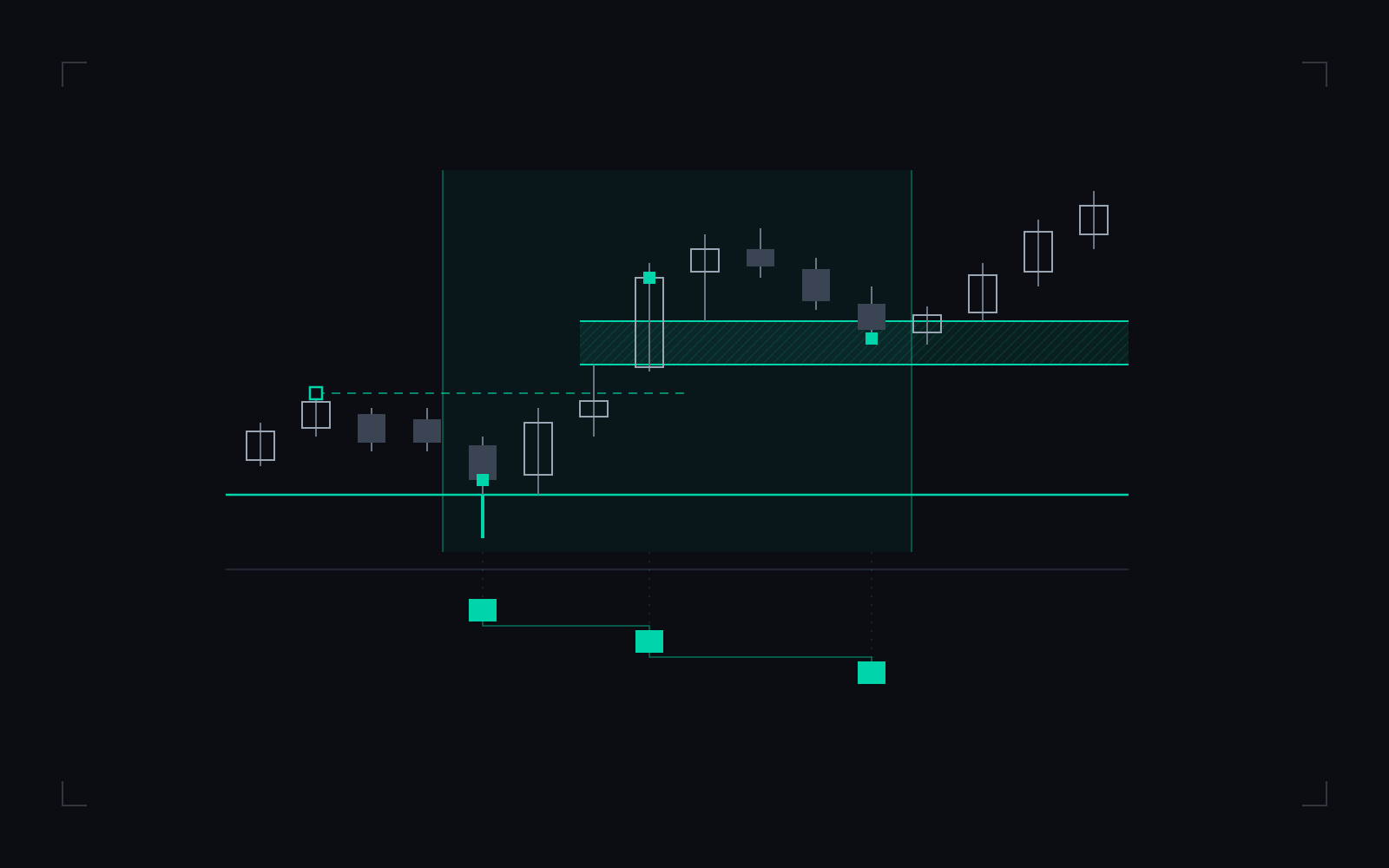
Grammar showing. The composite is a sequence of three component events — a sweep, a shift, and an array touch — and the lineage beneath names the instrument that detected each one, in the order it fired. A sequence you cannot decompose is a story; this one decomposes.
Decomposing a sequence establishes which components fired, in what order, and inside which window. It does not establish that a completed sequence is followed by anything.
Judas swing: what the definition states, in full.
| Element | What the definition states |
|---|---|
| Sequence grammar | Sweep, then shift, then array touch. |
| LineageEach component event names the instrument that detected it, so the composite is checkable against its parts rather than taken whole. | On. |
| Model windows | For silver bullet, the three taught one-hour windows. |
| Declared openWhich open the model measures from is named in advance, because an open chosen afterwards fits any morning. | election pending |
| Component windowsHow long each component has to arrive before the sequence lapses is a parameter, not a fact. | election pending |
| Not established | Whether a completed sequence is followed by anything. |
Commonly confused with
Neighbouring concepts that get used interchangeably, and the distinction that actually separates them.
- Liquidity sweep
The sweep is the general event at any hour. The judas swing is a scripted special case — anchored to a declared session open, cast as the day's first move, and required to resolve into an opposite-direction shift. Every judas swing contains a sweep; the sweep needs no open and no script.
- A false breakout
The classical name for a break that fails anywhere on the clock. The judas swing adds the session-open anchoring and the sequence requirement — the failure must be the day's opening act, not any act. Same picture, tighter casting call.
- The manipulation phase of power of three
Power of three narrates a whole session as accumulation, manipulation and distribution; the judas swing is the concrete event its manipulation chapter usually points at. One is a session-length story; the other is a definable move with parameters.
- An opening range breakout failure
Opening-range methods define a post-open range and trade its breaks; a failed break is their losing trade. The judas swing treats that same failure as the setup itself — the expected opening deception rather than the strategy's misfire.
How to measure it in your own data
A definition you cannot test is a definition you have to take on trust. This is the shortest honest route from the concept to a number you computed yourself.
- Records you need
Candle data with an unambiguous clock, a declared open — midnight New York or a session open, stated — a stated pool definition for what can be swept, and window parameters for how long after the open the push and the reversal may take.
- What you compute
After the declared open, flag the first directional push that trades through a qualifying pool; require a close back inside and an opposite-direction structure event within the stated window. The open election, the pool rule and both windows all change the population of events, so a judas flag states its configuration or it is a story.
- What the answer tells you
An early-session push that runs the obvious level from the overnight range — often the Asian session's high or low — then stalls, closes back inside, and gives way to the day's actual direction. The picture is memorable, which is not the same as being reliable; how often the opening push betrays versus leads is exactly the measurable part.
Questions and answers
What is a judas swing in trading?
The taxonomy's name for a session-open deception: the first push after a declared open sweeps a resting pool — commonly the overnight range's extreme — and then reverses into the day's real move. The name is the accusation: the opening direction betrays those who followed it.
When does a judas swing happen?
By definition, only in the window after a declared open — midnight New York or the London open in most tellings, inside the corresponding kill zone. The window lengths are parameters, and versions that leave them unstated cannot be checked against a chart.
How is a judas swing confirmed?
Under a stated rule: the opening push trades through a qualifying pool, closes back inside, and an opposite-direction shift arrives within the declared window. Each element is a parameterised event from this glossary — the sweep, the reclaim, the shift — composed with a clock anchor.
Does the first move of the session usually reverse?
That is the base-rate question the name quietly begs, and it is measurable: how often does the first directional push after a given open mark the day's opposite extreme rather than its direction? The label assumes an answer; a measurement would earn one.
Related terms
Derived from the links this entry makes and the entries that link back to it.
Where the term is in build
Detector datasheets whose concepts include this term, or whose published copy uses it. Each one states the build state it has reached and the parameters it exposes, and carries no measured verdict.