The measured version of any claim
is also the convincing version.
Every measurement I publish pre-registers before it runs, ships content-hashed, and stays recomputable by a stranger. This page is that method — it is not a record of results; those live on the research pages and the kill ledger as the work produces them.
Seven receipt pages.
The receipt page is the unit of proof on this site. There is one per instrument family, and each carries the same five parts: the versioned methodology with a formal definition, estimator, failure modes and non-claim for every metric that family measures; the pre-registrations; the proof corpus; the changelog; and the exact steps a stranger follows to recompute a published number without asking me for anything.
Eight measurements are now published with their artifacts — among them the positioning series behind the COT study, downloadable and hashed, from a hypothesis registered before the data had ever been fetched. No suite has assembled its own proof corpus yet, so three of those five parts remain empty on all seven pages — and they are empty visibly, slot by slot, rather than absent.
- Methodology, versionedProse and formal definitions. Every metric carries its name, its definition, the estimator that computes it, its known failure modes, and what it does not establish. The page carries a version, and the version is printed on it.
- Pre-registrationsDeclarations made and dated before any measurement runs: decision thresholds, exclusion rules, completeness bars. Immutable once posted — an amendment appends beneath the original with its reason, and never overwrites it.
- Proof corpusThe published artifacts themselves: dataset descriptors, content hashes, download links, and the version tag of the code that generated each one. A result whose inputs are not downloadable is not a receipt.
- ChangelogAppend-only, dated, written by a person. What changed on this page, when, and why. A correction is a new entry naming the entry it corrects — entries are never edited away.
- Independent recomputationThe exact numbered steps a stranger follows to re-derive a published number without asking me for anything. Where the recomputation disagrees, the disagreement is the finding.
Feed & Execution
Cadence, coordination, staleness, spread regimes — and what execution actually cost.
Backtest Honesty
Trial accounting, overfitting probability, dataset forensics, reproducible verdicts.
Desk Discipline
Halt distance, correlation-adjusted heat, shock replay, quote-to-fill drift.
Premium Add-on
Option positioning terrain, never-repaint regime labels, joint change points, cascades.
The Honesty Stack
Pre-registration ordering, the kill ledger, chain of custody, fail-visible fault doctrine.
The Terminal
Per-number provenance on the glass, and the LOCKED state that replaces a guess.
Integrity Services
Five-hop lineage traces, and drills that prove a CI gate can actually fail.
7 receipt pages covering 21 instruments. Measurements published on a receipt page: NOT YET PUBLISHED. That is the narrower of the two counts on this page and the one worth watching, because it is the one I have least ability to flatter — the corpus plate below counts the whole site, where eight content-hashed artifacts are published.
What I guarantee.
I always
- Pre-register methodology before the first measurement
- Content-hash every artifact so results are recomputable
- Publish warts first — my own broker's defects lead
- Preserve original errors verbatim when retracting
- Publish kill ledger entries with the same visibility as registrations
- Publish confidence intervals, effective-N, and honest nulls
- Ship the can-fail proof beside every test
- Build and run every instrument in-house — crediting the field's methods to the field, by name
I never
- Make performance claims or imply edge
- Use a composite 1–10 rating for broker profiles
- Accept affiliate compensation from brokers I measure
- Silently disappear a killed hypothesis
- Retroactively adjust methodology after seeing results
- Fabricate data, statistics, or completion claims
- Ship a test without proving it can fail
- Resell external analytics or third-party intelligence
From hypothesis to published receipt.
Every measurement passes through six stages. None can be skipped, reordered, or retroactively modified.
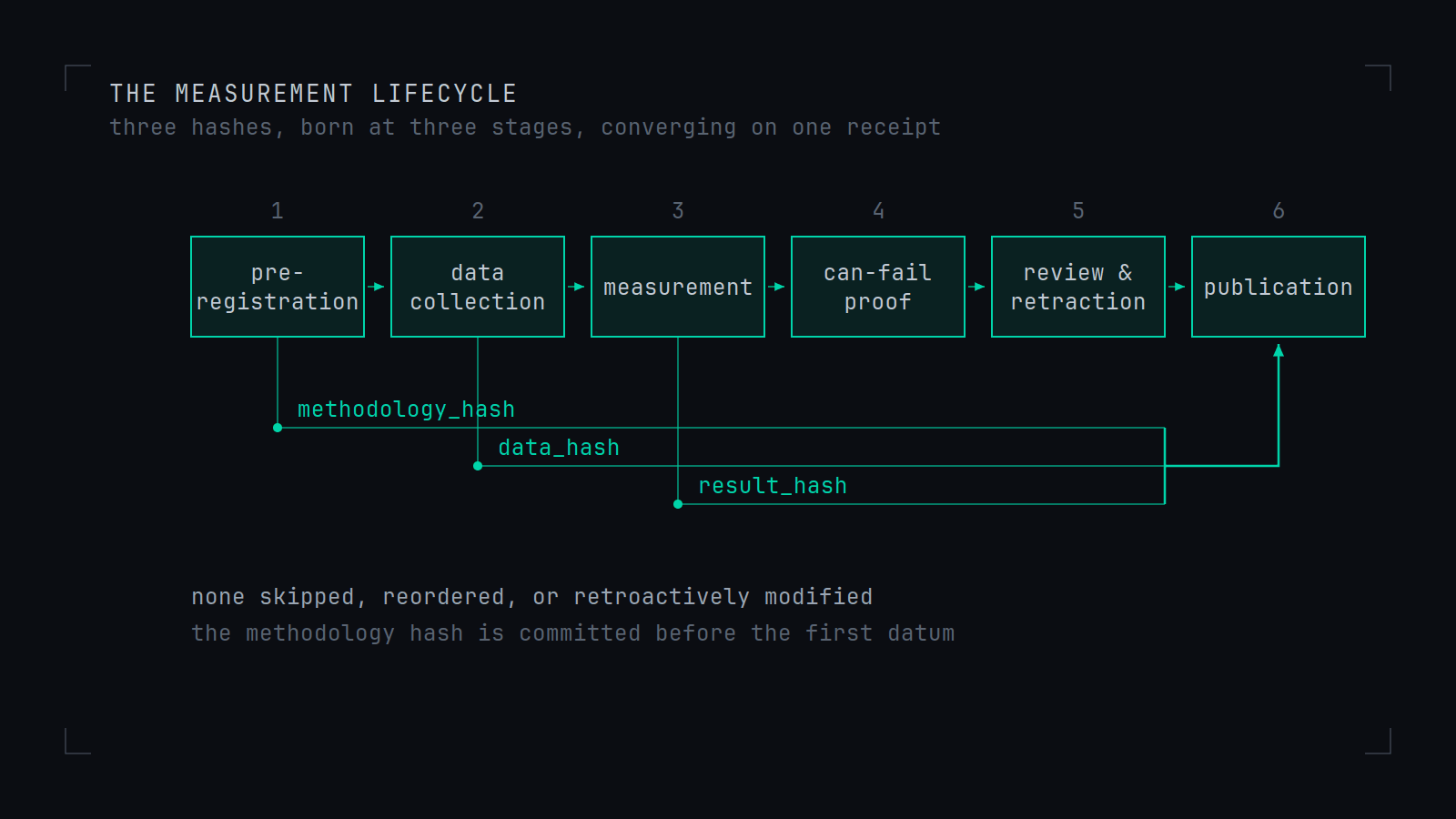
Six stages and three hashes. The methodology hash is committed before the first datum, the data hash when collection closes, and the result hash at measurement — all three converging on one published receipt.
Showing the order establishes what the process requires. It does not establish that any particular measurement has completed it.
Pre-registration
The methodology is written and content-hashed before any data is collected. This hash is the anchor — any post-hoc change to methodology would produce a different hash, and would be visible.
Data collection
Raw data is collected as point-in-time (PIT) snapshots — as-published, never backfilled. The raw archive is content-hashed at ingest. Timestamps are event-clock, not wall-clock where the instrument supports it.
Measurement execution
The pre-registered battery runs against the collected data. No parameter changes, no exclusions, no post-hoc methodology adjustments. The computation is deterministic — same inputs produce same outputs.
Can-fail proof
Every test ships with a demonstration that it could have failed. A test that always passes proves nothing. The can-fail proof is the difference between a measurement and a decoration.
Review & retraction
If an error is found, the original error is preserved verbatim — never deleted, never silently fixed. The correction is appended beside it. The circular denominator retraction is my founding example — the test was asserting its own defect — and its record is not published: see the corpus status below.
Publication
The result — pass, fail, or null — is published with full provenance: methodology hash, data hash, computation hash, can-fail proof status. A kill is published with the same visibility as a registration. No silent disappearances.
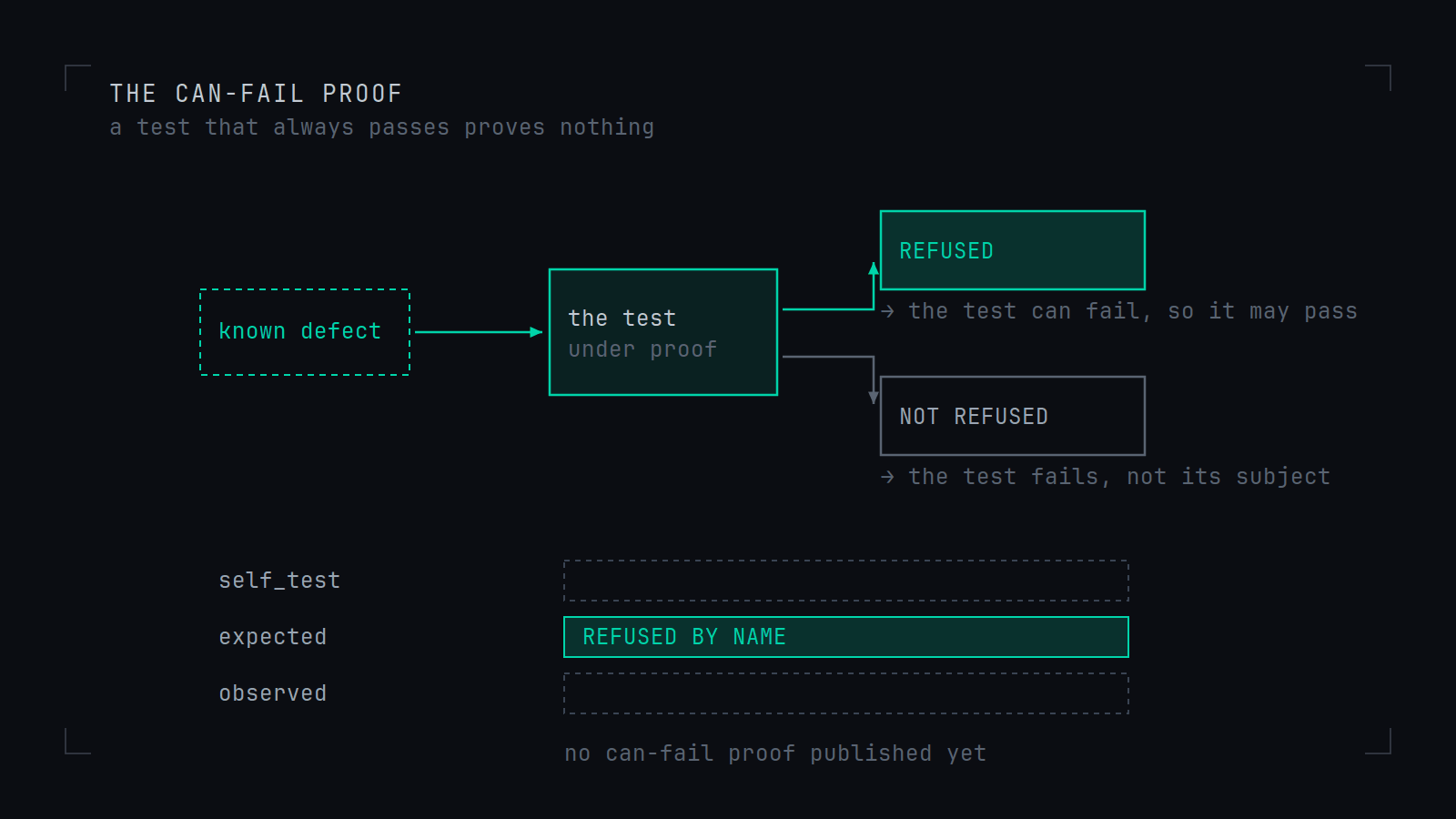
Stage four, drawn: a defect of known shape is fed to the test under proof, and only a refusal that names that defect admits the test. The other branch is the point — a test that cannot be shown refusing its own poison is failing, whatever its subject does. The strip beneath renders the receipt class in its honest state.
Proving a test can fail establishes the test. It does not establish any result the test later passes.
Six kinds of receipt.
Each kind answers a different question a sceptic would ask, and each is produced by the work itself rather than written about it afterwards. The blocks below are the formats those receipts take. Every field in them is a placeholder in angle brackets — none of them is filled in yet.
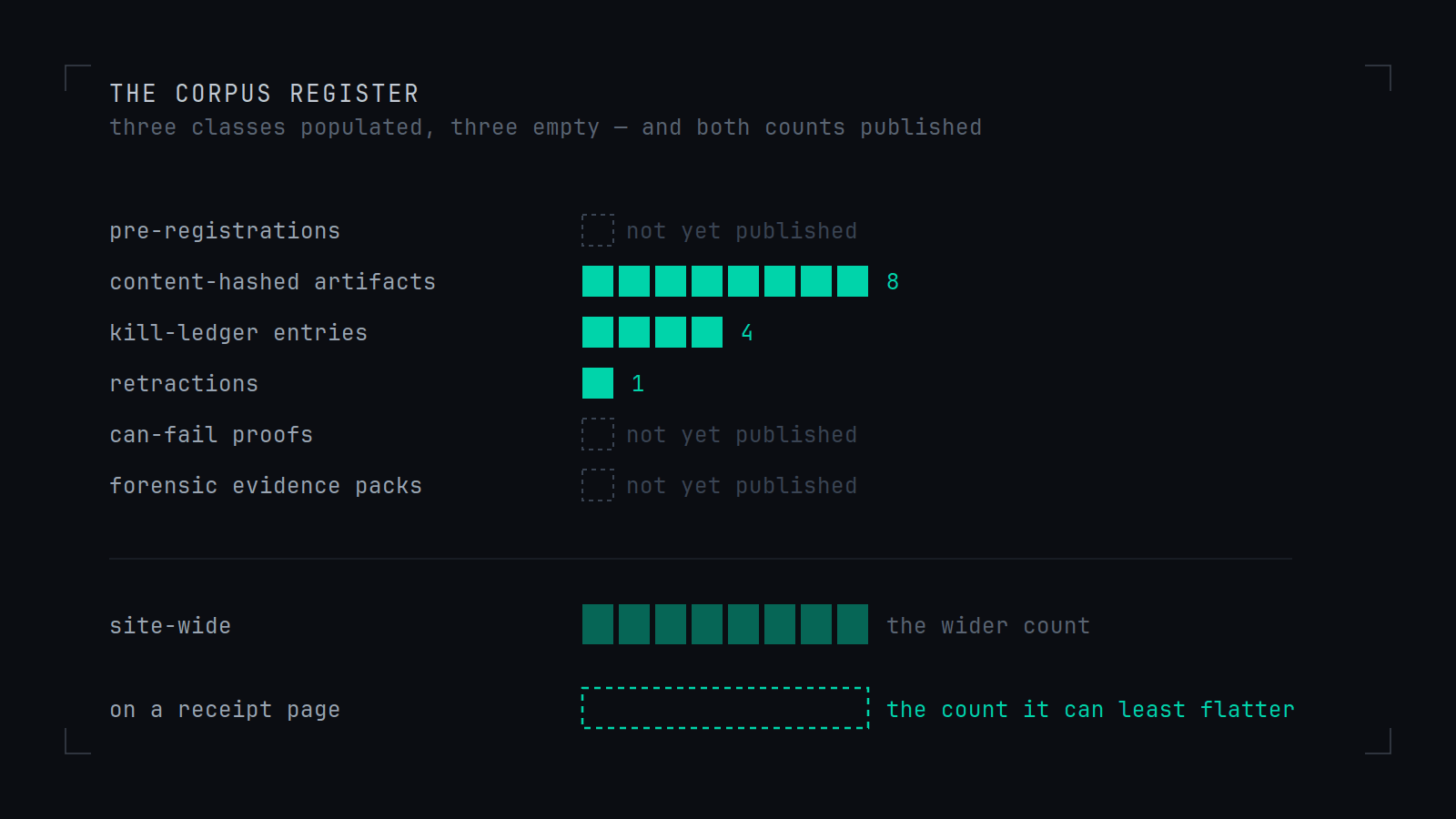
The corpus register: what each receipt class holds today. Three classes carry counts; three render their honest empty state — and a receipt page's own count is drawn beside the site-wide one, because the narrower count is the one it can least flatter.
Counting the corpus establishes what exists. It does not grade any artifact in it.
04dfd356ae…e9db3eVerifyDate2026-08-30The register as a table. Every count derives from the same exported register the digest above names; an empty class states itself.
| Receipt class | Held today |
|---|---|
| Pre-registrations | NOT YET PUBLISHED |
| Content-hashed artifacts | 8 |
| Kill-ledger entries | 4 |
| Retractions | 1 |
| Can-fail proofs | NOT YET PUBLISHED |
| Forensic evidence packs | NOT YET PUBLISHED |
- Pre-registrationsNOT YET PUBLISHED
- Content-hashed artifactsEIGHT PUBLISHED
- Kill-ledger entriesFOUR PUBLISHED
- RetractionsONE PUBLISHED
- Can-fail proofs (published)NOT YET PUBLISHED
- Forensic audit evidence packsNOT YET PUBLISHED
Nothing on this page is a record of a measurement. The narrative post-mortem of the agent-fabrication incident is published at The Burned Door; the evidence pack behind it has not been published. Each class above publishes with its hash, and this plate moves with the registers it reads.
Pre-registration
Methodology committed and content-hashed before data collection begins. The hash is the anchor — any change is visible.
Schema — a pre-registration record
registered: <UTC timestamp of registration>
first_data: <UTC timestamp of first collection>
status: <NOT YET PUBLISHED, or the publication hash>
Content hash
Every artifact — data, code, result — is SHA-256 hashed. The chain proves that declared results came from declared computation on declared data.
Schema — an artifact hash chain
code: sha256:<computed from source bytes>
result: sha256:<computed at publication>
status: <NOT YET PUBLISHED, or the publication hash>
Kill ledger
Hypotheses that were registered, tested, and killed. Published with the same visibility as registrations — no silent disappearances. The ledger has its own surface at the kill ledger, which now carries four engine-registry kills against a nineteen-entry denominator; the Observatory’s own side of it is still empty. The term is defined in the glossary.
Schema — a kill entry
states: REGISTERED → TESTED → KILLED
kill_date: <UTC date recorded at the kill>
evidence: <link to the run that killed it>
status: <NOT YET PUBLISHED, or the publication hash>
Retraction
Original error preserved verbatim. The correction is appended beside it, never a silent replacement. The error is the proof of the discipline.
Schema — a retraction record
state: RETRACTED
retracted: <UTC date>
correction: <appended beneath the original>
status: <NOT YET PUBLISHED, or the publication hash>
Can-fail proof
Every test ships with a demonstration that it could have failed. The self-test injects a known failure and asserts detection — REFUSED or PASS.
Schema — a can-fail proof
expected: REFUSED BY NAME
observed: <REFUSED | NOT REFUSED>
status: <NOT YET PUBLISHED, or the publication hash>
Forensic audit
A full investigation, published with its evidence chain. The agent-fabrication incident is the founding case: the narrative post-mortem is published at The Burned Door; the evidence chain that backs it is not.
Schema — an evidence pack
finding: <what the audit found>
evidence: <link to the preserved chain>
status: <NOT YET PUBLISHED, or the publication hash>
The measurement cycle
Broker portraits accumulate over time. Each measurement is a snapshot — the profile builds as the history grows. New dimensions add when the battery expands, but existing measurements are never retroactively changed.
Register
Methodology locked, hashed
Collect
PIT data, content-hashed
Measure
Deterministic battery run
Publish
Result + full provenance
Feed Fidelity Battery — dimensions
The battery each broker portrait will carry. Every dimension has a defined method, a can-fail proof and an honest null — and no dimension has yet been run against a published portrait.
Four columns: dimension, method, unit, honest null. Scroll sideways if they do not all fit.
| Dimension | Method | Unit | Honest null |
|---|---|---|---|
| Publication cadence | Inter-tick interval distribution, measured as floor (P01) and percentiles | ms | Insufficient ticks in sample |
| Bid-ask coordination | Joint vs. independent update detection via co-occurrence within cadence window | ratio | Indeterminate at current n |
| Staleness distribution | Per-side age since last update at each tick, measured as distribution | ms | Single-sided feed (no opposing quotes) |
| Spread regimes | Regime detection via change-point analysis on spread series | count | Insufficient variance for regime separation |
| Freeze / rollover | Gap detection + quote-age analysis during contract boundaries | behaviour | No rollover events in sample window |
| Non-crossing | Assertion: bid < ask at every observed tick | boolean | N/A (always computable) |
Where each definition actually lives
Everything above is the method in general. The metric-level detail — name, definition, estimator, known failure modes, and what the metric does not establish, for every quantity every instrument measures — is on the seven receipt pages, one per instrument family.
Three records sit alongside the method and are part of it rather than adjacent to it. The change log is where a definition that moved says so, in public and with a date, because a definition edited silently is a different measurement wearing the same name. The kill ledger is where a pre-registration that failed its own bar is published as loudly as it was registered — a research operation with no kill ledger is claiming a perfect hit rate, and this one now carries four engine-registry kills against a nineteen-entry denominator. And the data licence states the terms the hashed artifacts and dataset descriptors will carry when they publish, so recomputation is a right rather than a favour.