What I won't do.
Stated up front, because half of these are the reason someone should buy and the other half are the reason someone shouldn't — and both are useful to know before you spend anything. Every refusal on this page is already policy somewhere on this site; what this page adds is the mechanism behind each one, and a link to the surface that enforces it.
A refusal is worth more than a promise, because a promise asks for trust and a refusal removes the thing trust would have been needed for. The house that takes no broker money does not have to promise objectivity; the house that publishes no performance claims does not have to defend one.
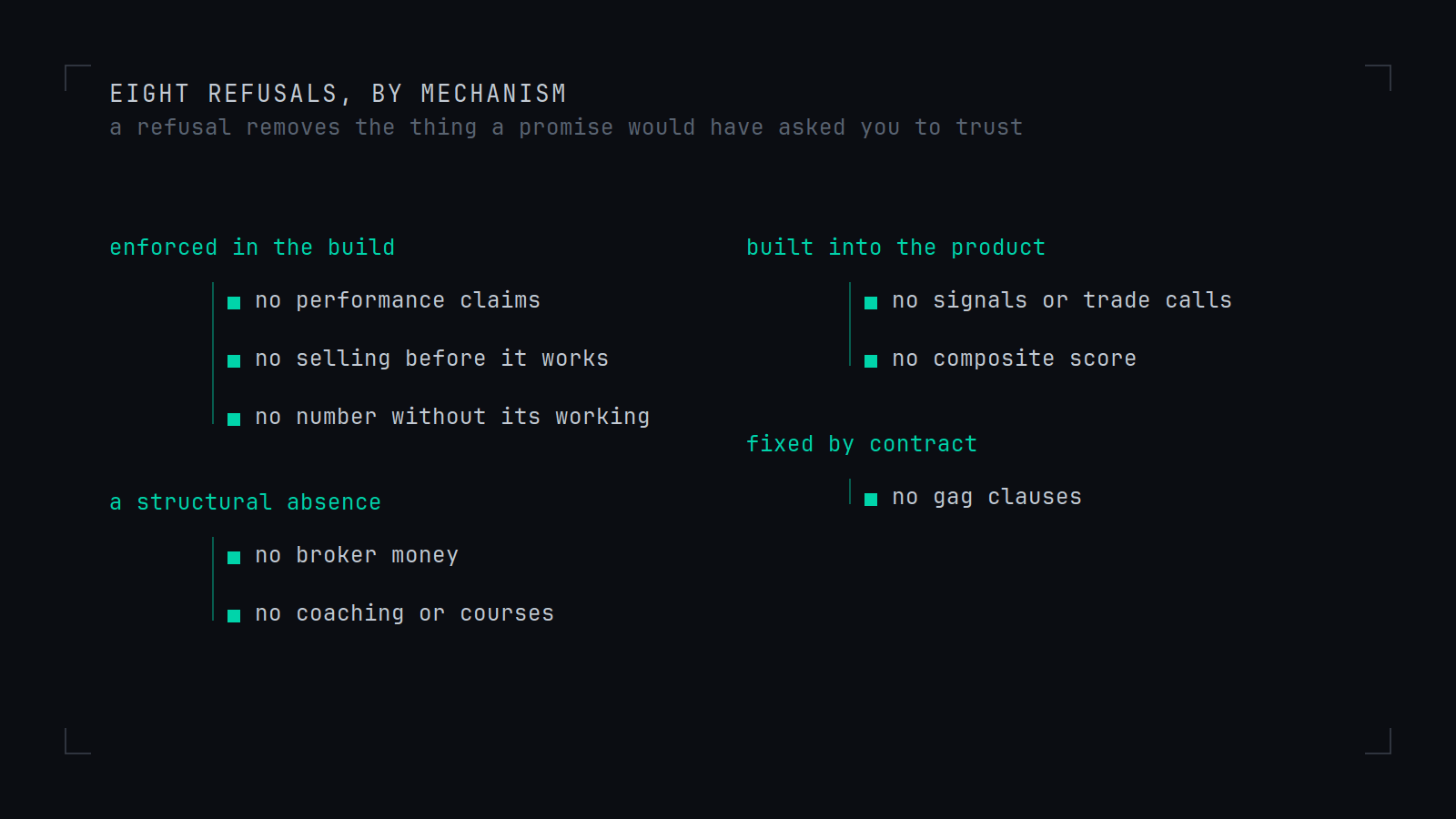
Eight refusals, grouped by what actually holds them: three enforced in the build, two that are a structural absence, two built into the product, and one fixed by contract.
Grouping a refusal by its mechanism establishes how it is held, not that the mechanism has been tested.
No signals, and no trade calls.
I will never tell you what to buy, when to enter, or where to put a stop. Instruments measure; the decision is yours and stays yours. The line holds because the products are built so they cannot cross it — the Prop-Evaluee Risk Guardian's own page states that it neither places nor blocks a trade, and that construction is repeated across the catalogue. A measurement house that also issues calls is a signal service with a laboratory coat on, and it inherits every conflict signal services carry.
No coaching, no mentorship, no course.
There is no tier where I look at your strategy and tell you whether it is good. That is discretionary advice with a different hat on, and it fails the same test the signals refusal fails. What exists instead is instrumentation that lets you interrogate the strategy yourself — the overfitting checks, the sample-size arithmetic, the execution-cost measurements — and documentation that states what each result does and does not establish.
No performance claims, ever.
Not a return, not a win rate, not an edge, not a testimonial implying any of them. This one is permanent. The homepage carries a plate for the number of performance claims on this site, and the figure it shows is the one number here that will never move: zero. The refusal is enforced rather than promised — the build refuses outcome-claim language on every page, and the register records the rule as a rail, not a resolution.
No composite score, and no league table.
Profiles, never rankings. A composite score is the part of a broker review that gets bought, because a single number is cheap to move and expensive to audit. The Observatory publishes multi-dimensional measured portraits with every panel traceable to its battery, and it will never collapse them into a 4.8. If you want the reasoning in full, the Observatory states it as its founding rule.
No broker money.
No introducing-broker revenue, no affiliate links, no paid placement, and no fee to be measured, un-measured, or removed. Measuring venues while taking venue money is the conflict this house exists to escape, and the refusal is structural: there is no advertising inventory on this site, no ads.txt, and no commercial relationship a measured venue could buy. The comparison table on the homepage exists to make the difference legible against sites funded the other way.
No gag clauses.
Nobody gets pre-publication veto over a finding about them. A finding you can suppress is not a finding — it is a negotiation. The rule is fixed before any partnership exists: only where the right to publish measurements is contractually unrestricted, and if a partner later introduces publication restrictions, the partnership ends and the profile stays.
No selling an instrument before it does what its page says.
The catalogue is written in the future tense where the work is unfinished, and that tense is a statement about timing rather than a hedge. Nothing on this site is purchasable today; every price is published as anticipated and marked as such, and the build refuses a purchasable state until every instrument behind it can actually be bought and delivered. When that changes, it changes on every surface in the same act.
No number I cannot show you the working for.
If a figure cannot be recomputed from a published artifact, it does not go on the site — which is why so much of this one currently reads NOT YET PUBLISHED. An uncomputed value renders as those words, never as a plausible-looking placeholder. The kill ledger is the same rule pointed at hypotheses: results that failed their own pre-declared criteria are published as kills, with digests, rather than quietly removed.
What these refusals filter.
The reader who wants a signal, a score, or a number confirmed will not find one here, and leaves. The reader who wants a claim tested stays. That is the filtering working as designed — products whose function is telling users hard truths select their own buyers, and what survives the funnel retains, because honest instrumentation has no substitute.