Candle Range Theory Indicator
Reference-candle sweeps at the higher grain, flagged by rule — the CRT event, checkable.
Candle range theory is the sweep vocabulary promoted to the higher timeframe’s candles, and its one virtue is how little it takes to state exactly. This instrument states it and draws nothing else.
What it draws
Reference candles at the declared grain — the campaign’s stated hourly and four-hourly defaults — and, on each, the event the theory names: the next candle trading beyond one side of the reference range and closing back inside it. Flags carry the side swept and the exact candles involved. The follow-through ledger then records what happened next, event by event, on the chart — occurrences and outcomes, deliberately raw and deliberately unscored, because the scoring is the calibration layer’s job under its stated nulls, and a vocabulary whose evidence is remembered anecdotes deserves a tool that replaces the remembering with a list anyone can audit.
A sweep with a calendar
Structurally this is the liquidity sweep grammar applied to a single candle’s range instead of a swing extreme, and the family resemblance is the point: one reclaim test, shared with the line’s sweep instrument, at a different reference.
What the higher grain adds is regularity — every reference candle proposes an event window on schedule — which is precisely what makes the theory unusually cheap to test honestly: the events are dense, defined, and nobody has to choose them after the fact. What the regularity does not buy is the conclusion. The theory’s claim — sweep one side, expect the other — is a matched comparison waiting to happen: these events against plain sweeps of equal size, against the base rates the grain already carries, and the campaign registers exactly that test. Until its reading ships, this instrument is a precise event-marker with a memory, and the memory it keeps is the raw material honesty gets built from.
The object it looks for
The frozen definition, drawn. This is the geometry the detector is built to find — not a capture of the instrument running, and not a result. A drawing that implied otherwise would be the one thing this line exists to refuse.
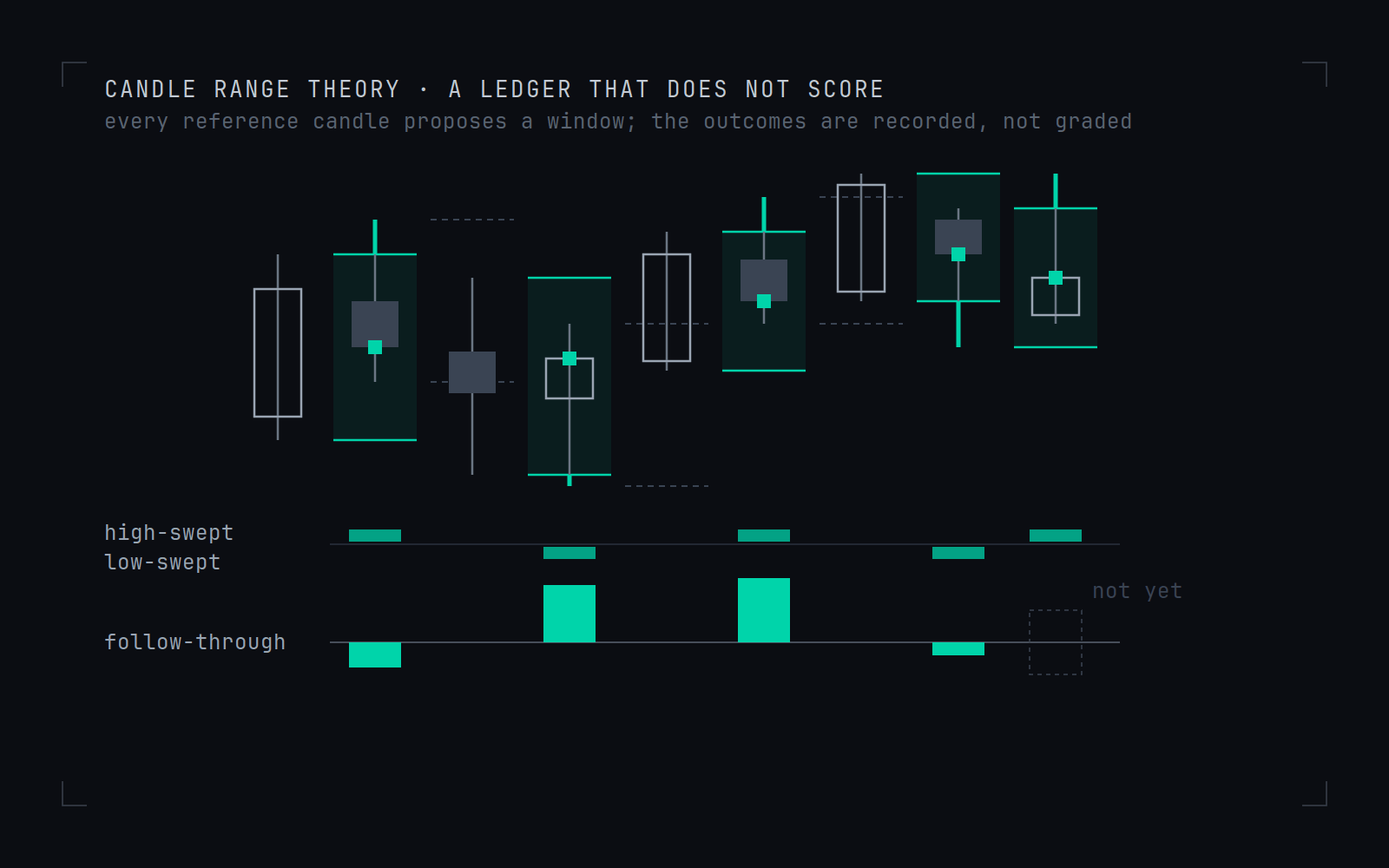
A ledger that does not score. Each reference candle proposes a window, the side that was taken is labelled, and the follow-through is recorded beneath — including the one that has not resolved, which reads as unresolved rather than being dropped or guessed.
Recording an outcome establishes what happened after a proposed window. It does not grade the window, rank it against the others, or establish that a swept reference candle is followed by anything.
Candle Range Theory Indicator: what the frozen definition states, in full.
| Element | What the definition states |
|---|---|
| Reference grain | H1 or H4. |
| Sweep test | The next candle trades beyond one side of the reference range and closes back inside it. |
| Side labelling | High-swept or low-swept. |
| Follow-through ledgerThe ledger reports what happened after each proposed window. It does not rank the windows, and it does not call any of them correct. | On. Outcomes are recorded, not graded. |
| Unresolved outcomesA window whose outcome has not arrived reads not yet, rather than being dropped from the ledger or given a provisional score — both of which would flatter the record. | Drawn as unresolved. |
| Not established | Whether a swept reference candle is followed by anything in particular. |
The definition in full, with the terms it uses, is at the glossary entry.
The parameters, in the open
Every threshold is a named parameter with its shipped state visible. Where a default reads election pending, the calibration run has not yet frozen it, and this page says so instead of inventing a number. Presets populate editable fields; they never lock them.
Candle Range Theory Indicator: every threshold it exposes, and the state each one is in.
| Parameter | Shipped state | What it decides |
|---|---|---|
| Reference grain | H1/H4 | The campaign's stated default timeframes whose candles serve as the reference ranges. |
| Sweep test | next candle trades beyond one side, closes back inside | The event itself: the reference range violated and reclaimed within the following candle. |
| Side labelling | high-swept / low-swept | Which extreme of the reference candle was taken, carried on every flag. |
| Follow-through ledger | on | What the subsequent candles did after each event, recorded as data on the chart rather than remembered as anecdote. |
The calibration certificate
Every instrument in this line ships with its report: the reaction and state statistics for its objects, computed on this estate's own recorded data under the campaign's measurement design, with the vintage's hash and date printed — and a refusal state when the vintage ages past its declared cadence. The report ships whatever it says.
This instrument's certificateNOT YET COMPUTED
The campaign's entry bar is the reason: no driver takes a live reading before it recovers a planted effect through the measurement harness, and the harness comes before every certificate. The drafting instrument is in build for the platforms above. Nothing is purchasable yet, here or anywhere.
What this instrument does not do
It makes no claim that its objects predict anything, and it ships no signals. It draws defined geometry under stated parameters; whether that geometry carries information is the measurement layer's question, answered against stated nulls and published either way. No performance figures appear on this page because none have been computed — and when they are, they arrive as the certificate above, not as marketing.
The research on the claim it draws
The objects drawn by the Candle Range Theory Indicator are taught with a claim, and no research note on this site examines that claim.
Questions and answers
What does the Candle Range Theory Indicator flag?
At most one event per reference candle: the next candle trading beyond one side of the reference range and closing back inside it. The flag carries the side swept, high or low, and the exact candles involved. Structurally it is the liquidity sweep's reclaim test applied to a single higher-timeframe candle instead of a swing extreme, shared with the line's sweep instrument.
Which timeframes does the CRT indicator use for its reference candles?
Hourly and four-hourly candles, the campaign's stated default grain. The grain gives the theory its regularity: every reference candle proposes an event window on schedule, so the events are dense, defined, and never chosen after the fact. The indicator names no best time of day to trade them.
Does the indicator measure how accurate candle range theory is?
Not on the chart. Its follow-through ledger records what the following candles did after each event, occurrences and outcomes, raw and unscored on purpose. Scoring belongs to the calibration layer, and the campaign registers a matched comparison: these events against plain sweeps of equal size, and against the base rates the grain already carries.
Why does it draw nothing beyond the CRT event and its follow-through?
Because the theory's one virtue is how little it takes to state exactly, and each added condition would narrow the events and make a result harder to compare with the plain version. The claim built on the event, sweep one side and expect the other, is a test the campaign registers rather than something the chart implies, so the indicator marks the event, the side and the aftermath, and leaves the verdict to the reading.
Where this sits
This instrument's concepts are defined in the glossary: candle range theory · liquidity sweep · judas swing · fair value gap. Its drivers sit in the claims ledger (W4.5) with their verdicts rendered honestly until computed.
Also in this line: Fair Value Gap Indicator · Order Block Indicator · Liquidity Sweep Indicator · Market Structure Indicator · Displacement Indicator · Session & Killzone Clock · Liquidity Pools Indicator · Premium-Discount & OTE Indicator · Opening Gap Indicator · Judas & Silver Bullet Models · SMT Divergence Indicator.
Standing policy
- No promise of profit, ever. Hadal makes no performance claims and carries no implied edge. Past measurements describe instrument behaviour — never future returns.
- You own risk management. Hadal cannot control it and does not insure it. Good tools do not fix bad discipline — and this site says so.
- Analytical tools, for discretionary use. Nothing here is investment advice or a recommendation to trade. Every decision, and every outcome, is yours.
The same statement stands in the footer of every page.Terms Privacy