SMT Divergence Indicator
Swing non-confirmation across pairs, same-candle aligned — sample honesty on show.
Divergence tools fail in two quiet ways — comparing swings that did not happen at the same time, and treating correlated pairs as independent witnesses. This instrument closes the first by construction and refuses to hide the second.
What it draws
Non-confirmations across the declared pair set: moments where one instrument takes out an aligned swing extreme and its counterpart declines to, flagged at the exact candles involved.
Alignment is enforced at the candle level — a swing on one chart is compared only to the time-aligned candle on the other, because the near-miss comparisons that pass for divergence in looser tools are artefacts of the misalignment, not information. The swing rule is the line’s shared engine, so what counts as an extreme cannot drift between the charts being compared, and every flag names the pair set that produced it. Basket variants — pairs against synthetic per-currency indices — are the campaign’s registered extension and arrive with the calibration layer rather than being improvised here ahead of their design.
The witness problem, stated
Divergence borrows its force from the idea of independent witnesses disagreeing. Correlated currency pairs are not independent witnesses — a set of dollar pairs is closer to one witness interviewed several times — and any honest reading of cross-pair signals has to carry that discount, so the instrument renders the caveat with the flags rather than leaving it to a footnote nobody ships.
The same arithmetic bounds the claims. The proposition under the vocabulary — that non-confirmation at extremes precedes the decliner’s direction winning — meets an unusually hard sample-size wall, because correlation shrinks the effective evidence well below the row count; this estate has killed studies of its own on exactly that wall when the power was not there, and the measurement layer inherits the discipline that killed them. The instrument shows the disagreement, precisely and reproducibly. The meaning waits for readings that can afford themselves.
The object it looks for
The frozen definition, drawn. This is the geometry the detector is built to find — not a capture of the instrument running, and not a result. A drawing that implied otherwise would be the one thing this line exists to refuse.
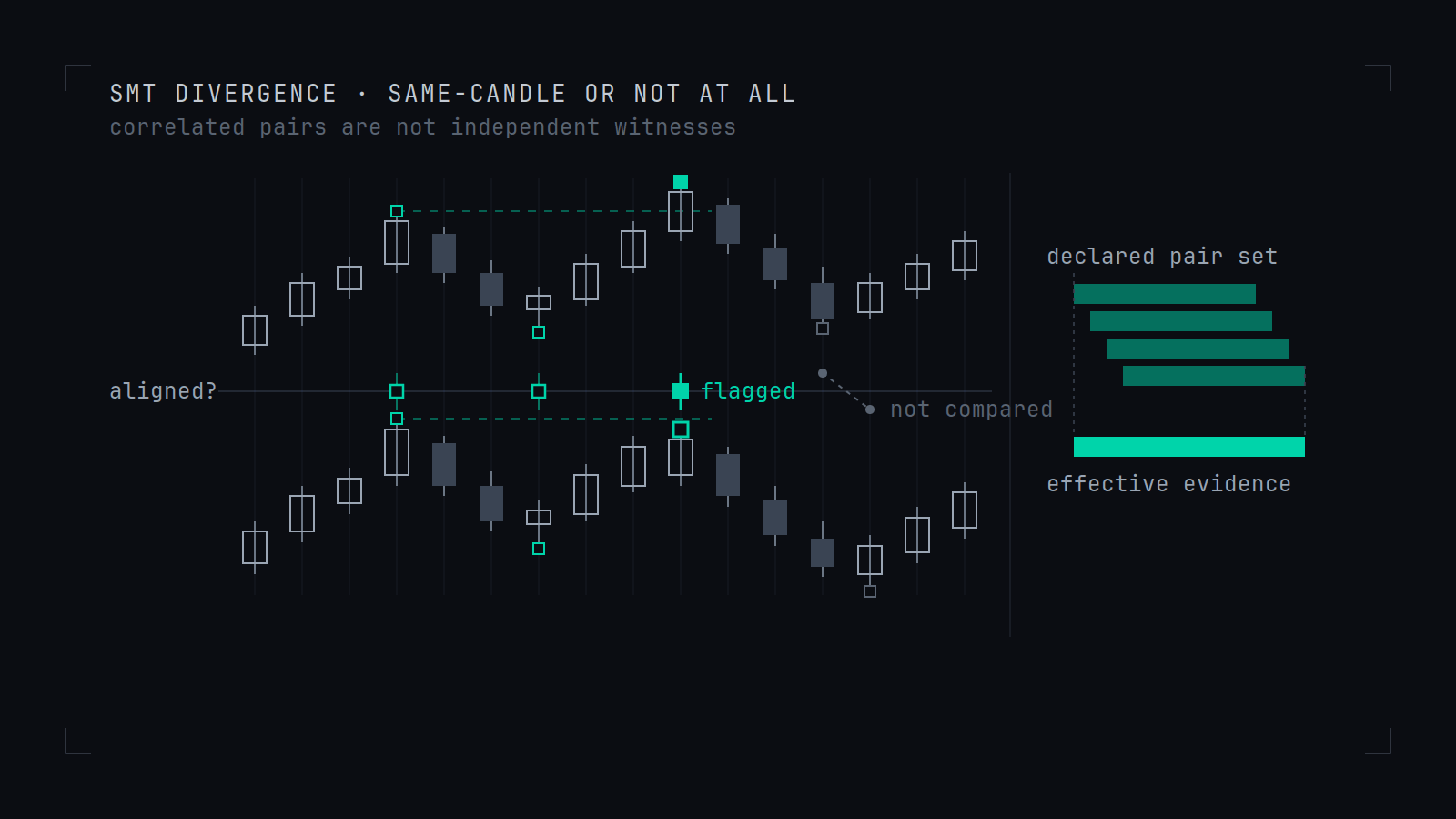
Same-candle or not at all. Two aligned series with their swing points compared only where the candles line up — one pair flagged, one left uncompared — and beside them the declared pair set against the evidence it actually carries.
Flagging a divergence establishes that two aligned series disagreed at a stated swing. It does not establish that the disagreement predicts anything, and it does not turn a larger pair set into more evidence.
SMT Divergence Indicator: what the frozen definition states, in full.
| Element | What the definition states |
|---|---|
| AlignmentA divergence read across candles that do not line up compares two different moments and calls the difference a signal. | Same-candle, enforced. |
| Swing rule | A three-bar fractal at k=1, with k=2 exposed. |
| Divergence test | One side takes its extreme while the other declines to. |
| Pair setDeclared in advance, because a pair chosen after the divergence appeared is not a witness, it is a selection. | election pending |
| IndependenceThe declared set is larger than the evidence it carries; what remains after their correlation is the effective evidence, and it is what a count of pairs quietly overstates. | Correlated pairs are not independent witnesses. |
| Not established | Whether a flagged divergence is followed by anything. |
The definition in full, with the terms it uses, is at the glossary entry.
The parameters, in the open
Every threshold is a named parameter with its shipped state visible. Where a default reads election pending, the calibration run has not yet frozen it, and this page says so instead of inventing a number. Presets populate editable fields; they never lock them.
SMT Divergence Indicator: every threshold it exposes, and the state each one is in.
| Parameter | Shipped state | What it decides |
|---|---|---|
| Pair set | election pending | Which instruments are compared — declared as a set, because divergence is a property of the set, not of one chart. |
| Alignment | same-candle, enforced | Swings compared only on time-aligned candles; near-misses across bars are the classic false divergence. |
| Swing rule | k=1 (3-bar fractal); k=2 exposed | The same engine as the structure tools, so a swing means one thing across the whole line. |
| Divergence test | one side takes its extreme, the other declines | The non-confirmation itself: correlated instruments disagreeing at aligned swings. |
The calibration certificate
Every instrument in this line ships with its report: the reaction and state statistics for its objects, computed on this estate's own recorded data under the campaign's measurement design, with the vintage's hash and date printed — and a refusal state when the vintage ages past its declared cadence. The report ships whatever it says.
This instrument's certificateNOT YET COMPUTED
The campaign's entry bar is the reason: no driver takes a live reading before it recovers a planted effect through the measurement harness, and the harness comes before every certificate. The drafting instrument is in build for the platforms above. Nothing is purchasable yet, here or anywhere.
What this instrument does not do
It makes no claim that its objects predict anything, and it ships no signals. It draws defined geometry under stated parameters; whether that geometry carries information is the measurement layer's question, answered against stated nulls and published either way. No performance figures appear on this page because none have been computed — and when they are, they arrive as the certificate above, not as marketing.
The research on the claim it draws
The objects drawn by the SMT Divergence Indicator are taught with a claim, and one research note on this site examines that claim; none tests the indicator itself.
Questions and answers
Which pairs does the SMT Divergence Indicator compare?
A declared pair set, because divergence is a property of the set rather than of one chart, and every flag names the set that produced it. Which set ships as the default is an election the calibration run has yet to freeze. Baskets, pairs against synthetic per-currency indices, are the campaign's registered extension and arrive with the calibration layer.
How does it decide that two charts diverge?
One instrument takes out an aligned swing extreme and its counterpart declines to. Alignment is enforced at the candle: a swing on one chart is compared only with the time-aligned candle on the other, because near-miss comparisons across bars are the classic false divergence. Swings come from the line's shared fractal engine, so an extreme means the same thing on both charts.
Is SMT divergence strong evidence when the pairs are correlated?
Weaker than it looks. Divergence borrows its force from independent witnesses disagreeing, and correlated currency pairs are not independent: a set of dollar pairs is closer to one witness interviewed several times. Correlation shrinks the effective evidence well below the row count, so the indicator renders that caveat with its flags instead of leaving it to a footnote.
Why do correlated pairs decouple on low timeframes?
Mostly because the measurement dissolves, as the research note on why correlated pairs decouple on low timeframes sets out. Below a measurable sampling interval, which the note calls the coherence floor, two instruments barely share prints, so most fine-grain decoupling is asynchrony rather than a relationship breaking; the academic record is the Epps effect, documented in 1979. Same-candle alignment keeps misaligned swings from reading as disagreement, but it cannot restore prints that were never shared.
Where this sits
This instrument's concepts are defined in the glossary: smt divergence · smart money concepts · break of structure · liquidity sweep. Its drivers sit in the claims ledger (W3.14) with their verdicts rendered honestly until computed.
Also in this line: Fair Value Gap Indicator · Order Block Indicator · Liquidity Sweep Indicator · Market Structure Indicator · Displacement Indicator · Session & Killzone Clock · Liquidity Pools Indicator · Premium-Discount & OTE Indicator · Opening Gap Indicator · Judas & Silver Bullet Models · Candle Range Theory Indicator.
Standing policy
- No promise of profit, ever. Hadal makes no performance claims and carries no implied edge. Past measurements describe instrument behaviour — never future returns.
- You own risk management. Hadal cannot control it and does not insure it. Good tools do not fix bad discipline — and this site says so.
- Analytical tools, for discretionary use. Nothing here is investment advice or a recommendation to trade. Every decision, and every outcome, is yours.
The same statement stands in the footer of every page.Terms Privacy