Premium-Discount & OTE Indicator
The dealing range with its equilibrium, and the committed 62–79 band — leg rule stated.
Range logic is where this vocabulary does its arithmetic, and this instrument draws the arithmetic exactly: the dealing range, its equilibrium, and the one retracement band the taxonomy actually commits to.
What it draws
The swing-anchored dealing range with its equilibrium line splitting premium from discount; per-bar occupancy of each half; and, over the stated reference leg, the optimal trade entry band at the taxonomy’s committed ratios — 62 to 79 percent with the 70.5 midline — rendered only when the leg rule’s conditions exist, because a band over an arbitrary leg is a costume.
The leg rule is the load-bearing election and it is printed: the same chart offers many legs, and hindsight fits bands to all of them. Range and band share the line’s one swing engine, so the premium half, the discount half and the band inside them are always measured from extremes the same engine qualifies, and the method’s own composition rule — the band belongs in the correct half of the range — is checkable at a glance rather than asserted.
Commitment as a feature
A plain retracement drawing offers a menu of levels and retroactively claims whichever held. A committed band with fixed edges can be tested — against neighbouring bands of equal width, the boundary-perturbation comparison the campaign pre-registers for exactly this object. This instrument ships the committed version because commitments are checkable and menus are not; that is the entire difference between a measured vocabulary and chart astrology with good typography.
The commitment also bounds what this page will say: deep retracements end somewhere, and whether they cluster at these ratios beyond what any equal-width deep band shows is the calibration layer’s question, tested against the band’s own neighbours and reported whichever way it lands. The instrument draws the taxonomy’s committed geometry; the geometry’s privilege is a hypothesis, and hypotheses buy their standing with evidence here or they stand unpaid.
The object it looks for
The frozen definition, drawn. This is the geometry the detector is built to find — not a capture of the instrument running, and not a result. A drawing that implied otherwise would be the one thing this line exists to refuse.
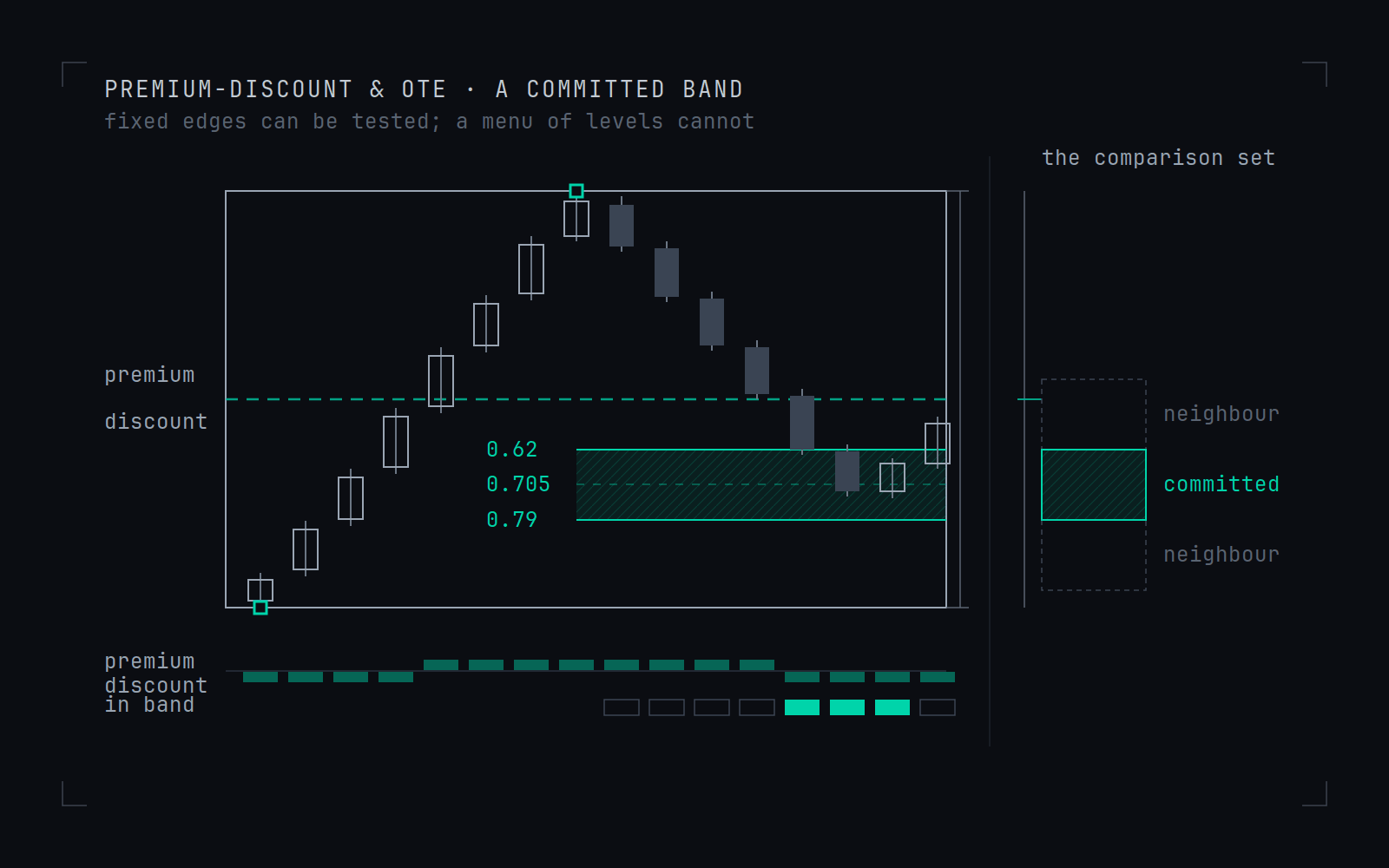
A committed band, and the set it will be compared against. The dealing range, its equilibrium, and one retracement band at stated edges — with the neighbouring bands drawn beside it, because fixed edges can be tested and a menu of levels cannot.
Drawing the band establishes where it sits and how long price spent inside it. It does not establish that the committed band differs from the neighbours drawn beside it — that is the measurement, and it has not been made.
Premium-Discount & OTE Indicator: what the frozen definition states, in full.
| Element | What the definition states |
|---|---|
| Dealing range | Swing-anchored, between qualifying extremes from the line’s one swing engine. |
| Equilibrium | 50% of the range. Above it is premium, below it is discount. |
| The band | 0.62 to 0.79 of the reference leg, midline 0.705. |
| CommitmentA set of ratios wide enough to always contain the price that mattered cannot be wrong, and a rule that cannot be wrong is not a rule. | One band, not a menu. |
| Comparison set | The committed band drawn against its neighbours, so the choice of edges is checkable rather than assumed. |
| Leg ruleWhich leg the band measures is named in advance, because a leg chosen after the fact fits anything. | election pending |
| Occupancy | Per-bar premium, discount and in-band states, so time in a zone is data rather than impression. |
| Not established | Whether the committed band differs from the neighbours beside it. |
The definition in full, with the terms it uses, is at the glossary entry.
The parameters, in the open
Every threshold is a named parameter with its shipped state visible. Where a default reads election pending, the calibration run has not yet frozen it, and this page says so instead of inventing a number. Presets populate editable fields; they never lock them.
Premium-Discount & OTE Indicator: every threshold it exposes, and the state each one is in.
| Parameter | Shipped state | What it decides |
|---|---|---|
| Range anchoring | swing-anchored per the shared swing rule | The dealing range runs between qualifying extremes from the same engine the structure tools use. |
| Equilibrium | 50% of the dealing range | The premium-discount split, rendered as the range's midline. |
| OTE band | 0.62–0.79, midline 0.705 | The committed retracement band over the reference leg, at the taxonomy's stated ratios. |
| Leg rule | election pending | Which leg the band measures — named in advance, because a leg chosen after the fact fits anything. |
| Occupancy flags | on | Per-bar premium/discount and in-band states, so time-in-zone is data rather than impression. |
The calibration certificate
Every instrument in this line ships with its report: the reaction and state statistics for its objects, computed on this estate's own recorded data under the campaign's measurement design, with the vintage's hash and date printed — and a refusal state when the vintage ages past its declared cadence. The report ships whatever it says.
This instrument's certificateNOT YET COMPUTED
The campaign's entry bar is the reason: no driver takes a live reading before it recovers a planted effect through the measurement harness, and the harness comes before every certificate. The drafting instrument is in build for the platforms above. Nothing is purchasable yet, here or anywhere.
What this instrument does not do
It makes no claim that its objects predict anything, and it ships no signals. It draws defined geometry under stated parameters; whether that geometry carries information is the measurement layer's question, answered against stated nulls and published either way. No performance figures appear on this page because none have been computed — and when they are, they arrive as the certificate above, not as marketing.
The research on the claim it draws
The objects drawn by the Premium-Discount & OTE Indicator are taught with a claim, and no research note on this site examines that claim.
Questions and answers
Which retracement levels does the indicator draw for optimal trade entry?
One committed band over the reference leg, from 62% to 79% retracement with a midline at 70.5%. It renders only when the leg rule's conditions exist, because a band over an arbitrary leg fits anything. Which leg the band measures is named in advance, and the leg rule's default is still an election for the calibration run.
How does it split premium from discount?
It draws the dealing range between qualifying swing extremes, taken from the same swing engine the structure tools use, and splits it at equilibrium, 50% of the range. The upper half is premium and the lower half discount, and per-bar occupancy flags record which half price sat in, so time spent in each is data rather than impression.
Why one fixed band instead of a menu of Fibonacci levels?
Because a menu can claim whichever level held after the fact, and a band with fixed edges can be tested. The campaign pre-registers a boundary-perturbation comparison for exactly this object, the committed band against neighbouring bands of equal width. By the method's own composition rule the band also belongs in the correct half of the range, and sharing one swing engine makes that checkable at a glance.
Does the indicator claim that retracements stop inside the band?
No. Deep retracements end somewhere, and whether they cluster at these ratios beyond what any equal-width deep band shows is the calibration layer's question, reported whichever way it lands. The indicator draws the committed geometry; the privilege of those ratios is a hypothesis until evidence pays for it.
Where this sits
This instrument's concepts are defined in the glossary: optimal trade entry · pd array · market structure shift · liquidity sweep. Its drivers sit in the claims ledger (W3.1) with their verdicts rendered honestly until computed.
Also in this line: Fair Value Gap Indicator · Order Block Indicator · Liquidity Sweep Indicator · Market Structure Indicator · Displacement Indicator · Session & Killzone Clock · Liquidity Pools Indicator · Opening Gap Indicator · Judas & Silver Bullet Models · SMT Divergence Indicator · Candle Range Theory Indicator.
Standing policy
- No promise of profit, ever. Hadal makes no performance claims and carries no implied edge. Past measurements describe instrument behaviour — never future returns.
- You own risk management. Hadal cannot control it and does not insure it. Good tools do not fix bad discipline — and this site says so.
- Analytical tools, for discretionary use. Nothing here is investment advice or a recommendation to trade. Every decision, and every outcome, is yours.
The same statement stands in the footer of every page.Terms Privacy