Liquidity Sweep Indicator
Trade-through and reclaim at prior extremes, flagged under one stated test — not by eye.
A sweep is the easiest call in this vocabulary to make after the fact and the hardest to make consistently in advance, because the test has three parts and most tools state none of them. This instrument states all three.
What it draws
The standing pool map — prior swing extremes under the stated fractal rule, equal-extreme clusters within the stated tolerance, prior-day, prior-week and session boundaries — and, against it, every sweep the test admits: a trade through a qualifying pool with the close reclaimed inside the stated window.
A trade-through that never reclaims is labelled for what it became instead, because a breakout misfiled as a sweep corrupts every observation downstream of the label. Each flag says which pool, which bar, and under which configuration, so any sweep on the chart can be checked by a second person running the same settings — the reproducibility the hand-called version of this vocabulary has never offered, on the one event the whole taxonomy leans on hardest.
The engine behind it
The sweep detector is the one piece of the measurement campaign that predates it: the estate’s own sweep-confirmation machinery, with its threshold frozen engine-side, ported to the platform as a drawing instrument.
What ships is the geometry, not the estate — the detector’s public face, with its parameters in the open and its configuration printed beside its flags. What does not ship is an answer to who swept, or why, or what follows. The sweep-versus-stop-hunt distinction is precisely the line between geometry and accusation — this estate’s research on the accusation is linked from this page — and the sequence claims built on sweeps belong to the measurement layer’s tests, not to the drawing’s implication. The instrument tells you the level was traded and reclaimed, with the receipts to check it. It does not tell you a story about who needed it to happen, because candle data does not contain one.
The object it looks for
The frozen definition, drawn. This is the geometry the detector is built to find — not a capture of the instrument running, and not a result. A drawing that implied otherwise would be the one thing this line exists to refuse.
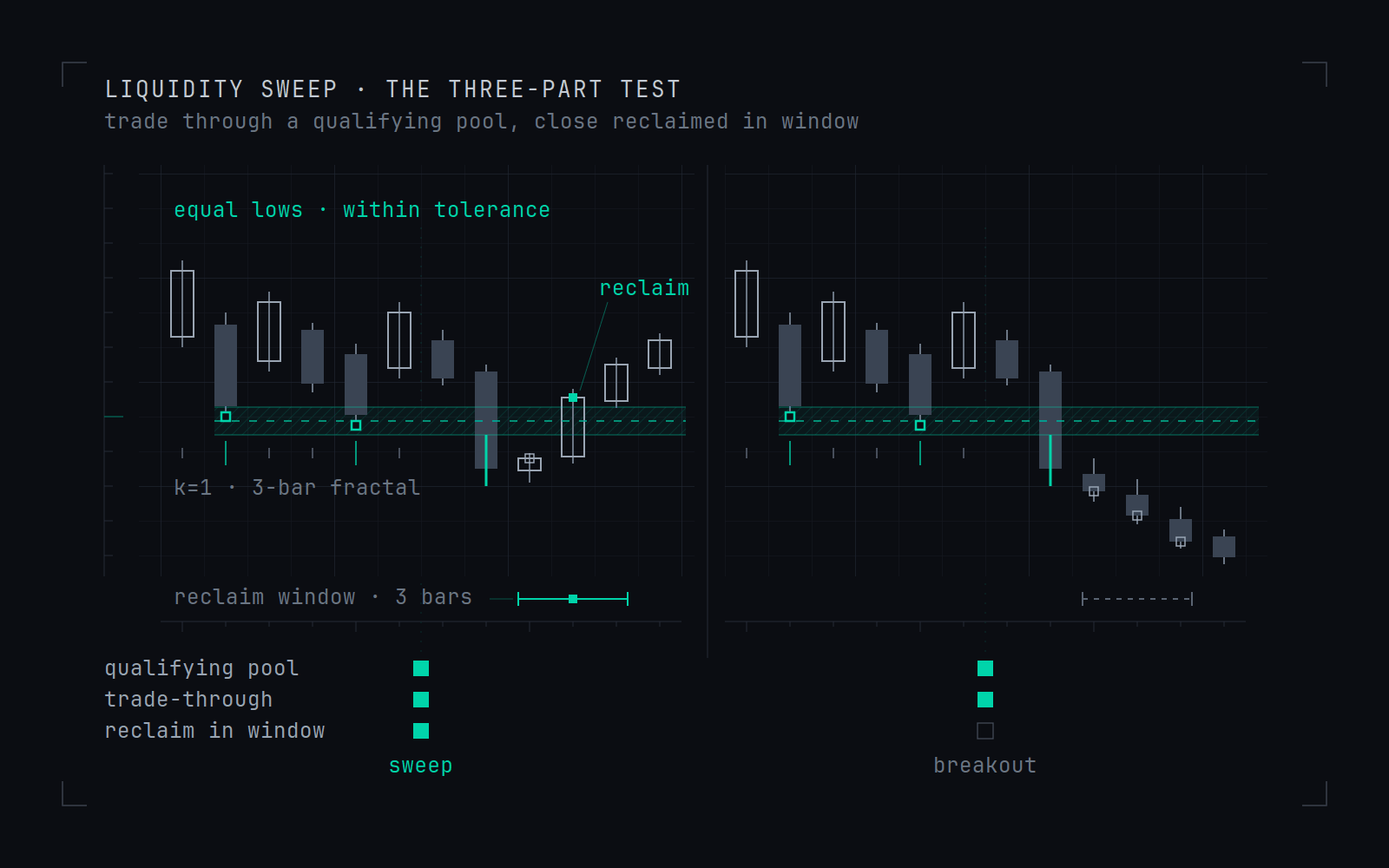
The three-part test, and the fork it turns on: the same trade-through completes as a sweep when a close reclaims the pool inside the window, and stands as a breakout when the window expires with price still beyond it.
Completing the test establishes that the sequence occurred. It does not establish that a sweep is followed by anything, or that the reclaim carries the intent the taxonomy reads into it.
Liquidity Sweep Indicator: what the frozen definition states, in full.
| Part of the test | What the definition states |
|---|---|
| Qualifying pool | A prior swing extreme under the stated fractal rule, three bars by default, or two or more such extremes lying inside an equality tolerance. |
| Trade-through | A bar trades beyond the pool. |
| Reclaim | A close returns to the original side of the pool, inside the reclaim window. |
| Reclaim windowDrawn here as three bars. The length is a parameter, and different statements of the rule choose differently. | election pending |
| Equality toleranceHow near two extremes must sit to count as one pool is a parameter, not a fact about the market. | election pending |
| The fork | Without the reclaim, the same trade-through is a breakout. The two events are indistinguishable until the window expires. |
| Not established | Whether a completed sweep is followed by anything at all. |
The definition in full, with the terms it uses, is at the glossary entry.
The parameters, in the open
Every threshold is a named parameter with its shipped state visible. Where a default reads election pending, the calibration run has not yet frozen it, and this page says so instead of inventing a number. Presets populate editable fields; they never lock them.
Liquidity Sweep Indicator: every threshold it exposes, and the state each one is in.
| Parameter | Shipped state | What it decides |
|---|---|---|
| Swing rule | k=1 (3-bar fractal); k=2 exposed | How many bars must flank an extreme for it to qualify as a sweep candidate. |
| Equality tolerance | election pending | How close, in measured-spread units, two extremes must sit to count as an equal-highs or equal-lows pool. |
| Reclaim window | election pending | How many bars the close has to return inside before the trade-through stops being a sweep and becomes a breakout. |
| Pool registry display | on | Prior-day, prior-week and session extremes rendered on the standing pool map the sweeps are read against. |
The calibration certificate
Every instrument in this line ships with its report: the reaction and state statistics for its objects, computed on this estate's own recorded data under the campaign's measurement design, with the vintage's hash and date printed — and a refusal state when the vintage ages past its declared cadence. The report ships whatever it says.
This instrument's certificateNOT YET COMPUTED
The campaign's entry bar is the reason: no driver takes a live reading before it recovers a planted effect through the measurement harness, and the harness comes before every certificate. The drafting instrument is in build for the platforms above. Nothing is purchasable yet, here or anywhere.
What this instrument does not do
It makes no claim that its objects predict anything, and it ships no signals. It draws defined geometry under stated parameters; whether that geometry carries information is the measurement layer's question, answered against stated nulls and published either way. No performance figures appear on this page because none have been computed — and when they are, they arrive as the certificate above, not as marketing.
The research on the claim it draws
The objects drawn by the Liquidity Sweep Indicator are taught with a claim, and one research note on this site examines that claim; none tests the indicator itself.
Questions and answers
How does the Liquidity Sweep Indicator tell a sweep from a breakout?
By the reclaim. A sweep is a trade through a qualifying pool with the close back inside within the reclaim window; a trade-through that stays out past the window is labelled a breakout instead. The window's length is still pending calibration and is printed with the flags, because a breakout misfiled as a sweep corrupts every observation built on the label.
Which levels count as a pool it can sweep?
The levels on its standing pool map: swing extremes flanked by one bar on each side by default, or two when set; clusters of equal highs or equal lows within a tolerance measured in spread units; and prior-day, prior-week and session boundaries. Each flag names the pool, the bar and the configuration, so a second person running the same settings can check any sweep on the chart.
Is a liquidity sweep a stop hunt by the broker?
The indicator records geometry, not motive: the level was traded and reclaimed, with the receipts to check it, and candle data holds no account of who needed that. The accusation is the subject of the research note asking whether brokers hunt stop losses, which measured the one-sided spread move on bid and ask streams. At round numbers it occurred about 67% of the time, where a random walk carrying the same spread gives 77%, so the move did not occur more often than chance on the account measured.
Does the indicator say what happens after a sweep?
No. What ships is the detector's public face, the estate's own sweep-confirmation machinery, ported to the platform as a drawing instrument. Who swept, why, and what follows are outside it; the sequence claims built on sweeps belong to the measurement layer's tests, not to anything the flag implies.
Where this sits
This instrument's concepts are defined in the glossary: liquidity sweep · inducement · judas swing · absorb sweep. Its drivers sit in the claims ledger (W1.13) with their verdicts rendered honestly until computed.
Also in this line: Fair Value Gap Indicator · Order Block Indicator · Market Structure Indicator · Displacement Indicator · Session & Killzone Clock · Liquidity Pools Indicator · Premium-Discount & OTE Indicator · Opening Gap Indicator · Judas & Silver Bullet Models · SMT Divergence Indicator · Candle Range Theory Indicator.
Standing policy
- No promise of profit, ever. Hadal makes no performance claims and carries no implied edge. Past measurements describe instrument behaviour — never future returns.
- You own risk management. Hadal cannot control it and does not insure it. Good tools do not fix bad discipline — and this site says so.
- Analytical tools, for discretionary use. Nothing here is investment advice or a recommendation to trade. Every decision, and every outcome, is yours.
The same statement stands in the footer of every page.Terms Privacy