Session & Killzone Clock
One wall-clock authority — sessions and killzones, DST handled once, edges editable.
Session tools disagree with each other because they hide two decisions — whose clock, and what happens when the clocks change. This instrument makes both decisions in the open, on the chart, in your platform.
What it draws
Session and killzone occupancy on the chart: shaded windows, boundary lines, and per-bar flags, all defined on the New York wall clock and converted through the tz database so daylight-saving transitions land correctly without a manual offset ritual twice a year.
The platform’s own server-time offset is printed alongside, because the gap between broker candles and any session table is the single most common source of confusion this vocabulary produces — a candle that opens at midnight server time opens at some other hour entirely on the clock the windows are defined in, and this instrument does that conversion once, visibly, instead of leaving it to arithmetic at two in the morning. The free web version of this clock runs on the site; the product is the same discipline living inside the platform, drawn on the chart where the trading happens.
Conventions, stated and editable
Published session and killzone boundaries genuinely differ across sources, and an instrument that silently picks one manufactures certainty. Every window table here is a visible convention with editable edges, and the chart labels carry the convention in force, so two charts can be compared without archaeology.
What no table here claims is that any window contains anything. Hour-of-day base rates exist everywhere; whether a named killzone differs from what plain seasonality already explains is a measured comparison the calibration layer owes — against the generic clock, which is the one incumbent every time-window claim must beat, and the cheapest question in this whole vocabulary to study honestly once the clock is disciplined. Until that reading ships, the windows are labels with good timekeeping, and the instrument says so rather than borrowing significance it has not earned.
The object it looks for
The frozen definition, drawn. This is the geometry the detector is built to find — not a capture of the instrument running, and not a result. A drawing that implied otherwise would be the one thing this line exists to refuse.
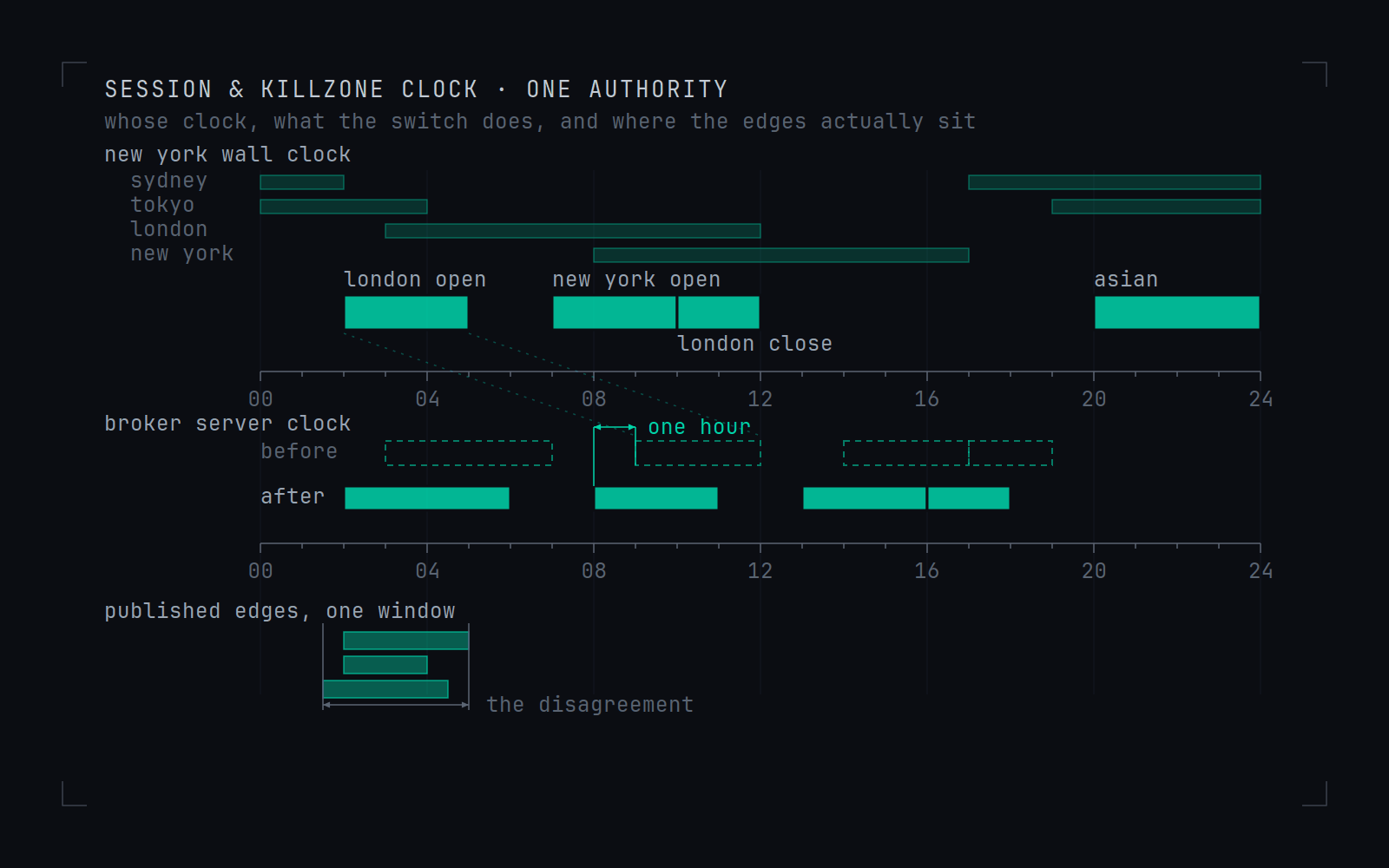
The four named windows placed on the New York wall clock, drawn as one stated convention: the edges are a configuration this page declares, not a fact the market publishes.
Drawing a window establishes when a method acts. It does not establish that the window differs from the ordinary hour-of-day base rates every seasonality table already shows.
Session & Killzone Clock: what the frozen definition states, in full.
| Window | Stated convention |
|---|---|
| London open | Early New York hours. |
| New York open | Mid-morning, New York. |
| London close | Around midday, New York. |
| Asian | Late New York evening. |
| ClockA boundary has to live in someone’s timezone; this one lives there deliberately. | The New York wall clock, riding its daylight-saving switches. |
| EdgesThe drawing puts three published edge sets for the SAME window side by side and calipers the spread between them, rather than picking one and calling it the table. | A configuration, stated. Published boundaries disagree. |
| Daylight savingA broker server clock an hour off moves every edge by an hour, twice a year, without anything about the method changing. | The windows ride the New York clock’s switches. |
| Broker offsetThe same window sits at a different server time per broker, which is why a window quoted without its clock cannot be checked by the person reading it. | Displayed. |
| Macro windowsNot drawn, because a figure implying they were on would misstate the shipped default. | Off by default. |
| Not established | That a named window differs from ordinary hour-of-day base rates. |
The definition in full, with the terms it uses, is at the glossary entry.
The parameters, in the open
Every threshold is a named parameter with its shipped state visible. Where a default reads election pending, the calibration run has not yet frozen it, and this page says so instead of inventing a number. Presets populate editable fields; they never lock them.
Session & Killzone Clock: every threshold it exposes, and the state each one is in.
| Parameter | Shipped state | What it decides |
|---|---|---|
| Clock authority | America/New_York via the tz database | Every boundary lives in one wall clock, converted outward — daylight saving handled once, nowhere else. |
| Session table | one stated convention; editable | Sydney, Tokyo, London, New York windows with their boundaries printed and overridable, because published tables disagree. |
| Killzone table | one stated convention; editable | Asian, London-open, New York-open and London-close windows, labelled as a taught convention rather than a market fact. |
| Macro windows | off | The narrower minute-scale windows of the taxonomy, rendered when enabled, same clock discipline. |
| Broker-offset display | on | The platform's server-time offset from New York, printed — because candle-open times are the usual source of session confusion. |
The calibration certificate
Every instrument in this line ships with its report: the reaction and state statistics for its objects, computed on this estate's own recorded data under the campaign's measurement design, with the vintage's hash and date printed — and a refusal state when the vintage ages past its declared cadence. The report ships whatever it says.
This instrument's certificateNOT YET COMPUTED
The campaign's entry bar is the reason: no driver takes a live reading before it recovers a planted effect through the measurement harness, and the harness comes before every certificate. The drafting instrument is in build for the platforms above. Nothing is purchasable yet, here or anywhere.
What this instrument does not do
It makes no claim that its objects predict anything, and it ships no signals. It draws defined geometry under stated parameters; whether that geometry carries information is the measurement layer's question, answered against stated nulls and published either way. No performance figures appear on this page because none have been computed — and when they are, they arrive as the certificate above, not as marketing.
The research on the claim it draws
The objects drawn by the Session & Killzone Clock are taught with a claim, and one research note on this site examines that claim; none tests the indicator itself.
Questions and answers
What time zone does the Session & Killzone Clock use?
New York wall time, America/New_York in the tz database. Every session and killzone boundary is defined on that clock and converted outward, so daylight-saving changes land correctly without a manual offset twice a year. The platform's server-time offset from New York is printed beside the windows, because broker candle times are the usual source of session confusion.
Does the killzone clock run on TradingView?
Not this instrument, which targets MetaTrader 4, MetaTrader 5 and cTrader and draws inside the chart where the trade is placed. The free forex session clock on this site runs the same New York clock discipline in a browser.
Which killzones does it show, and can their times be changed?
Its killzone table holds the Asian, London open, New York open and London close windows, labelled as a taught convention rather than a market fact. Published boundaries genuinely differ between sources, so every edge is editable and the chart label carries the convention in force. The narrower minute-scale macro windows can be switched on as well; they are off by default.
Do killzones mean more than the time of day?
No window on this clock claims to contain anything. Hour-of-day base rates exist everywhere, so a named killzone has to beat the generic clock before it means more than the hour. The research note asking whether a volatility regime is just telling the time measured how large the clock's share can be: with the time-of-day pattern removed from one FX pair, a standard volatility classifier stopped finding compression at all, and all six features measured moved.
Where this sits
This instrument's concepts are defined in the glossary: ict kill zones · ict macro times · judas swing · non farm payrolls. Its drivers sit in the claims ledger (S0.1, W1.15, W1.16) with their verdicts rendered honestly until computed.
Also in this line: Fair Value Gap Indicator · Order Block Indicator · Liquidity Sweep Indicator · Market Structure Indicator · Displacement Indicator · Liquidity Pools Indicator · Premium-Discount & OTE Indicator · Opening Gap Indicator · Judas & Silver Bullet Models · SMT Divergence Indicator · Candle Range Theory Indicator.
Standing policy
- No promise of profit, ever. Hadal makes no performance claims and carries no implied edge. Past measurements describe instrument behaviour — never future returns.
- You own risk management. Hadal cannot control it and does not insure it. Good tools do not fix bad discipline — and this site says so.
- Analytical tools, for discretionary use. Nothing here is investment advice or a recommendation to trade. Every decision, and every outcome, is yours.
The same statement stands in the footer of every page.Terms Privacy