40 / 97
ICT macro times
Working definition
Short windows on the New York clock, twenty to thirty minutes long, which ICT teaching singles out as the minutes price is most expected to run for liquidity or turn.
A kill zone tells the method which part of the day to watch, and a macro narrows it to a few minutes.
The table, as it circulates
The ICT vocabulary names eight short windows, all defined on the New York wall clock. The table below is the one that appears, time for time, across independent published listings:
- 02:33 to 03:00, in the London morning
- 04:03 to 04:30, in the London morning
- 08:50 to 09:10, before the New York equity open
- 09:50 to 10:10, after it
- 10:50 to 11:10, across the top of the eleventh hour
- 11:50 to 12:10, across midday
- 13:10 to 13:40, in the New York afternoon
- 15:15 to 15:45, in the last hour before the equity close
The times agree; the names do not. The 09:50 to 10:10 window is a New York morning macro in one listing and a London close macro in another, and the 10:50 to 11:10 window is sometimes named for the London fix. Some versions add a window or drop one. That is why a serious statement of the macros is a configuration, one table with its source, rather than a fact about the market.
The clock they live on
Every window is a New York wall-clock time, so every window moves against UTC when New York changes to and from daylight time. On standard time, add five hours to reach UTC; on daylight time, add four. The 09:50 to 10:10 window is 14:50 to 15:10 UTC in January and 13:50 to 14:10 UTC in July.
There is a second trap in the London windows. The United States and the United Kingdom change their clocks on different dates, so for a few weeks each spring and autumn New York and London are four hours apart instead of five. A window defined in New York time keeps its New York minutes through those weeks and lands an hour differently against London’s session, which is exactly when tables copied into another timezone quietly go wrong.
What sits beside the windows
Several windows sit next to events with their own calendar. The New York equity market opens at 09:30, twenty minutes before the 09:50 window. Many United States data releases are published at 10:00, inside that window. The London fix at 16:00 London time falls at 11:00 New York time for most of the year, inside the 10:50 to 11:10 window. And the 15:15 to 15:45 window runs up to the 16:00 New York equity close.
None of that says the windows are wrong. It says that activity inside some of them has an ordinary explanation, and a claim about macros has to separate release days, the fix and the equity open and close from the windows themselves before it can credit the windows with anything.
How the method uses them
Inside the taught sequence, macros are a time filter at the finest scale. A liquidity sweep or a market structure shift that prints inside a macro is read as more significant than the same event a few minutes later, and entries are sometimes timed to a macro inside a kill zone. Two macros sit across the edges of the 10:00 to 11:00 hour that the ICT 2022 model restricts itself to in its silver bullet form. The session and killzone clock datasheet carries the macro windows as an optional table on the same clock discipline as the kill zones.
What a window has to show
A macro is a claim about minutes, so its test is a comparison of minutes: what happens inside each window against what happens in the same minutes of the same hour outside it, across many days, with release days and fixing times held apart. The minutes around the top of the hour are busy for ordinary reasons, and eight windows covering more than three hours of the day will contain plenty of sharp moves by chance, so the comparison has to be matched to mean anything. The macro-window driver has its own row in the claims ledger, where the verdict renders. The two lenses keep the table, which is a clock label anyone can check, apart from the claim that the labelled minutes behave differently.
Where it sits in the ICT sequence
The ICT vocabulary in the order the method is taught, with a step for each kind of object.
- Step
- 01 of 08 Time: the hours the method watches
- Also at this step
- Kill zones (ICT), ICT weekly profiles
- Before it
- Kill zones (ICT)
- After it
- ICT weekly profiles
The shape, drawn
The smallest arrangement the definition admits. It is a drawing of a rule, not a reading of a market — nothing here is measured, and the table below it is the authoritative version.
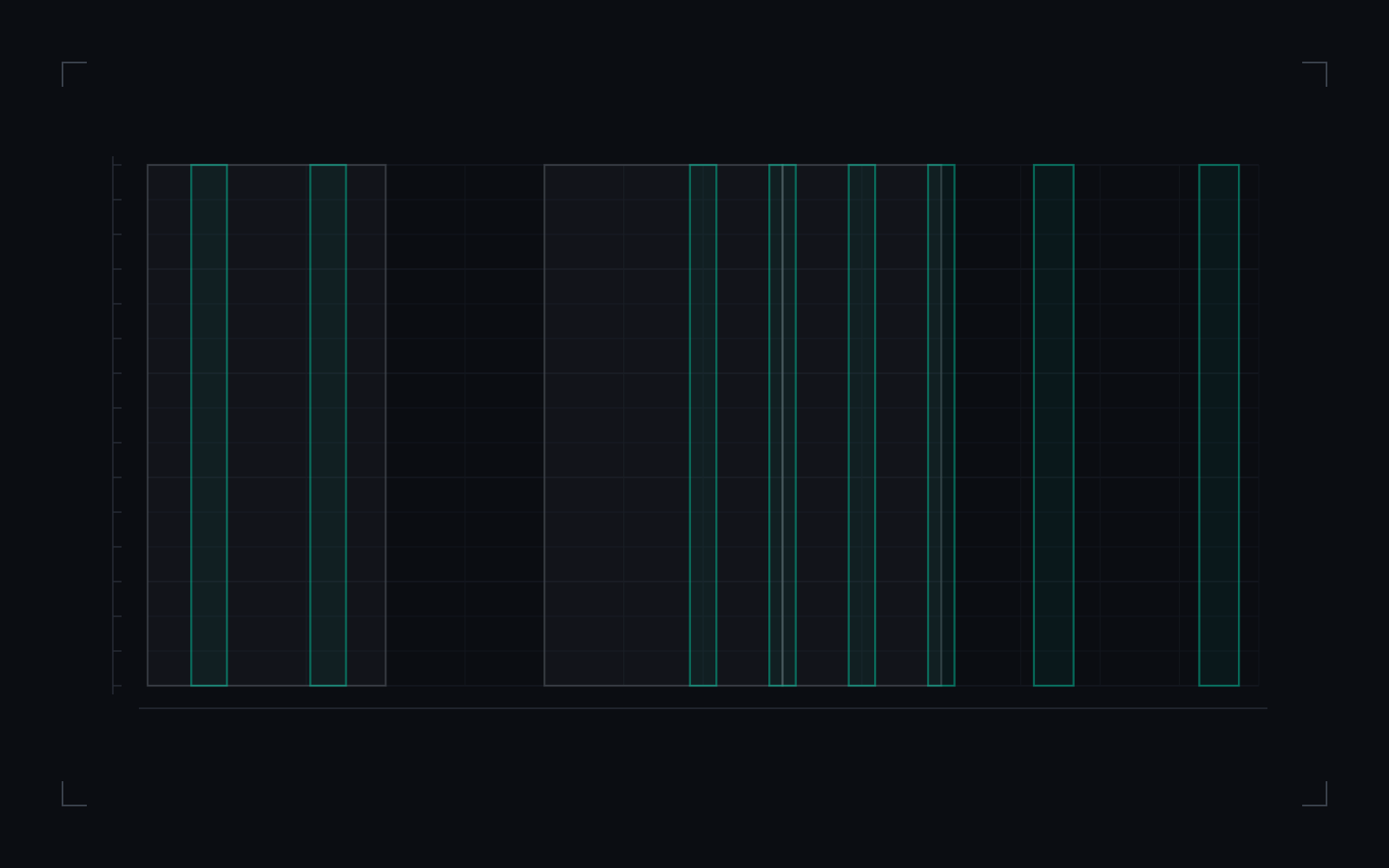
- Eight macro windows on the New York clock, each twenty to thirty minutes long, from 02:33 in the London morning to 15:45 in the last New York hour.
- Behind them, drawn quiet, the London open, New York open and London close kill zones under the convention the kill zones entry states.
The eight macro windows on the New York clock between 02:00 and 16:00, drawn over the kill zones most of them sit in: short solid bands for the macros, quiet bands for the kill zones behind them.
Drawing a window establishes when a method looks. It does not establish that the minutes inside it behave differently from the same minutes outside it.
ICT macro times: what the definition states, in full.
| Window | New York time |
|---|---|
| London morning | 02:33 to 03:00 |
| London morning | 04:03 to 04:30 |
| Before the equity open | 08:50 to 09:10 |
| After the equity open | 09:50 to 10:10 |
| Across 11:00 | 10:50 to 11:10 |
| Across midday | 11:50 to 12:10 |
| Afternoon | 13:10 to 13:40 |
| Last hour | 15:15 to 15:45 |
| Clock | The New York wall clock, riding its daylight-saving switches. |
| NamesThe times agree across independent published listings; the names given to each window do not. | Vary between listings. |
| Not established | That the minutes inside a window differ from the same minutes of the hour outside it. |
Commonly confused with
Neighbouring concepts that get used interchangeably, and the distinction that actually separates them.
- Kill zones
Kill zones are hour-scale windows around session opens and closes. Macro times are minute-scale windows inside the day, and under the convention the kill zones entry states, six of the eight sit inside or across the edge of a kill zone. The kill zone names the part of the day; the macro names the minutes within it.
- The silver bullet windows
The silver bullet windows are whole hours in which a complete setup has to form. Macros are shorter windows used to time a move inside an hour. Two macros sit across the edges of the 10:00 to 11:00 silver bullet hour, and none falls inside the other two.
- Hour-of-day seasonality
Seasonality is measured activity by minute or hour across many days. A macro is a declared window. Whether a macro's minutes differ from the same minutes' ordinary behaviour, which is often lively anyway around the top of the hour, is the question the label cannot answer.
- Scheduled release windows
A data release or a fixing moves price on its calendar time. Several macros sit beside such events, and a move inside one of them may belong to the event rather than the window, which is why the two have to be separated before a macro can be credited with anything.
How to measure it in your own data
A definition you cannot test is a definition you have to take on trust. This is the shortest honest route from the concept to a number you computed yourself.
- Records you need
Timestamped one-minute data with an unambiguous timezone, converted to New York wall-clock time through the tz database; the window table stated as configuration, since published tables agree on the times more than on the labels; and a calendar of scheduled releases and fixings.
- What you compute
Flag every minute inside each window. Compare what the windows contain, such as the range, the number of sweeps of prior highs and lows, and the rate of direction changes, with the same measures for minutes of the same hour outside the windows, across many days, with release days and fixing times separated from ordinary days.
- What the answer tells you
A sharp move or a turn that happens to print inside one of the windows. Such pictures are easy to find, because eight windows cover more than three hours of the trading day and the minutes around the top of the hour are busy for ordinary reasons; the useful question is whether the windows hold more of those events than matched minutes outside them.
Questions and answers
What are ICT macro times?
Short windows on the New York clock, twenty to thirty minutes long, that ICT teaching treats as the moments price is most expected to run for liquidity or change course. They sit inside the day's larger time windows, most of them within or across the edge of a kill zone.
What time are the ICT macros?
Eight windows in New York time, as widely listed: 02:33 to 03:00 and 04:03 to 04:30 in the London morning; 08:50 to 09:10, 09:50 to 10:10, 10:50 to 11:10 and 11:50 to 12:10 across the New York morning; and 13:10 to 13:40 and 15:15 to 15:45 in the afternoon. Sources agree on the times more closely than on the names they give each window.
What time zone does ICT use for macros?
New York wall-clock time, the same clock as the kill zones. The windows move against UTC when New York changes to and from daylight time, so a table written in UTC or in a broker's server time is correct for only part of the year.
What are the ICT macro times in UTC?
Add five hours while New York is on standard time and four while it is on daylight time. On standard time the 09:50 to 10:10 window is 14:50 to 15:10 UTC; on daylight time it is 13:50 to 14:10 UTC. Every other window moves by the same hour on the same dates.
How many ICT macros are there?
Eight in the commonly circulated table: two in the London session and six in New York. Some versions add or relabel windows, which is why a macro table should be quoted with its source and treated as a configuration rather than a fixed fact.
What is the difference between macros and kill zones?
Scale. Kill zones are windows of two to four hours around session opens and closes; macros are windows of twenty to thirty minutes. A kill zone tells the method which part of the day to watch, and a macro narrows that to particular minutes.
Do ICT macros work?
A window is a label, and what would make one matter is a comparison: the moves inside it against the same minutes of the hour outside it, on ordinary days and on release days separately. The macro-window driver's row in the claims ledger is where that comparison's verdict renders.
Related terms
Derived from the links this entry makes and the entries that link back to it.
Where the term is in build
Detector datasheets whose concepts include this term, or whose published copy uses it. Each one states the build state it has reached and the parameters it exposes, and carries no measured verdict.