65 / 97
Opening range gap (ORG)
Written ORG throughout.
Working definition
The price range between one day's regular-session close and the next day's 09:30 open on United States index products, measured in regular-session prices while the futures keep trading overnight; ICT teaching marks its edges and midpoint for the New York session.
Index futures trade through the night, but the regular session still has a close and an open, and the opening range gap is the distance between them.
The construction
The close is the last price of the previous regular session. Published sources write it as 16:14 or 16:15 New York time: read as the close of the one-minute candle that opens at 16:14, both name the price at the session’s 16:15 end. The open is the first price of the session at 09:30. The band between them is the gap: bullish when the session opens above the prior close, bearish when it opens below, with its midpoint marked as consequent encroachment.
A worked case, with constructed numbers, on an equity index future in quarter-point ticks. The regular session closes at 21,415.50 and the next session opens at 09:30 at 21,443.50. The gap runs from 21,415.50 to 21,443.50, twenty-eight points, with its midpoint at 21,429.50. A first-hour decline to 21,431.00 enters the gap and stops short of the midpoint; a trade at 21,415.25 fills it.
A gap in regular-session prices
The futures behind the gap trade almost around the clock, pausing only for an evening hour. Between the 16:15 close and the 09:30 open they trade for more than fifteen hours, so the band normally holds prices that did trade overnight, sometimes many times. On a chart set to regular trading hours the overnight session is hidden and the gap looks like an empty stretch; on a chart set to all hours it is a run of ordinary candles. The gap is real as a regular-session construct, a difference between two session prices, and the teaching’s expectation that price returns to it is an expectation about the session, not about prices nobody traded.
Where the overnight session leaves its marks
Because the overnight session trades, it leaves its own high and low, and those often sit inside the gap or beyond it. A gap whose band the overnight session already crossed is a different situation from one the overnight session never touched, and teaching watches the overnight extremes as pools of resting orders alongside the gap’s edges. The buy-side and sell-side liquidity entry treats session highs and lows as those pools. A count of gap behaviour that mixes the two situations averages over both.
The opening range beside it
The opening range gap is known at 09:30. The opening range is what trades after it: the high and low of a stated window, commonly the first thirty minutes. A session that trades back into the gap inside its opening range and one that extends away from it are different days, and teaching reads both against the New York open kill zone from 07:00 to 10:00 and the macro window from 09:50 to 10:10.
Early closes and holidays
The exchange calendar moves both prices. On a shortened session the regular close comes early, and the gap is measured from that earlier price; after a holiday the previous close belongs to the last session that traded, which can be several days back. A gap series built from a fixed 16:15 time without the calendar picks up the wrong prices on exactly those days.
One trading day, three gaps
An index future can carry all three opening gaps across one stretch of trading. The regular session closes at 16:15. The futures pause from 17:00 to 18:00, and the change across that hour is a new day opening gap; on a Friday the pause runs into the weekend, and the change across it is a new week opening gap. Trading resumes overnight, and at 09:30 the regular session opens and the opening range gap is set. The three are measured between different pairs of prices, and the same stretch of trading can print a large opening range gap with a tiny daily gap inside it, or the reverse. A chart that carries all three needs each one labelled, since their edges can sit close enough to be mistaken for one another.
Size against the session
The gap is measured in index points, and a twenty-point gap means something different after a quiet week and after a volatile one. Stated against the average of recent regular-session ranges, it becomes comparable across days and years, and a size floor stated the same way keeps the smallest gaps, which ordinary opening volatility can cross in a minute, apart from the rest of a count.
Identifying one, step by step
- Choose the contract and the session times in New York time: the regular close, 16:15 or the early close on shortened days, and the 09:30 open.
- Take the close of the last regular-session candle.
- Take the open of the first candle at 09:30.
- Draw the band and its midpoint, and mark the overnight high and low beside them.
- State the fill rule before the session starts: a trade at the far edge, or a close beyond it.
Trading it, as taught
Teaching uses the gap as a map for the first hours of the session. Its edges and midpoint are marked before the open, the first reactions at those lines frame the early trades, and a gap left open is carried forward like any other gap, with the expectation that price may return to fill it on a later day. One guide also pairs the gap with the first fair value gap that prints inside the opening range, reading the move out of the open as the displacement that leaves it. Each use carries its own elections, and a result for one does not describe another.
Common mistakes
Measuring the gap on an all-hours chart, where it does not exist, and tracking its fill there. Leaving the close convention unstated. Ignoring the calendar on shortened sessions. And crediting the gap with a reaction that belongs to the overnight high or low beside it.
What the gap does not settle
The construction is exact once the session times are stated: two prices, a band and a midpoint. Whether the session trades into the band, to its midpoint or through it more often than it would trade into a band of the same width that is not a gap is a measurement, and the opening range gap driver has a row in the claims ledger, where the verdict renders. The two lenses keep the two session prices, which anyone can read, apart from the claim about what the session does with them.
Where it sits in the ICT sequence
The ICT vocabulary in the order the method is taught, with a step for each kind of object.
- Step
- 02 of 08 Levels: the opens, gaps and ranges a session is measured from
- Also at this step
- New week opening gap (NWOG), New day opening gap (NDOG), Central bank dealers range (CBDR), IPDA (interbank price delivery algorithm)
- Before it
- New day opening gap (NDOG)
The shape, drawn
The smallest arrangement the definition admits. It is a drawing of a rule, not a reading of a market — nothing here is measured, and the table below it is the authoritative version.
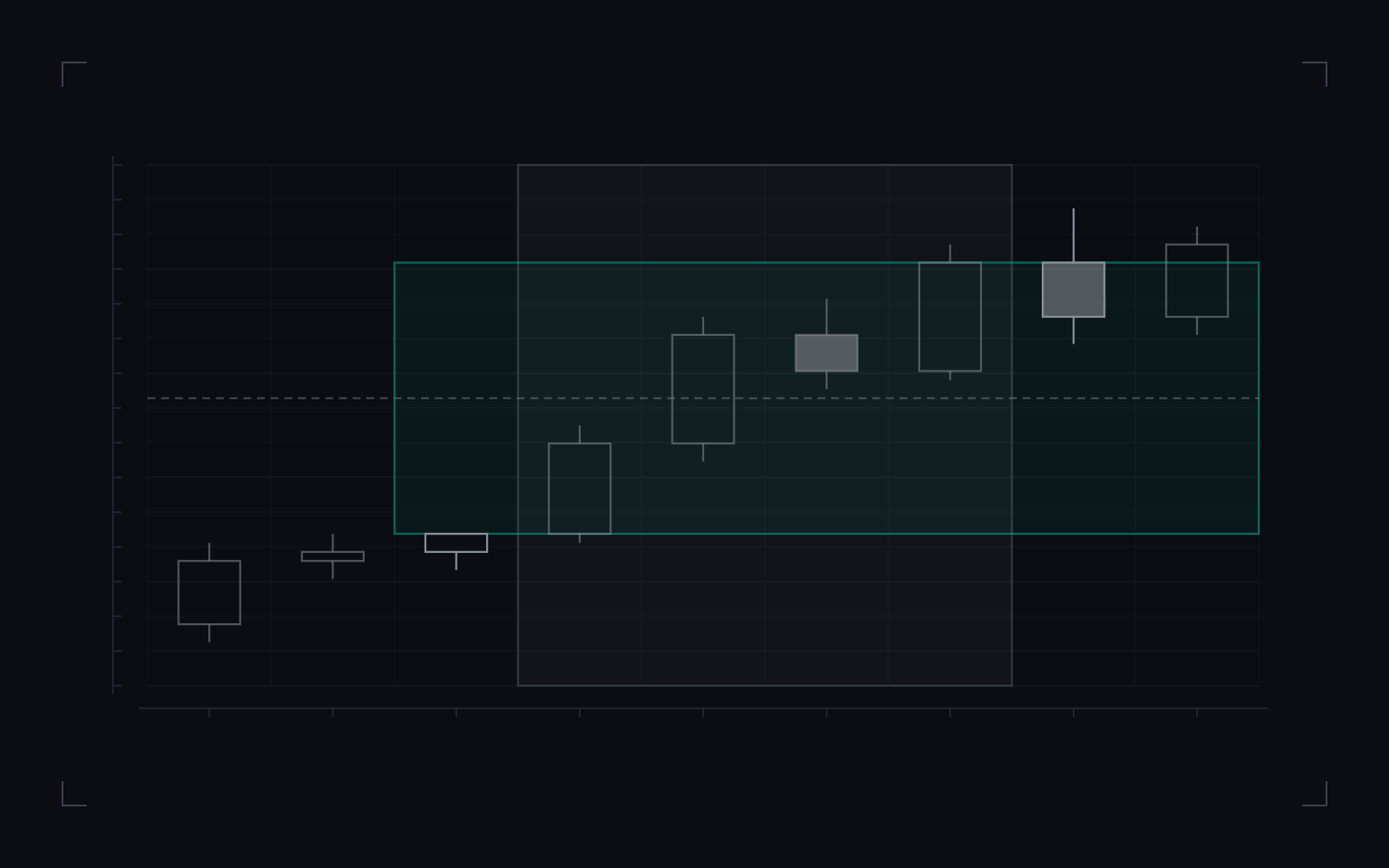
- The last regular-session candle, closing at the 16:15 end.
- The first regular-session candle, at 09:30.
- The overnight session. The futures trade through it, so the band was traded; the gap exists in regular-session prices.
- The opening range gap: the band between the regular close and the 09:30 open.
- Its midpoint.
A gap in regular-session prices: the regular close, an overnight session that trades through the band, the 09:30 open above the close, and a first-hour decline that enters the band and stops above its midpoint.
Drawing the gap establishes the two session prices. It does not establish that the session trades back to them, or that the overnight trading inside the band matters either way.
Opening range gap (ORG): what the definition states, in full.
| Element | What the definition states |
|---|---|
| CloseSources write 16:14 or 16:15; read as the close of the one-minute candle that opens at 16:14, both name this price. | The prior regular session’s last price, at its 16:15 end. |
| Open | The first price at 09:30 New York time. |
| Overnight | Traded: the band is a gap only in regular-session prices. |
| Calendar | Early closes and holidays move the close. |
| Not established | Whether the session trades into the band, to its midpoint or through it, more often than into bands of the same width that are not gaps. |
Commonly confused with
Neighbouring concepts that get used interchangeably, and the distinction that actually separates them.
- New day opening gap
Measured across the evening halt from 17:00 to 18:00, when the futures actually stop. The opening range gap spans an overnight session in which they trade, so it is a gap only in regular-session prices.
- The opening range
The opening range is the high and low traded in a stated window after the open, such as the first thirty minutes. The opening range gap is the band between the prior close and the open itself, and it exists before a single regular-session trade prints.
- A stock's opening gap
A single stock's regular session closes at 16:00, and its opening gap is the jump to the next 09:30 open. The ICT gap is drawn on index futures, whose regular session ends at 16:15 and which trade almost around the clock, so the band usually holds prices that traded overnight.
- Fair value gap
A fair value gap is three candles inside continuous trading whose outer wicks fail to overlap. The opening range gap is two session prices, a close and an open, with no candle test at all.
How to measure it in your own data
A definition you cannot test is a definition you have to take on trust. This is the shortest honest route from the concept to a number you computed yourself.
- Records you need
Index futures data with the regular-session boundaries stated in New York time, the close convention (the close of the one-minute candle that opens at 16:14, which is the price at the 16:15 end), and the exchange calendar of holidays and early closes, which move the regular close.
- What you compute
For each day, take the stated regular-session close and the 09:30 open, and mark the band those two session prices bound, with its centre line. Record whether the first hour of the session trades into the band, to its midpoint or through it, and compare those rates with bands of the same width that are not gaps.
- What the answer tells you
On a chart set to regular trading hours, a jump between one day's last candle and the next day's first, with the overnight session hidden. Switch the chart to all hours and the jump becomes a run of ordinary overnight candles, which is why the gap is described as a regular-session construct.
Questions and answers
What is an opening range gap (ORG)?
The price range between one day's regular-session close and the next day's 09:30 open on United States index products. The futures trade overnight, so the gap exists in regular-session prices, and ICT teaching marks its edges and midpoint as reference levels for the New York session.
What time is the opening range gap?
From the previous day's regular-session close to the 09:30 open, New York time. Published sources write the close as 16:14 or 16:15. Read as the close of the one-minute candle that opens at 16:14, both name the price at the session's 16:15 end; a close taken a minute earlier would be a different price, which is why the convention is stated.
What is the difference between the opening range and the opening range gap?
The opening range is what trades after the open, the high and low of a stated window such as the first thirty minutes. The opening range gap is what the open jumped over, the band between the previous close and the open, known the moment the session starts.
Does the opening range gap get filled?
Sometimes. Teaching expects the session to trade toward the gap or its midpoint; some gaps are filled early in the session and others are left open for days. How often each happens, and how that changes with the gap's size, is a count to make on the data.
Which markets have an opening range gap?
Markets with a regular session inside a longer trading day, above all United States equity index futures. Spot currencies have no regular session and so no opening range gap; their nearest relatives are the daily and weekly gaps across real halts.
How is the opening range gap different from the new day opening gap?
They span different stretches. The new day opening gap spans the one-hour halt from 17:00 to 18:00, when the futures stop; the opening range gap spans the whole overnight session, from the regular close to the 09:30 open, while the futures trade. The same day can print a large gap of one kind and a tiny gap of the other.
Related terms
Derived from the links this entry makes and the entries that link back to it.