25 / 97
Displacement
Working definition
A candle or short run of candles whose bodies dominate their ranges — price delivered aggressively in one direction, with little trade against it, often leaving imbalances behind.
Some candles negotiate and some candles deliver, and displacement is the name for the second kind.
The geometry is simple to state precisely, which is rare in this vocabulary. A candle displaces when its body dominates its range — open to close covering most of high to low — meaning price spent the bar travelling rather than rotating. A stricter variant adds a volatility test: the candle’s range must also exceed a stated multiple of recent average true range, so that a quiet market’s small bodies do not qualify by ratio alone. Consecutive qualifying candles in one direction aggregate into a single displacement leg. Every one of those thresholds is a parameter somebody chose; a version of this definition that does not state its numbers is a mood, not a measurement.
What a displacement records is one-sidedness. For price to travel that far, that fast, one side transacted through whatever was resting on the book while the other side declined to replenish at pace — the same mechanics measured at the book level by the absorb/sweep balance, read here from candle geometry instead of depth. The move frequently leaves marks behind it: territory crossed with little two-way trade becomes a liquidity void, and the three-candle form of that thinness prints as a fair value gap.
The taxonomy this term comes from treats displacement as a qualifier — a break of structure accompanied by displacement is read as more meaningful than one without it, and a market structure shift is often required to be displacement-qualified before it counts. Those are composition rules inside a method, and they are stated here as what the method says, not as what the market owes anyone.
Bullish and bearish, worked
Displacement takes the direction of its bodies: a bullish leg is a run of up-closing candles that pass the test, a bearish leg a run of down-closing ones. The displacement indicator states its defaults as a body of at least 0.60 of the range, with an ATR-scaled alternate of a range of at least 1.5 times ATR(14). Three constructed fifteen-minute candles, with ATR(14) at 14 pips, show what each test admits:
- Opens 1.0850, high 1.0882, low 1.0848, closes 1.0879. Body 29 pips of a 34-pip range, 0.85; range 2.4 times ATR. It passes both tests.
- Opens 1.0850, high 1.0885, low 1.0845, closes 1.0858. Body 8 of 40, 0.20, although the range is 2.9 times ATR. A wide candle that rotated rather than travelled, and it fails the body test.
- Opens 1.0850, high 1.0860, low 1.0849, closes 1.0859. Body 9 of 11, 0.82, but a range of 0.8 times ATR. It passes the body test and fails the range test: a small candle in a quiet market.
Identifying it, step by step
- Declare the timeframe and the tests. A body-to-range threshold, an ATR multiple, or both, with the numbers.
- Test each candle. Body divided by range against the threshold, and range against the ATR multiple if that test is in use.
- Join the run. Consecutive qualifying candles in one direction form one displacement leg; a candle that fails the test ends it.
- Record what the leg left. A fair value gap inside it, a broken swing, or a stretch of thin traversal, each a separate object with its own test.
What displacement is not
A wide candle with long wicks on both sides is volatility without delivery: price travelled and came back. A jump between one session’s close and the next open is not displacement either, because no candle traded through the jump. A slow grind of small candles can move price a long way while no single candle passes the range test. And a candle on a news release is displacement if it passes the test and not otherwise; the definition does not ask why a candle printed.
Attribution and forecast
What the label does not carry: attribution or forecast. The candle does not say who traded it, and body-dominance is not evidence about what happens next — reading it as a forecast is a separate claim requiring separate evidence, the two lenses applied here as everywhere. The honest use of the term is descriptive: it names a delivery character precisely enough that two people looking at the same chart can agree on which candles qualify, which is more than most of this vocabulary manages.
Where it sits in the ICT sequence
The ICT vocabulary in the order the method is taught, with a step for each kind of object.
- Step
- 04 of 08 Structure: whether the swings have turned, and with what force
- Also at this step
- Break of structure (BOS), Change of character (CHoCH), Market structure shift (MSS)
- Before it
- Market structure shift (MSS)
- After it
- Fair value gap (FVG)
The shape, drawn
The smallest arrangement the definition admits. It is a drawing of a rule, not a reading of a market — nothing here is measured, and the table below it is the authoritative version.
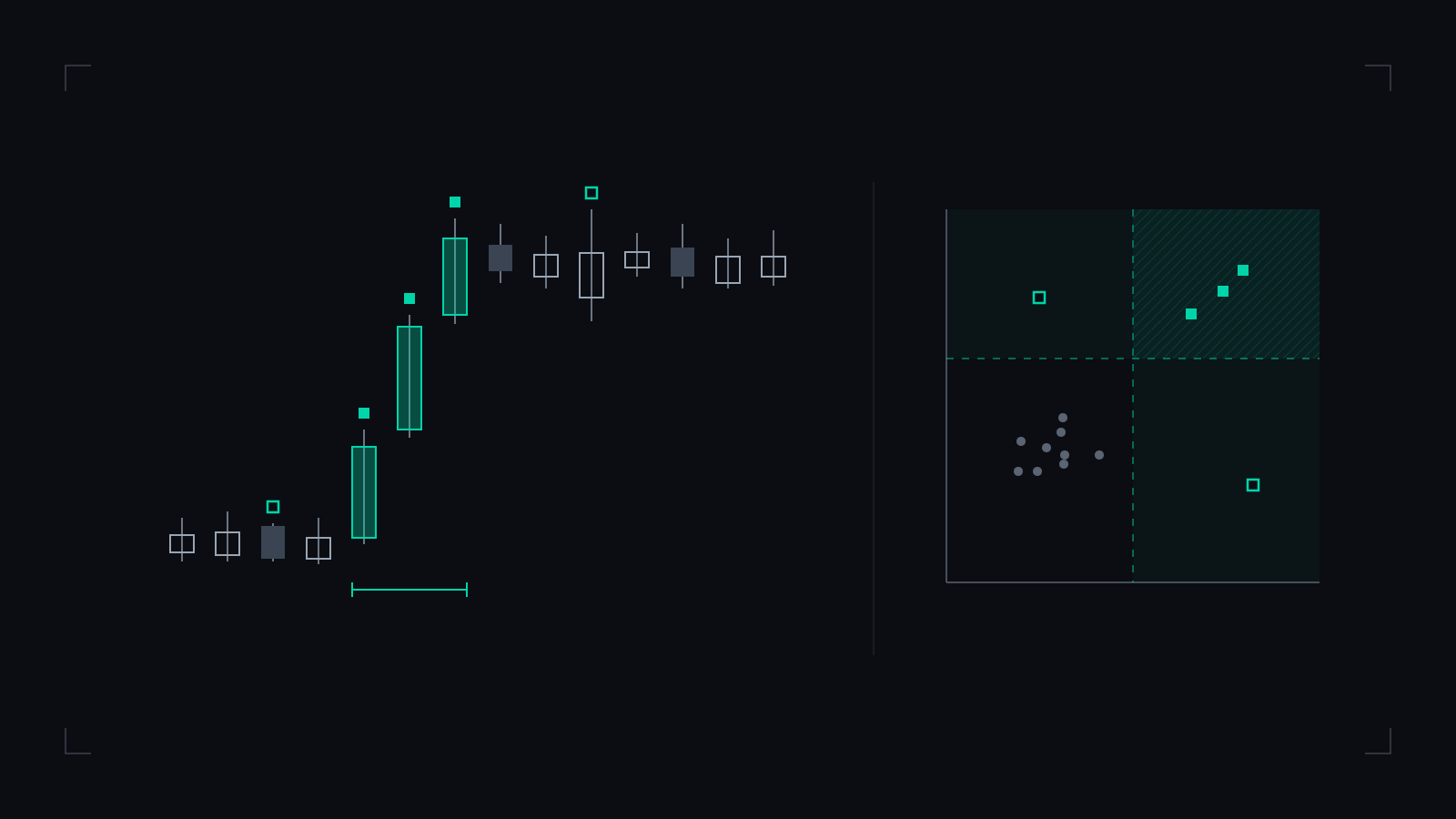
Two stated tests, and the toggle between them. Body dominance and the volatility alternate, plotted for every bar. Five bars qualify under either; three under and.
Admitting a bar establishes which test it passed. It does not establish that a displaced bar, or a leg of them, is followed by anything.
Displacement: what the definition states, in full.
| Element | What the definition states |
|---|---|
| Body dominance | Body as a fraction of range, at or above a stated threshold. |
| Volatility alternateRequired alongside body dominance, it excludes the quiet-market bar that is body-dominant only because its range is small. | Range as a multiple of ATR, at or above a stated threshold. |
| CombinationOn the drawn series, OR admits five bars of fourteen and AND admits three. The toggle is not a preference: it changes which bars exist for everything downstream. | election pending |
| Leg aggregationThe drawing brackets three consecutive bars into one leg without asserting how many the rule requires. | election pending |
| ScopeThe imbalances and voids a displacement leaves are drawn by its siblings; this instrument stays single-purpose. | Bars and legs only. |
| Not established | Whether a displaced bar or leg is followed by anything. |
Commonly confused with
Neighbouring concepts that get used interchangeably, and the distinction that actually separates them.
- A breakout
A breakout is defined by what was crossed — a level. Displacement is defined by how price travelled — bodies dominating ranges, regardless of whether any level was involved. A move can break out without displacing, and displace in the middle of nowhere.
- Momentum
Momentum is usually an indicator reading computed over a lookback window. Displacement is a per-candle geometric test with a stated threshold. The two often agree and are not the same object: one is a smoothed series, the other a labelled event.
- Liquidity void
A void is the traversed range itself — the levels crossed so fast that little traded there. A displacement is the candle geometry that does the traversing. The move is the displacement; the thin territory it leaves behind is the void.
- Fair value gap
A fair value gap is a specific three-candle imbalance that a displacement often prints, but neither requires the other. Displacement describes delivery character over one or more bars; the gap is a defined geometric object with its own boundaries and states.
How to measure it in your own data
A definition you cannot test is a definition you have to take on trust. This is the shortest honest route from the concept to a number you computed yourself.
- Records you need
Candle data at a declared timeframe — body and range per bar — plus an average true range series if the volatility-scaled variant is used. Nothing here needs the order book.
- What you compute
Per candle, the ratio of body to range against a stated threshold; or the candle's range against a multiple of average true range; or both, with the choice declared. Consecutive qualifying candles aggregate into one displacement leg. Every threshold is a parameter someone chose, so state it — a displacement definition without its numbers is not a definition.
- What the answer tells you
A candle whose body fills nearly all of its range, usually arriving in a run of similar candles in one direction, with small or absent wicks against the move. On the chart it reads as price being delivered rather than negotiated: one side transacting through whatever was resting, without the two-way rotation that fills wicks.
Questions and answers
What is displacement in ICT trading?
A label for aggressive one-directional delivery — a candle or short run of candles whose bodies dominate their ranges, taught in the ICT taxonomy as the footprint of strong participation. The geometry is checkable on any chart; what caused it, and what follows it, are separate questions.
How is displacement actually defined?
There is no single canonical threshold, which is why a precise definition states its parameters: a body-to-range ratio above a declared level, or a range beyond a declared multiple of average true range, or both at once, with consecutive qualifying candles aggregated into one leg. Different thresholds label different sets of candles.
Does displacement mean institutions are trading?
The geometry cannot say. A body-dominant candle records that one side transacted through the book faster than the other side replenished it — it does not record who, or why. Attributing it to any particular class of participant is a claim about intent that candle data does not contain.
Is displacement bullish or bearish?
It carries the direction of its own bodies and nothing more. Whether a displaced move continues, stalls or retraces is exactly the kind of claim that needs measured evidence rather than a definition, and a definition page is not that evidence.
What is the difference between displacement and a normal move?
Delivery character, stated as numbers. A normal move rotates, with wicks on both sides and bodies that cover a modest share of each range. A displaced move travels, with bodies that fill most of each range at a size that is large against recent average true range. Where the line sits is a threshold, and a precise use of the word states it.
Related terms
Derived from the links this entry makes and the entries that link back to it.
Where the term is in build
Detector datasheets whose concepts include this term, or whose published copy uses it. Each one states the build state it has reached and the parameters it exposes, and carries no measured verdict.