06 / 97
Break of structure (BOS)
Written BOS throughout.
Working definition
A close through the most recent qualifying swing point in the direction of the prevailing trend — a new structural high in an uptrend, or a new structural low in a downtrend.
Structural trend-reading has exactly two events, and the break of structure is the one the trend itself keeps producing.
The definition inherits everything from two stated rules. The swing rule decides which extremes qualify: conventionally a bar flanked on each side by a declared number of lower highs (for a swing high) or higher lows (for a swing low) — and the flank count is a real choice, because the same tape carries different swing sequences at different settings. The rule also composes into a hierarchy: short-term points flanked by lesser short-term points become intermediate ones, intermediate points flanked likewise become long-term ones, so every break can be graded by the tier of the point it takes. The break election decides what counts as taking one out — a close through, or any wick through — and the two disagree on real charts often enough that the choice changes which events exist.
With the rules fixed, the event is almost mundane: in an uptrend, a qualifying break beyond the most recent swing high; in a downtrend, beyond the most recent swing low. The sequence of higher highs and higher lows ratchets itself one notch on. That mundanity is the point — a structural trend is defined as the sequence that keeps doing this, which is why the taxonomy reserves its attention for the qualifiers: a break arriving with displacement is graded above one that limps through, and a break at a higher swing tier above one at the lowest.
The sibling event carries the meaning by contrast. The same test applied against the prevailing direction — the first failure of the ratchet — is the change of character, and its heavier, tier-qualified form is the market structure shift. Keeping the orientations straight is most of what this corner of the vocabulary asks: continuation with the trend, first failure against it, and the same close through the same price can be either depending on what the sequence had been doing.
What the event cannot carry is a promise. A break of structure records that the trend reached one more notch — it is a statement about the past ending at that close. Whether broken structure precedes more of the same, at what rates, under which qualifiers, is a measurement with a row of its own in the claims ledger, and the two lenses keep the record separate from the forecast on this page as on every other.
Where it sits in the ICT sequence
The ICT vocabulary in the order the method is taught, with a step for each kind of object.
- Step
- 04 of 08 Structure: whether the swings have turned, and with what force
- Also at this step
- Change of character (CHoCH), Market structure shift (MSS), Displacement
- Before it
- SMT divergence
- After it
- Change of character (CHoCH)
The shape, drawn
The smallest arrangement the definition admits. It is a drawing of a rule, not a reading of a market — nothing here is measured, and the table below it is the authoritative version.
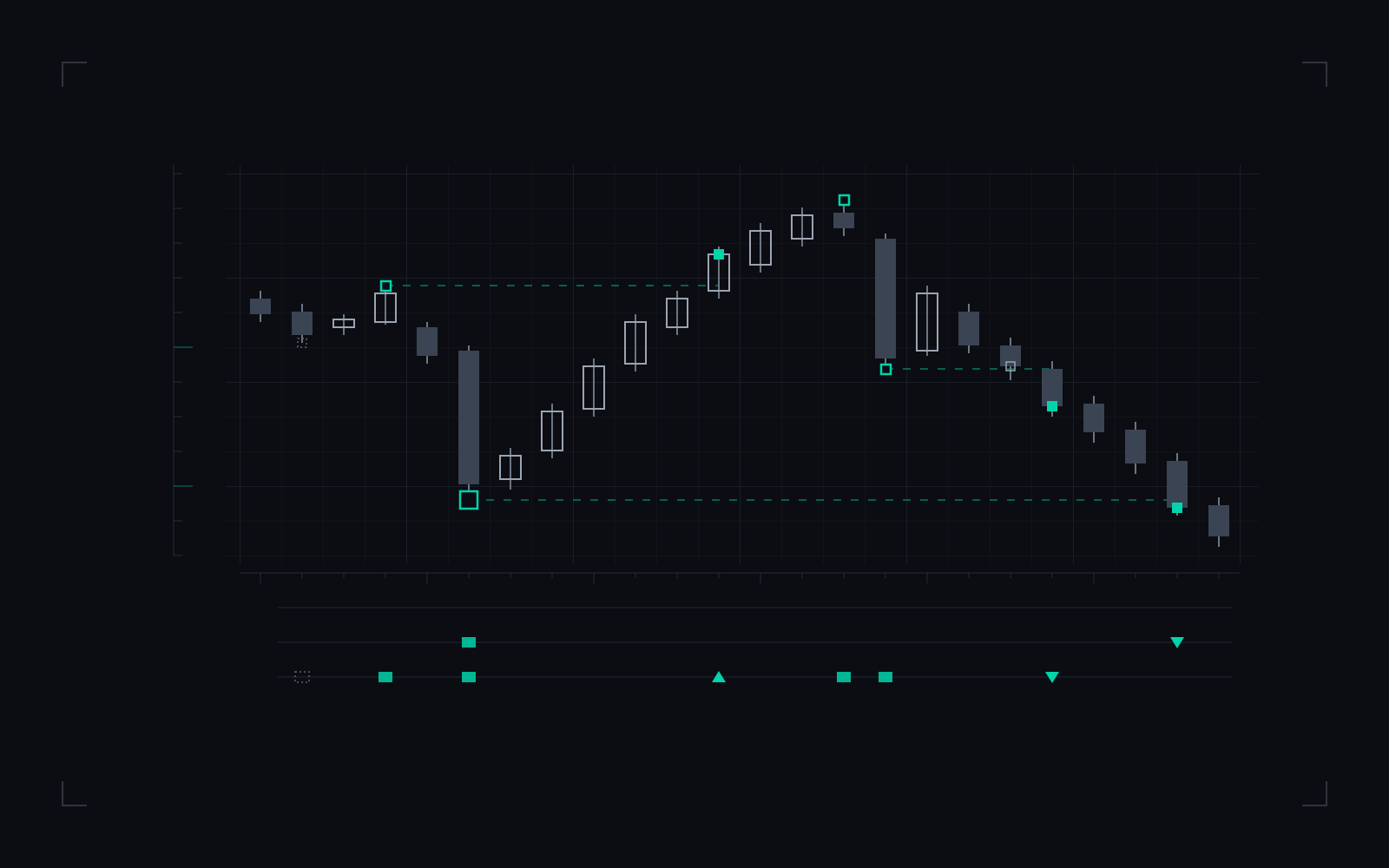
One swing engine, three events. BOS, CHoCH and MSS are the same close-through test read against the tier of the point it takes. The dimmed marker is a consumed swing, retained because it composes the intermediate tier. Illustrative — synthetic series, not recorded data.
Locating an event establishes which point the test consumed and at what tier. It does not establish that a break is followed by anything, or that a tier carries the significance the taxonomy reads into it.
Break of structure (BOS): what the definition states, in full.
| Element | What the definition states |
|---|---|
| Swing rule | A three-bar fractal at k=1: a low flanked by higher lows on either side, and the mirror for highs. |
| Tier | A point is intermediate when flanked by higher lows, or lower highs, of the tier below. The scale continues upward; on this series the long-term row is empty, and is drawn empty. |
| BOS | A close through a swing point in the direction of the trend. |
| CHoCH | The same close-through, against the trend. |
| MSSOne engine, not three: only the tier and the direction change. | The same counter-trend close-through, at an intermediate or higher tier. |
| Break testA bar that pierces the level on its wick and closes back inside does not break it. The drawing shows the two disagreeing, because they routinely do. | Close, not wick. |
| Displacement qualifierNot drawn here. A figure implying it were on would misstate the shipped default. | Off by default |
| Not established | Whether a break of any tier is followed by anything. |
Commonly confused with
Neighbouring concepts that get used interchangeably, and the distinction that actually separates them.
- Change of character
The same geometric test with opposite orientation. A break of structure extends the prevailing direction; a change of character is the first break against it. Which one a given break is depends entirely on the trend context the swing sequence establishes.
- A breakout
A breakout is defined against any level someone cares about — a range boundary, a drawn line, a round number. A break of structure is defined against swing points a stated fractal rule identifies. Every break of structure is a breakout of something; the reverse is nowhere near true.
- Market structure shift
The shift is the counter-trend event at a heavier swing tier, often required to arrive with displacement. A break of structure is the with-trend continuation event. The two are routinely conflated because both involve swing breaks; their orientations are opposite.
- A new high or low
Any tick beyond a prior extreme makes a new high or low. A break of structure requires the extreme to be a qualifying swing under the stated rule, and the break to satisfy the stated close-versus-wick election. Most new extremes break no structure at all.
How to measure it in your own data
A definition you cannot test is a definition you have to take on trust. This is the shortest honest route from the concept to a number you computed yourself.
- Records you need
Candle data at a declared timeframe plus the swing rule in force — how many bars must flank an extreme for it to qualify — and the break election, close-through or wick-through.
- What you compute
Maintain the sequence of qualifying swing highs and lows; in an uptrend flag a qualifying break beyond the most recent swing high, in a downtrend beyond the most recent swing low. The swing rule's flank count builds a hierarchy — short-term points flanked by lesser ones compose into intermediate and long-term points — and a break is graded by the tier it takes.
- What the answer tells you
The trend doing what a structural trend is defined to do: an uptrend closing beyond its prior swing high, ratcheting the sequence one notch on. Routine by construction — which is exactly why the taxonomy attaches significance not to the event but to its qualifiers.
Questions and answers
What is a break of structure?
A close through the most recent qualifying swing point in the trend's own direction — the uptrend taking out its prior swing high, the downtrend its prior swing low. It is the continuation event of structural trend-reading: the sequence extending itself.
What is the difference between BOS and a breakout?
The reference. A breakout can be measured against any level — ranges, drawn lines, round numbers. A break of structure is measured only against swing points a stated rule identifies, which anchors it to the chart's own geometry rather than to a choice of what to draw.
What is the difference between BOS and CHoCH?
Direction relative to trend. The break of structure extends the prevailing direction; the change of character is the first break against it. The same close through the same price can be either, depending on what the swing sequence had been doing.
Does a break of structure confirm the trend will continue?
It records that the trend continued as far as that break — nothing further. Whether broken structure is followed by more of the same is a base-rate question for measurement, and a definition that quietly promises continuation is overdrawing what geometry can carry.
What makes a valid break of structure?
Two stated rules and a trend. The swing rule decides which extremes qualify, usually a bar flanked on each side by a declared number of lesser bars. The break election decides what takes one out: a close through, or any wick through. With both fixed, a valid break is a qualifying swing high taken out in an uptrend, or a qualifying swing low in a downtrend. Left unstated, "valid" is something nobody else can check.
Related terms
Derived from the links this entry makes and the entries that link back to it.
Where the term is in build
Detector datasheets whose concepts include this term, or whose published copy uses it. Each one states the build state it has reached and the parameters it exposes, and carries no measured verdict.