60 / 97
Market structure shift (MSS)
Written MSS throughout.
Working definition
A counter-trend break at an intermediate or higher swing tier — the change-of-character event graded up by the significance of the swing it takes, often required to arrive with displacement before it counts.
The vocabulary keeps two words for a trend breaking against itself, and the shift is the one with a bar to clear.
The construction stands on the swing hierarchy. Under a stated fractal rule, the shortest-term swing points are those flanked by a declared number of lesser bars; short-term points flanked by lesser short-term points compose into intermediate-term points, and those, flanked likewise, into long-term ones. A change of character fires on the first counter-trend break of any qualifying swing. The market structure shift is that same event graded up: the broken point must sit at an intermediate or higher tier — a swing that itself anchored the structure — and stricter versions add a second qualifier, requiring the breaking move to arrive with displacement before the shift counts. Two elections, stated or the flag is unreproducible.
Why the taxonomy bothers with the grade: minor counter-breaks are everywhere — the shortest fractal tier fails constantly inside perfectly healthy trends — so a vocabulary whose only counter-trend word fired on all of them would cry wolf for a living. Reserving the shift for structurally significant swings, and optionally for conviction delivery, is a filtering decision inside the method. Whether the filter earns its keep — whether tier-graded, displacement-qualified breaks are followed by different outcomes than plain ones — is a measurable comparison, and precisely the kind this vocabulary rarely runs on itself.
In the method’s grammar the shift is the hinge of the core sequence: a liquidity sweep of an extreme, then the shift, then entry at an array such as an order block or fair value gap — with the sweep-shift pair also anchoring the session-open judas swing. Reported as grammar, because that is what it is.
Bullish and bearish
A bearish shift breaks an uptrend at an intermediate or higher swing low; a bullish shift breaks a downtrend at an intermediate or higher swing high. Some listings add a third, neutral kind for ranging markets. The definition used here has no place for one: a shift is a break against a prevailing direction, and a range has no direction to break against.
A worked case
Constructed numbers, and the tiers named first. A short-term low is a low with a higher low on each side; an intermediate low is a short-term low with a higher short-term low on each side. An uptrend prints short-term lows at 1.1045, 1.1030, 1.1052 and 1.1068. The low at 1.1030 has 1.1045 before it and 1.1052 after it, both higher, so it is an intermediate low. Price then closes below 1.1068, the latest short-term low: a change of character at the shortest tier, and nothing more. The decline continues and closes at 1.1024, beneath the intermediate low, in candles whose bodies fill most of their ranges. Under a rule that requires an intermediate break with displacement, that close is the market structure shift.
Identifying one on a chart
State three things, then watch one level. The swing rule, with its tier hierarchy. The break rule, a close or a wick through. The displacement election, required or not. With those fixed, mark the most recent intermediate swing against the trend; the first qualifying break through it is the shift. Breaks of shorter-tier swings before it are changes of character at most.
With the rest of the sequence
The shift is taught inside a sequence rather than alone: after a sweep of a prior high or low, and before an entry in the zone its own move leaves behind, the gap the displacement opened or the last opposing candle before it. The ICT 2022 model is that sequence written as a rule. The smart money reversal at the turn of the market maker model is marked by the same sweep and break, at a higher-timeframe array. Across correlated markets, SMT divergence is read at the swept extreme, before the shift, as confirmation.
Tiers, and when they become known
A tier is not known when the low prints. In the worked case, 1.1030 is an intermediate low only once 1.1052 has printed after it, and 1.1052 is a short-term low only once a higher low has printed after that. Every swing in the hierarchy is confirmed by later candles, and the higher the tier, the longer the wait. A study that labels tiers with candles that had not printed at the time of the break is using information the chart did not have, and it will find shifts cleaner than any reader could have marked them live. The sound version records each swing’s tier at the candle that confirmed it, and grades a break only against swings already confirmed.
Timeframes
The shift is read inside a timeframe, and teaching commonly uses two: a location or bias on a higher timeframe, and the shift itself on a lower one, inside the higher timeframe’s array. The same decline can be a shift on a five-minute chart and a pullback in an hourly uptrend, so a shift is quoted with its timeframe, and a claim that combines a higher-timeframe bias with a lower-timeframe shift names both.
Common mistakes
Calling every counter-trend break a shift, which removes the tier and turns the term into a synonym for change of character. Choosing the swing tier after seeing which break led somewhere. And reading the shift on one timeframe while quoting the trend from another, so that the break and the structure it breaks do not belong to the same chart.
What the event is not
The boundary this page holds: the shift is one event, known when it prints; a reversal is a verdict about everything after. The taxonomy’s reading of the shift as early reversal evidence is an expectation built on the event — testable, and not smuggled into the definition. The two lenses stay in force where the vocabulary most wants them suspended.
Where it sits in the ICT sequence
The ICT vocabulary in the order the method is taught, with a step for each kind of object.
- Step
- 04 of 08 Structure: whether the swings have turned, and with what force
- Also at this step
- Break of structure (BOS), Change of character (CHoCH), Displacement
- Before it
- Change of character (CHoCH)
- After it
- Displacement
The shape, drawn
The smallest arrangement the definition admits. It is a drawing of a rule, not a reading of a market — nothing here is measured, and the table below it is the authoritative version.
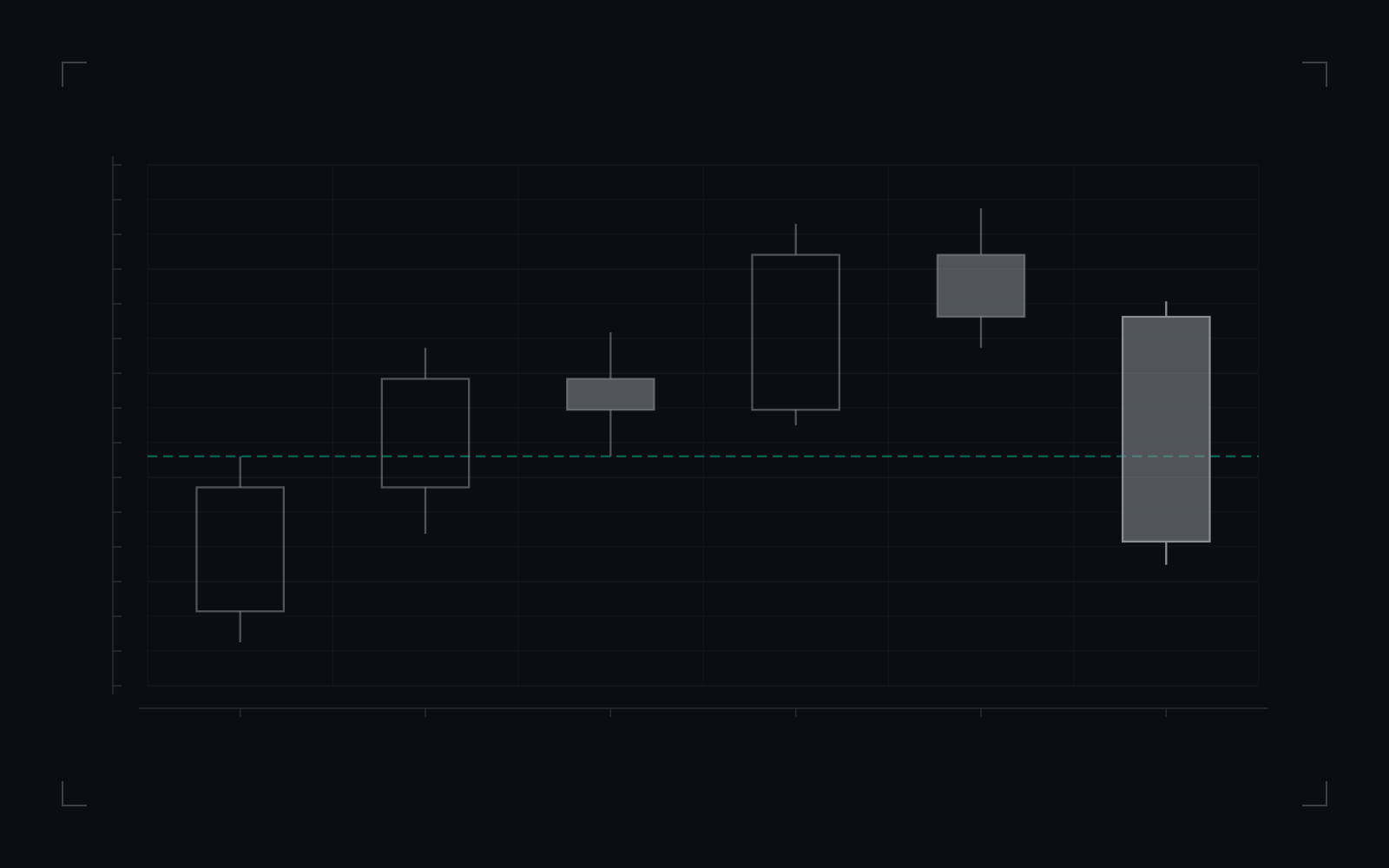
- An intermediate-tier swing low — a low flanked by higher lows of the tier beneath, per the shared swing engine.
- The counter-trend close through it, delivered with displacement: the body dominates the range, which is what upgrades the event from a change of character.
The change-of-character event graded up: the same counter-trend close-through, read at an intermediate swing tier, arriving with displacement — the subject candle’s body dominates its range, because many statements of the rule require it to.
Grading the event by tier establishes which swing it took. It does not establish that a higher tier carries more consequence — that is the measurable claim, and it has not been measured.
Market structure shift (MSS), the graded event: what the definition states, in full.
| Element | What the definition states |
|---|---|
| The event | A counter-trend close-through at an intermediate or higher swing tier. |
| One engine | The same swing rule and the same close-through test as every other structure event — only the tier and the direction change. |
| Displacement requirementOften required before the event counts; whether it is required here is a stated parameter. | election pending |
| Not established | That a shift at a higher tier is followed by more than one at a lower tier. |
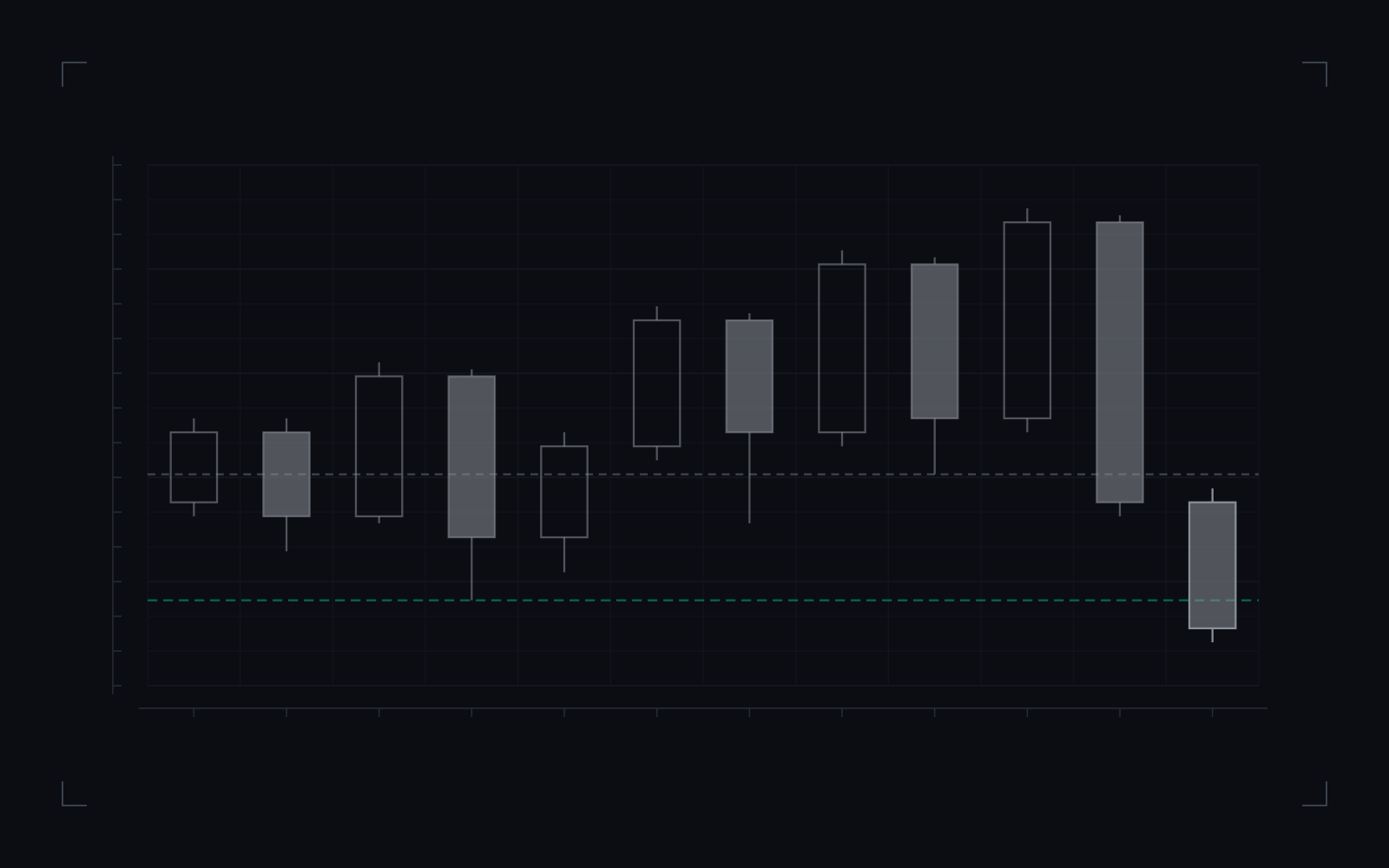
- The latest short-term low, a low with a higher low on each side. The first close beneath it is a change of character at the shortest tier.
- The intermediate low: a short-term low with a higher short-term low on each side, the swing that anchored the uptrend.
- The close beneath the intermediate low, its body filling most of its range: the market structure shift, where displacement is elected.
The two tiers in one decline: an uptrend’s short-term lows, one of which is also an intermediate low, then a close beneath the latest short-term low and, one candle later, a displaced close beneath the intermediate low. Only the second is the shift.
Drawing both breaks establishes which swing each one took. It does not establish that the second break carries more consequence than the first.
Market structure shift (MSS), both tiers in one decline: what the definition states, in full.
| Element | What the definition states |
|---|---|
| Short-term low | A low with a higher low on each side. |
| Intermediate low | A short-term low with a higher short-term low on each side. |
| First break | A close beneath the latest short-term low: a change of character. |
| Second break | A close beneath the intermediate low: the shift, when the tier rule is met and any displacement election is satisfied. |
| Not established | That the second break is followed by different outcomes than the first. |
Commonly confused with
Neighbouring concepts that get used interchangeably, and the distinction that actually separates them.
- Change of character
Every shift is a change of character; almost no change of character is a shift. The shift label is reserved for counter-trend breaks at heavier swing tiers — intermediate-term points rather than the shortest fractal — and versions of the definition add a displacement requirement on top.
- Break of structure
Opposite orientation. The break of structure extends the prevailing direction; the shift breaks against it at a significant tier. Conflating them erases the one distinction this corner of the vocabulary exists to make.
- A reversal
The shift is one graded event, known when it prints. A reversal is a verdict about what followed. The taxonomy treats the shift as its strongest early evidence for one — which is an expectation built on the event, not a property of it.
- A trend change on an indicator
Moving-average crosses and similar signals fire on smoothed series with lag chosen by their windows. The shift is anchored to specific swing points under a stated fractal rule, which is what makes two independent readings of the same chart agree on whether one happened.
How to measure it in your own data
A definition you cannot test is a definition you have to take on trust. This is the shortest honest route from the concept to a number you computed yourself.
- Records you need
Candle data at a declared timeframe, the swing rule with its tier hierarchy — short-term points flanked by lesser ones composing into intermediate and long-term points — and the elections: which tier qualifies, close or wick, displacement required or not.
- What you compute
Maintain the swing hierarchy; flag a qualifying counter-trend break of an intermediate-or- higher point; apply the displacement qualifier if elected. Every election changes the population of shifts, so a shift flag carries its configuration or it carries nothing.
- What the answer tells you
An established sequence — higher highs, higher lows — broken not at its shallowest recent swing but at a point that itself anchored the structure, usually by a candle run whose bodies dominate their ranges. The chart reads as the trend's frame cracking rather than its surface scratching.
Questions and answers
What is a market structure shift?
A counter-trend break graded up by significance: the broken swing is an intermediate or higher point in the fractal hierarchy, not merely the most recent minor one, and many definitions additionally require the breaking move to show displacement. It is the taxonomy's heavyweight version of the change of character.
What is the difference between MSS and CHoCH?
Tier and qualifiers. A change of character is any first counter-trend swing break; a shift requires the swing to matter — an intermediate-term point or above — and, in stricter versions, requires displacement in the break. Same direction of meaning, different bar to clear.
Does displacement have to be present for an MSS?
Only under definitions that say so, which is exactly why the election must be stated. The displacement-qualified version marks fewer, sharper events; the unqualified version marks more. Neither is canonical, and results quoted across the two are not comparable.
Is a market structure shift a reversal signal?
It is taught as the earliest strong evidence of one, and that teaching is an expectation, not a measurement. What follows shifts, at what rates, under which qualifiers — that is a distribution to establish with data, and the label neither contains nor substitutes for it.
What is the difference between a market structure shift and a break of structure?
Orientation. A break of structure extends the prevailing trend, an uptrend taking out its prior swing high. A market structure shift breaks against the trend at an intermediate or higher swing tier, often with displacement required. A close through a swing point is one or the other depending on which way the structure had been running.
What are the types of market structure shift?
Two, by direction: a bearish shift breaks an uptrend at an intermediate or higher swing low, and a bullish shift breaks a downtrend at an intermediate or higher swing high. Some listings add a neutral kind for ranges, which this definition has no room for, because a range has no direction to break against.
How do you trade a market structure shift?
As taught, not alone: a sweep of a prior high or low first, then the shift, then an entry on a return into the gap or block the shift's own move left, with the stop beyond the swing the move started from. Each step carries its own rule, and a result for the sequence depends on every one of them being stated.
Related terms
Derived from the links this entry makes and the entries that link back to it.
Where the term is in build
Detector datasheets whose concepts include this term, or whose published copy uses it. Each one states the build state it has reached and the parameters it exposes, and carries no measured verdict.