61 / 97
Mitigation block
Working definition
A failed order block reborn in the opposite role after a failure swing — the same flip construction as a breaker block, minus the liquidity sweep that defines the breaker's origin.
When an order block fails, the vocabulary does not discard it — it renames it, and the mitigation block is the rename reserved for failures that took nothing with them.
The construction is the breaker block’s with one part removed. Both begin as an order block — the last opposing candle before a qualifying move — that a later move consumes: a qualifying close through the zone, breaking structure. The breaker requires that consuming move to have first swept a prior extreme, collecting the pool resting beyond it; the mitigation block’s consuming move made no such stop. It came from a failure swing — a lower high in what had been an uptrend, a higher low in a downtrend — and broke through the block without the raid. Sweep versus no sweep is the entire taxonomy between the siblings, and the method grades the swept origin as the stronger one: a ranking of two expectations that no measurement on this page adjudicates.
The name carries its own story and deserves to have it read out loud. Mitigation is the claim that the participants whose positions built the original block — now stranded on the wrong side after its failure — return to the zone to exit at reduced damage, and that their exits supply the reaction the flipped zone is expected to show. It is an intent narrative assembled entirely from candle geometry: the candles are checkable, the stranded inventory and its motives are not, and the two lenses mark exactly where the checkable part ends.
Bullish and bearish
A bearish mitigation block starts as a bullish order block that fails: price makes a lower high without trading above the prior high, then closes down through the block, and the zone is expected to act as resistance when price returns. A bullish mitigation block is the mirror: a bearish block that fails after a higher low, expected to act as support.
A worked case
Constructed numbers. A bullish order block runs from 1.2710 to 1.2724 beneath a rally to 1.2790. Price pulls back to a higher low at 1.2735, rallies again but stops at 1.2776, short of 1.2790, and then falls, closing at 1.2702: through the higher low at 1.2735 and through the block’s lower edge at 1.2710. No prior extreme was taken on the way, so the failed block is re-registered as a bearish mitigation block, expected to resist a return into 1.2710 to 1.2724. Had the second rally traded to 1.2795, beyond the 1.2790 high, before the same decline, the same failure would have made a breaker block.
Identifying one, step by step
- Start from an order block identified under a stated rung and boundary election.
- Watch for a failure swing: a lower high in an uptrend or a higher low in a downtrend, with no trade beyond the prior extreme.
- Mark the consuming close: a close through the block’s far edge that also breaks structure.
- Check for the sweep. If the move that consumed the block first traded beyond a prior high or low, the object is a breaker block instead.
- Re-register the zone in the opposite role, keeping the boundary election it had.
Mitigated is not a mitigation block
The word also appears as a verb. In common use an order block is mitigated once price has returned into it, and unmitigated until then, whether or not the block held. That usage describes a state any block can be in. The mitigation block is a specific object: a block that failed through a failure swing, without a sweep, and flipped roles. A chart note that a block was mitigated says price came back; it does not say the block became a mitigation block.
What would settle it
What would settle the object’s worth is the comparison its literature never runs: revisits of failed blocks against revisits of matched neutral zones — same distance, same volatility context, no vocabulary attached. The construction above is precise enough to run that test, which is more than most drawing conventions can offer, and precisely the kind of question a measurement estate exists to close. Until then the mitigation block is a well-defined rename with an unmeasured expectation attached, sitting beside its swept sibling and the gap-parented inverse fair value gap in the taxonomy’s small museum of failures given second careers.
Where it sits in the ICT sequence
The ICT vocabulary in the order the method is taught, with a step for each kind of object.
- Step
- 06 of 08 Blocks: the candles that mark a return zone, and what became of them
- Also at this step
- Order block, Breaker block, Rejection block, Propulsion block
- Before it
- Breaker block
- After it
- Rejection block
The shape, drawn
The smallest arrangement the definition admits. It is a drawing of a rule, not a reading of a market — nothing here is measured, and the table below it is the authoritative version.
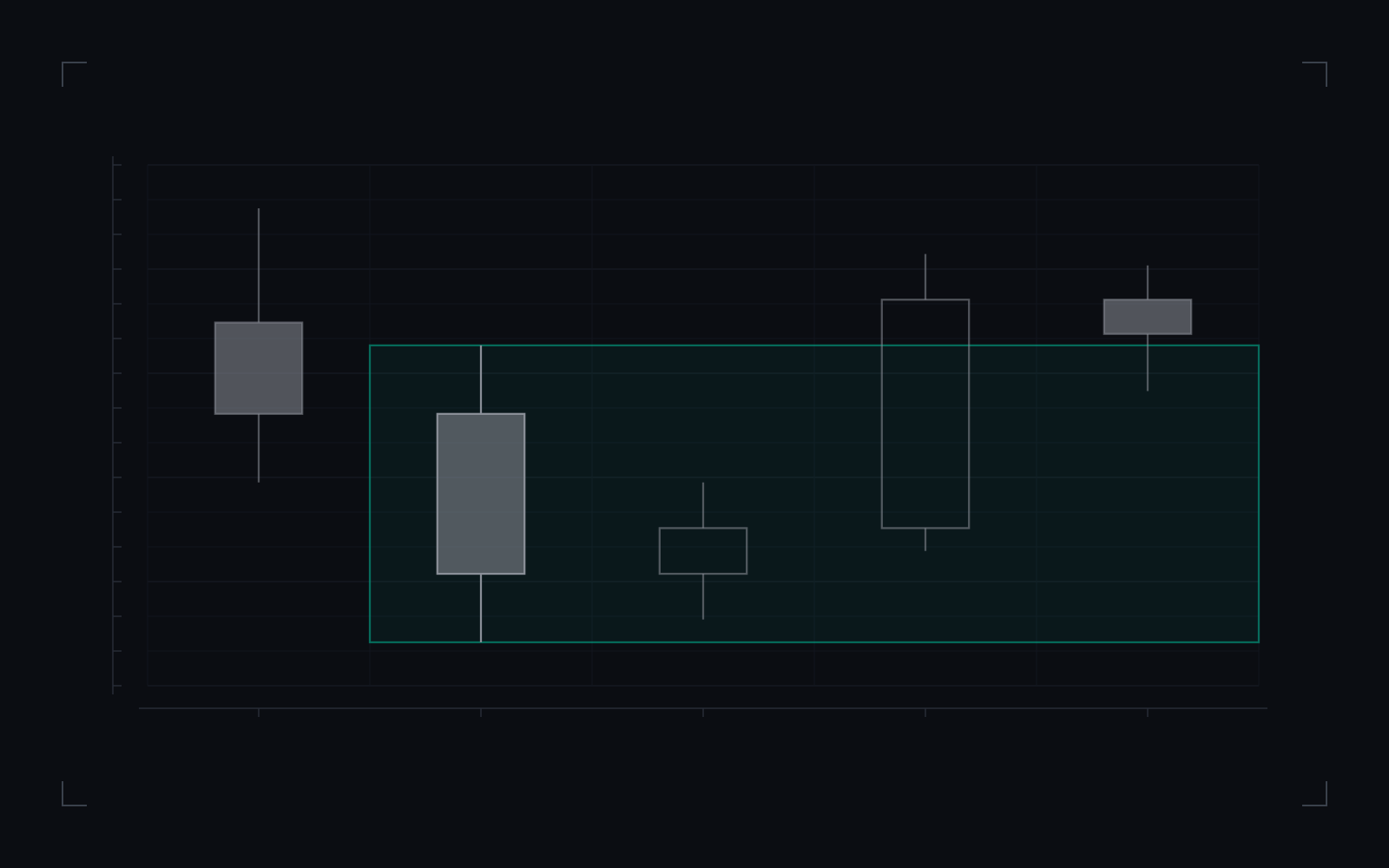
- The block: the last candle closing against the move that follows.
- The failure swing: the next attempt holds above the block’s low. No prior extreme is swept — compare the breaker, where the sweep is required.
- The block’s range, reborn in the opposite role after the break.
The same flip construction as the breaker, minus the sweep: a block forms, price fails to make a new extreme, and the break through the block rebirths it in the opposite role. What is absent from this drawing is the point of it.
Drawing the failure swing establishes the construction. It does not establish that the reborn zone behaves differently from any other level.
Mitigation block: what the definition states, in full.
| Element | What the definition states |
|---|---|
| Origin | A failed order block, rebirthed by a failure swing. |
| The distinctionThe breaker requires one; the mitigation block is defined by its absence. | No liquidity sweep precedes the break. |
| Not established | Whether the reborn zone is respected, or how the two flip constructions differ in outcome — that comparison is a measurement, and it has not been made. |
Commonly confused with
Neighbouring concepts that get used interchangeably, and the distinction that actually separates them.
- Breaker block
The same flip — a consumed order block expected to work the other way — with one construction difference: the breaker's move first swept a prior extreme, the mitigation block's came from a failure swing that took no liquidity first. Sweep versus no sweep is the entire boundary, and the taxonomy keeps both names because it grades the two origins differently.
- Order block
The parent. An order block is the last opposing candle before a qualifying move, expected to hold on revisit. The mitigation block is what the vocabulary calls it after it failed to hold and the structure broke — same candle, new name, opposite expectation.
- An inverse fair value gap
Also a failure-flip object, from a different parent: the inverse gap is a failed three- candle imbalance, the mitigation block a failed position candle. The flip narratives rhyme; the geometry that gets drawn does not.
- A retest of broken support
The classical flip trades a horizontal level earning its status through touches. The mitigation block inherits a zone — the failed block candle's range or body — and its flip is dated to a specific structural failure rather than accumulated history.
How to measure it in your own data
A definition you cannot test is a definition you have to take on trust. This is the shortest honest route from the concept to a number you computed yourself.
- Records you need
Candle data at a declared timeframe, the parent order block's identification rule, the structure-break definition that marks the failure, and the boundary election for the flipped zone.
- What you compute
Track order blocks to their violation: a qualifying close through the block that breaks structure without a preceding sweep of a prior extreme. Re-register the zone in the flipped role and grade revisits by the stated touch rule — against a matched neutral zone, if the claim is ever to be more than a story.
- What the answer tells you
A block that was expected to hold instead gives way — structure breaks through it from a failure swing — and a later return trades into the old zone from the other side. The taught picture has the return stalling there; the frequency of that stall is the measurement the name does not come with.
Questions and answers
What is a mitigation block?
A failed order block that the taxonomy re-registers in the opposite role: the move that consumed it came from a failure swing — without first sweeping a prior extreme — and revisits of the old zone are expected to react the other way. It is the breaker block's sibling, separated by the missing sweep.
What is the difference between a mitigation block and a breaker block?
One construction detail with a heavy narrative load: the breaker's consuming move swept a prior high or low first; the mitigation block's did not. The taxonomy reads the sweep as the stronger origin, which is a ranking between two expectations, not between two measurements.
Why is it called mitigation?
From the story that institutions left with losing inventory at the failed block return to the zone to mitigate — to exit at less damage — and their exits supply the reaction. It is an intent narrative built on candle geometry; the geometry is checkable, the mitigation is not.
Do mitigation blocks work?
The testable form of the question: do revisits of failed blocks react differently from revisits of matched neutral zones? That comparison is well-posed and absent from the sources that teach the object — which is the gap between vocabulary and evidence this glossary keeps pointing at.
What is the difference between a mitigation block and an order block?
The order block is the parent: the last candle closing against a qualifying move, expected to hold when price returns. The mitigation block is that same zone after it failed, a move from a failure swing having broken structure through it, re-registered with the opposite expectation. One candle, a later chapter of its history, and a new name for that chapter.
What does mitigated mean for an order block?
In common use, that price has returned into the block, whether or not it held; an unmitigated block is one price has not yet revisited. The verb describes a state any block can be in, and is separate from the mitigation block, which is a block that failed without a sweep and flipped roles.
Related terms
Derived from the links this entry makes and the entries that link back to it.
Where the term is in build
Detector datasheets whose concepts include this term, or whose published copy uses it. Each one states the build state it has reached and the parameters it exposes, and carries no measured verdict.