79 / 97
Rejection block
Working definition
A zone drawn from the wick of a candle at a swing high or low, between the candle's body and the tip of its wick, where price reached and was refused, and where the ICT method expects it to be refused again.
A long wick at a swing high is a record of price going somewhere and being sent back, and the rejection block is the ICT habit of treating that record as an address.
The zone, stated
Start from a swing extreme under a stated swing rule, and take the candle whose wick forms it. The rejection block is the stretch of price between the wick’s tip and the candle’s body: at a swing high, from the high down to the top of the body; at a swing low, from the low up to the bottom of the body. The body boundary is an election, the close, the open or simply whichever edge of the body is nearer the wick, and so is a minimum wick size, since every candle has some wick and only a pronounced one is taught as meaningful. The wick’s midpoint is tracked as a line of its own.
Where several candles at the same extreme leave wicks at similar prices, some versions draw the block across the cluster, from the most extreme wick tip to the nearest body among them. That is a further rule, and it changes which zones exist.
Bullish and bearish
A bearish rejection block forms at a swing high from a long upper wick. The expectation attached to it is that a later rally into the wick range meets selling again, with the wick’s tip as the price that should not be closed above. A bullish rejection block is the mirror at a swing low, from a long lower wick, with the wick’s low as the line that should hold. As with the rest of the block family, the direction describes the geometry, and the expectation is the method’s.
A worked case, constructed. An hourly candle with a low of 1.1038 opens at 1.1041, closes at 1.1052, and prints the swing high at 1.1080. Its upper wick runs from 1.1052 to 1.1080, twenty-eight of the candle’s forty-two pips. The bearish rejection block is the band from 1.1052 to 1.1080, and its midpoint is 1.1066. If price later rallies to 1.1070 and turns, the zone was respected; if a candle closes at 1.1084, above the tip, it was violated.
Wick versus body
The distinction from the order block is the part of the candle each one keeps. The order block keeps the body, or the full range, of the last candle that closed against a qualifying move, on the reading that positions were built there. The rejection block keeps only the wick, on the reading that the wick marks prices the market visited and refused. Both belong to the family of zones the taxonomy expects price to react at, alongside the breaker block and the mitigation block, and they can sit a long way apart on the same chart because they are built from different evidence.
The wick often has a history of its own. A long wick through a prior high that closes back inside the range is a liquidity sweep, and the rejection block drawn from that wick is the zone the sweep leaves behind. Classical candlestick reading sees the same bar as a shooting star or a hammer and acts on it at once; the rejection block instead waits for price to return.
What a return would have to show
The claim under the name is that the second visit to a wick behaves like the first. That is a measurable frequency with an obvious baseline: price turns inside bands of every size all the time, so the respect rate of rejection blocks means something only against equal-sized bands placed at arbitrary nearby prices, under the same touch and close rules. The detector campaign lists rejection blocks as a driver of their own in the claims ledger, and the verdict renders on that row. The two lenses leave the page with half an answer by design: where the zone is can be checked, and whether it holds is the ledger’s to say.
Where it sits in the ICT sequence
The ICT vocabulary in the order the method is taught, with a step for each kind of object.
- Step
- 06 of 08 Blocks: the candles that mark a return zone, and what became of them
- Also at this step
- Order block, Breaker block, Mitigation block, Propulsion block
- Before it
- Mitigation block
- After it
- Propulsion block
The shape, drawn
The smallest arrangement the definition admits. It is a drawing of a rule, not a reading of a market — nothing here is measured, and the table below it is the authoritative version.
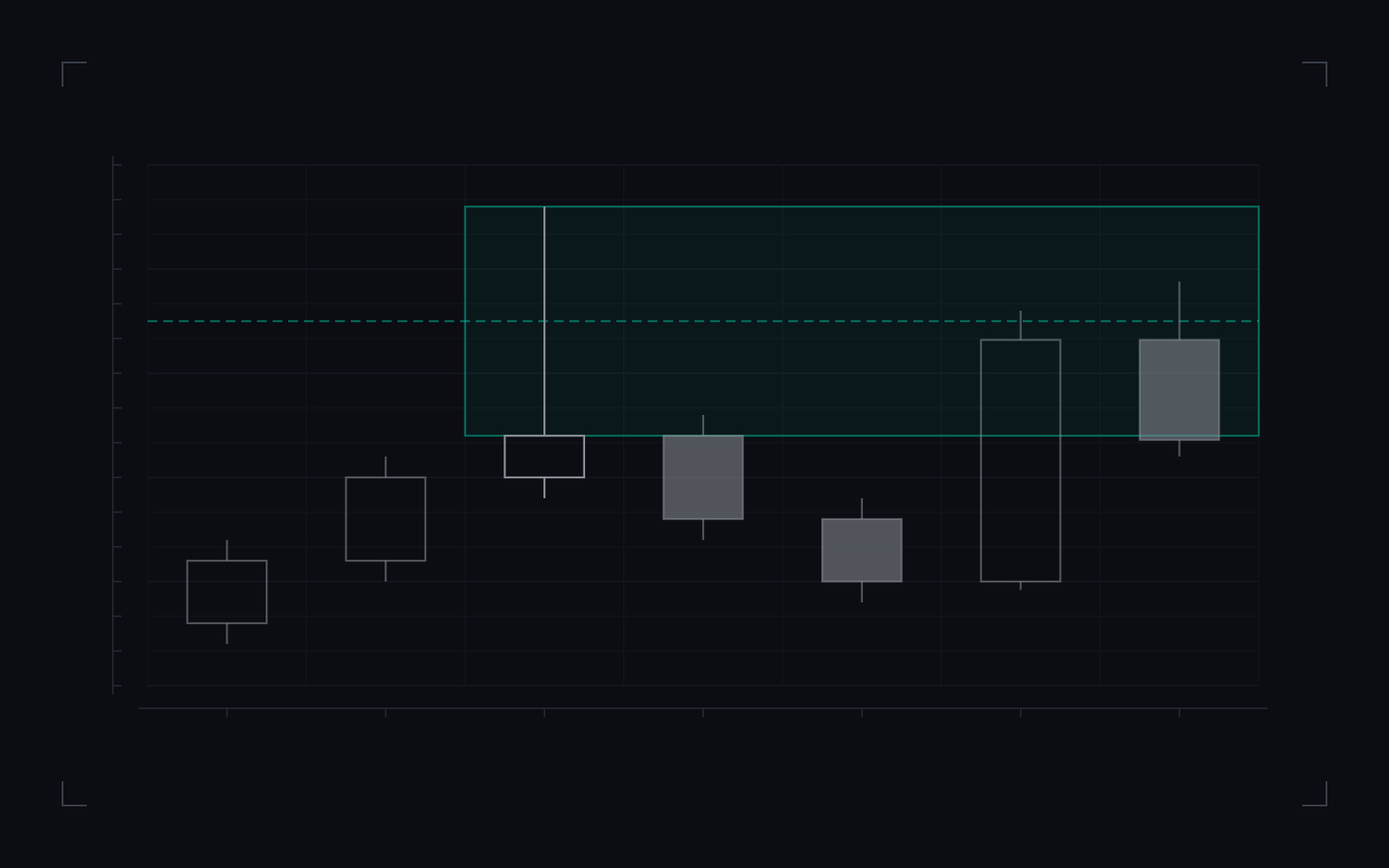
- The candle whose upper wick forms the swing high. Its body tops out at 14.5; the wick runs on to 20.
- The rejection block: the wick’s range, from the top of the body to the tip, carried forward.
- The wick’s midpoint, tracked as a line of its own.
- A later rally back into the band. Whether a return turns inside it, or closes beyond the tip, is what the respect rule records.
The candle whose wick forms the swing high, and the zone the wick leaves: from the top of the body to the tip, with the wick’s midpoint marked, and a later rally trading back into the band and turning inside it.
Drawing the zone establishes where the wick was. It does not establish that price is refused there again, or how often.
Rejection block: what the definition states, in full.
| Element | What the definition states |
|---|---|
| Swing extreme | A swing high or low under the stated swing rule, formed by a wick. |
| Zone | From the tip of the wick to the candle’s body. |
| Body boundaryThe close, the open, or whichever edge of the body is nearer the wick. Each draws a different band. | election pending |
| Minimum wickA floor relative to the candle’s range or to average true range; every candle has some wick. | election pending |
| Midpoint | Halfway between the tip of the wick and the body boundary. |
| Respect ruleA turn inside the band, against a close beyond the tip. Wick and close rules record different outcomes for the same return. | election pending |
| Not established | Whether a return is refused, how often, or against what baseline. |
Commonly confused with
Neighbouring concepts that get used interchangeably, and the distinction that actually separates them.
- Order block
An order block is drawn from the body or the full range of the last candle closing against a qualifying move. A rejection block is drawn from the wick of a candle at a swing extreme. Both are zones the taxonomy expects price to react at; they are built from different parts of a candle and often sit at different prices on the same chart.
- A pin bar, hammer or shooting star
Classical candlestick reading treats a long wick as a signal on the bar that prints it. The rejection block keeps the wick as a zone and waits for price to come back to it. One is a one-bar pattern; the other is a level with a future.
- Liquidity sweep
A long wick through a prior high that closes back inside the range is a sweep, and the wick it leaves is often exactly where a rejection block is drawn. The sweep is the event; the rejection block is the zone the event leaves behind.
- A supply or demand zone
Supply and demand zones are usually drawn by eye around the base a move departed from, often several candles wide. The rejection block is one wick at one extreme, bounded by that candle's body and its tip, so two readers mark it identically once the rules are stated.
How to measure it in your own data
A definition you cannot test is a definition you have to take on trust. This is the shortest honest route from the concept to a number you computed yourself.
- Records you need
Candle data at a declared timeframe; a swing rule for which highs and lows qualify; a minimum wick size relative to the candle's range or to average true range; and the boundary rule, whether the zone runs from the wick tip to the body's close, its open, or whichever edge of the body is nearer the wick.
- What you compute
At each qualifying swing extreme, take the candle whose wick forms it, draw the zone from the tip of the wick to the body boundary under the stated rule, and mark the wick's midpoint. Record later returns into the zone as violated (a close beyond the tip) or respected (a turn inside it), and compare the respect rate with that of equal-sized bands placed at arbitrary nearby prices.
- What the answer tells you
A swing high made by a long upper wick above a smaller body, or a swing low made by a long lower wick, with later price trading back into that wick range. The taught reading is that the second visit is refused where the first was; the measurable question is whether it is refused more often than price turns inside any band of the same size.
Questions and answers
What is a rejection block?
A zone taken from the wick of the candle that forms a swing high or low, running from the tip of the wick to the candle's body. The wick records prices the market reached and refused, and the ICT method expects a later return into that range to be refused again.
What does a rejection block look like?
At a swing high, a candle with a long upper wick above a comparatively small body; the block is the wick's length, from the high down to the top of the body. At a swing low, the mirror: a long lower wick, with the block running from the low up to the bottom of the body.
How do you find rejection blocks?
Under stated rules rather than by eye. Mark swing highs and lows with a declared swing rule, keep only those formed by a wick above a stated minimum size, and draw each zone from the wick's tip to the body boundary you have elected. Two people using the same rules will then find the same blocks.
How is a rejection block different from an order block?
By the evidence it is built from. The rejection block keeps a wick, prices visited and refused. The order block keeps the body or full range of the last candle closing against a qualifying move, on the reading that positions were built there. The two often sit apart on one chart and are tested separately.
What is a bullish rejection block?
One formed at a swing low by a long lower wick. The zone runs from the wick's low up to the candle's body, and the method expects later returns into that range to meet buying again, with the wick's low as the price that should not be closed beneath.
What is the midpoint of a rejection block used for?
Teaching commonly tracks the wick's halfway line, treating a close beyond it as a sign the zone is weakening and the wick's tip as the line that invalidates it. Both are stated lines. Whether either behaves differently from any other interior price is a measured question, not a stated one.
Do rejection blocks work?
The question is a frequency with an obvious baseline: price turns inside bands of every size all the time, so the respect rate of rejection blocks is informative only against equal-sized bands at arbitrary nearby prices, judged by the same touch and close rules.
Related terms
Derived from the links this entry makes and the entries that link back to it.