16 / 97
Consequent encroachment (CE)
Written CE throughout.
Working definition
The midpoint of a fair value gap, halfway between its two boundaries, which the ICT method treats as the gap's balance point; the same fifty-percent line drawn through a wick carries the same name.
Halve a gap and you have a line, and consequent encroachment is the ICT decision to treat that line as the most important price inside the gap.
The line, stated
A fair value gap has two exact boundaries: in a bullish gap, the first candle’s high and the third candle’s low. Consequent encroachment is the mean of those two prices, the midpoint of the band. It needs no election the gap itself did not already need. Once the gap’s rules are stated, its minimum size and its timeframe, the midpoint is fixed, and two readers will draw it at the same price to the last pip.
The name is applied more widely than gaps. The halfway point of a long wick is also called its consequent encroachment, which matters for the rejection block, a zone drawn from a wick. The halfway point of an order block’s body carries a different name, mean threshold. The arithmetic is the same in all three; the object being halved is what changes.
How the method reads it
The midpoint is taught as the gap’s balance point. A return into a bullish gap that holds above consequent encroachment is read as the gap doing what it is expected to do, supporting price within its upper half. A candle that closes beneath the line is read as the imbalance being worked through, and the gap as weakening. Entries are sometimes placed at the line itself rather than at the gap’s edge, with the far boundary as the point of invalidation.
A worked case, constructed. A bullish gap runs from 1.1000 to 1.1012, so consequent encroachment is 1.1006. Price later falls back into the gap and prints a low of 1.1007 before rising: the midpoint held, by a wick rule. Had a candle closed at 1.1003, beneath the line but above the gap’s lower edge, the method would record the gap as encroached past its midpoint and still open.
Midpoint, fill and inversion
The line also organises the gap’s life story. On the state machine the fair value gap entry describes, a gap is untouched until price returns, touched at first re-entry, at its midpoint when price reaches consequent encroachment, and filled when the whole band has been traded. Past filled, a stated invalidation rule turns it into an inverse fair value gap. Half filled and at consequent encroachment describe the same moment in two vocabularies.
The frozen definition set tracks the fifty-percent line of every zone as a detector of its own, consequent encroachment and mean threshold together, listed in the claims ledger.
Bearish gaps, and the half that matters
Everything mirrors in a bearish gap, where the band runs from the third candle’s high up to the first candle’s low. There the method reads a return that stays beneath consequent encroachment as the gap still pressing down, and a close above the line as the gap being worked through. In both orientations the half that matters is the one on the side of the move that created the gap: the upper half of a bullish gap, the lower half of a bearish one.
Constructed numbers for the mirror. A bearish gap spans 1.2540 to 1.2566, so consequent encroachment is 1.2553. A rally back into the gap that tops out at 1.2550 held the line by a wick rule; a candle closing at 1.2559 went through it.
The line on a wick
A long wick is halved in the same way. Its consequent encroachment sits between the wick’s tip and the body edge it grows from, and teaching uses it as a finer reference inside the zone a rejection block draws: a return that turns before the wick’s midpoint is read as the rejection still standing, and a close beyond it as the rejection being absorbed. The caution that applies to the gap applies here too, since a line through the middle of a wick lies close to where many turns inside that wick land by chance.
Elections that move the line
The midpoint inherits every election of the object it halves. A gap’s minimum size decides which gaps have a midpoint at all, and the timeframe decides which gaps exist. For a wick, the body edge chosen, open or close, decides where the line falls. None of these is visible on a chart that shows only the line, which is why a claim about consequent encroachment is incomplete until the rules for the underlying gap or wick are stated with it.
Across timeframes
A gap exists only on the timeframe that printed it, and so does its midpoint. A one-hour chart and a five-minute chart of the same morning carry different gaps, and a small gap on the lower timeframe can sit inside a large one on the higher, each with its own consequent encroachment a few pips from the other. Which of those lines a return is judged against is an election, most often the higher timeframe’s gap, with the lower timeframe used to watch the reaction. Stated in advance, the choice is checkable; left unstated, a turn at either line can be claimed as respect after the fact.
The comparison the line owes
Here the base rate is the whole question. A line through the middle of a band sits close to where many turns inside that band land anyway, so a chart full of returns that turned near the midpoint is expected even if the midpoint carries no special meaning at all. The claim that consequent encroachment matters is the claim that turns cluster at it more tightly than at other interior lines of the same gaps, the quarter and three-quarter lines, under the same touch rule. That comparison is cheap to run and absent from most teaching. The two lenses put the definition on one side, exact and free, and the privilege of the midpoint on the other, which only a measurement can grant.
Where it sits in the ICT sequence
The ICT vocabulary in the order the method is taught, with a step for each kind of object.
- Step
- 05 of 08 Imbalances: the bands price crossed one-sidedly and is expected to revisit
- Also at this step
- Fair value gap (FVG), Inverse fair value gap (IFVG), Balanced price range (BPR), Liquidity Void, Volume imbalance
- Before it
- Fair value gap (FVG)
- After it
- Inverse fair value gap (IFVG)
The shape, drawn
The smallest arrangement the definition admits. It is a drawing of a rule, not a reading of a market — nothing here is measured, and the table below it is the authoritative version.
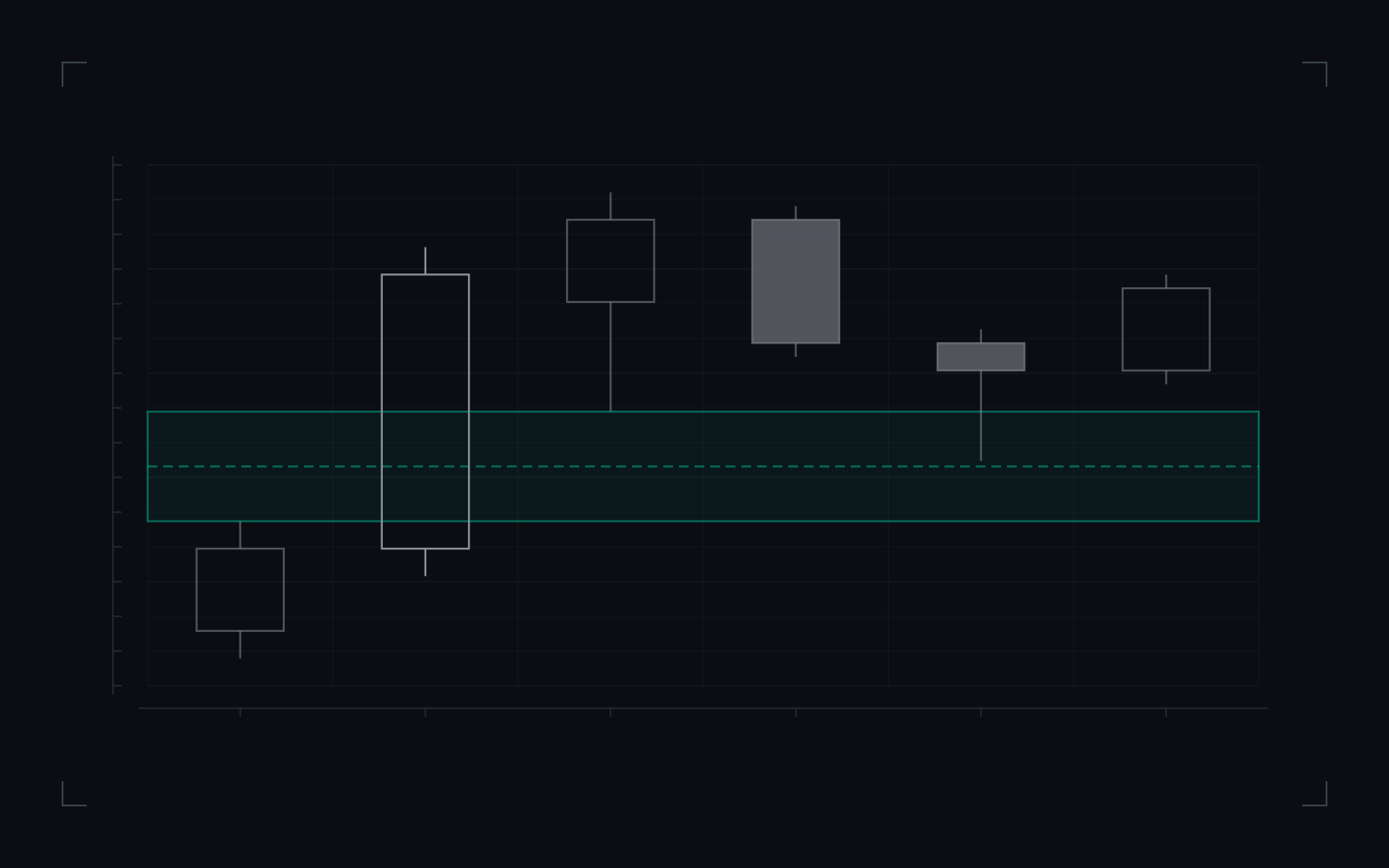
- The middle candle of the three, whose range leaves the first candle’s high and the third candle’s low unable to overlap.
- The fair value gap: the band between the first candle’s high at 10 and the third candle’s low at 14, carried forward.
- Consequent encroachment: the mean of the two boundaries, 12, drawn through the band.
- The return: price comes back into the band and turns just above its midpoint.
A fair value gap and the line through its middle: the band from the first candle’s high to the third candle’s low, its midpoint drawn, and a later return that turns just above that line.
Drawing the midpoint establishes where the line is. It does not establish that the midpoint matters more than any other price inside the gap.
Consequent encroachment (CE): what the definition states, in full.
| Element | What the definition states |
|---|---|
| Construction | The mean of a zone’s two boundaries. |
| On a fair value gap | Consequent encroachment: halfway between the first candle’s high and the third candle’s low (bullish), mirrored for bearish. |
| On a wick | Halfway between the tip of the wick and the body edge it grows from, under the same name. |
| On an order block body | Mean threshold: the same arithmetic under a different name. |
| Touch ruleWhether a wick reaching the line counts, or only a close. The two record different returns. | election pending |
| Not established | That turns cluster at the midpoint more tightly than at other interior lines of the same gaps. |
Commonly confused with
Neighbouring concepts that get used interchangeably, and the distinction that actually separates them.
- Mean threshold
Mean threshold is the fifty-percent line of an order block's body. Consequent encroachment is the fifty-percent line of a fair value gap, or of a wick. The arithmetic is identical and the objects are different, which is why the taxonomy keeps two names for one kind of midpoint.
- Fair value gap
The gap is the band; consequent encroachment is one line inside it. A gap can be touched, reach its midpoint and be filled, and those are three different states of the same object.
- A 50% Fibonacci retracement
A retracement level is measured across a whole swing, from its high to its low. Consequent encroachment is measured across a gap a few prices wide. Both are halfway points, and they sit at different prices because they halve different things.
- The equilibrium of a dealing range
Equilibrium splits a whole dealing range into its premium and discount halves. Consequent encroachment splits one imbalance. A range's midpoint and a gap's midpoint coincide only by accident.
How to measure it in your own data
A definition you cannot test is a definition you have to take on trust. This is the shortest honest route from the concept to a number you computed yourself.
- Records you need
Candle data at a declared timeframe with the fair value gaps already identified under stated rules, since their boundaries fix the midpoint exactly, or the wicks being measured; and a stated touch rule, whether a wick reaching the line counts or only a close.
- What you compute
For each gap, the midpoint is the mean of its two boundaries. Record every return into the gap and whether it turned before the midpoint, at it within a stated tolerance, or passed through it. Compare reaction rates at the midpoint with rates at other interior lines of the same gaps, such as the quarter and three-quarter lines, which is the comparison that decides whether the midpoint is special.
- What the answer tells you
A return into a gap that turns close to its halfway line rather than at its edge. A line through the middle of a band is near where many turns inside that band land by chance, so the picture of price respecting the midpoint is expected even if the midpoint means nothing; only the comparison with other interior lines separates the two.
Questions and answers
What is consequent encroachment in ICT?
The halfway line of a fair value gap: the mean of its two boundaries. ICT treats it as the gap's balance point, reads a return that holds it as the gap doing its job, and reads a close through it as the gap weakening. The same fifty-percent line drawn through a long wick carries the same name.
What is CE in ICT trading?
CE abbreviates consequent encroachment. When a teacher says price respected CE, it means price came back into a gap, reached or approached its midpoint and turned there, rather than filling the gap or turning at its edge.
How is consequent encroachment calculated?
Add the gap's two boundaries and halve the sum. For a bullish gap between a first candle's high of 1.1000 and a third candle's low of 1.1012, consequent encroachment is 1.1006. For a wick, add the tip of the wick and the edge of the body it grows from, and halve that.
What is the difference between consequent encroachment and mean threshold?
The object being halved. Consequent encroachment halves a fair value gap or a wick; mean threshold halves an order block's body. The arithmetic is the same, which is why the two get confused, and the taxonomy keeps them apart because the objects carry different expectations.
Is consequent encroachment the same as a 50% fill?
Close to it. A gap is half filled when price has traded back to its midpoint, which is exactly the consequent encroachment line. The difference is emphasis: fill language describes how much of the gap has been retraced, while consequent encroachment names the line as a reference in its own right.
Does price react at consequent encroachment?
That is a measurement, not a definition. Price turning near a gap's midpoint is expected often by chance, because a turn anywhere inside a band has a good chance of landing near its middle. The question worth answering is whether turns cluster at the midpoint more tightly than at other interior lines of the same gaps.
What is consequent encroachment of a wick?
The halfway point of a candle's wick, between the tip and the edge of the body it grows from. It is used the way a gap's midpoint is: a return that turns on the near side of the line is read as the wick's rejection still standing, and a close beyond it as that rejection being worked through.
Does consequent encroachment apply to order blocks?
Not by that name. The halfway line of an order block's body is called its mean threshold. The arithmetic is the same, and keeping two names lets a reader tell from the word alone whether the line halves a gap, a wick or a block.
Where are stops placed relative to consequent encroachment?
Teaching varies, and each convention is an election: beyond the far edge of the gap, beyond the midpoint, or beyond the swing that created the gap. Each choice changes both how often a position is stopped and what it risks, so results quoted without the convention cannot be compared.
Related terms
Derived from the links this entry makes and the entries that link back to it.
Where the term is in build
Detector datasheets whose concepts include this term, or whose published copy uses it. Each one states the build state it has reached and the parameters it exposes, and carries no measured verdict.