67 / 97
Order block
Working definition
The last candle closing against the direction of a subsequent qualifying move — taught as the footprint of positions built before the move, and drawn as a zone expected to react on revisit.
Every impulsive move leaves a last candle that disagreed with it, and the order block is the taxonomy’s bet that the disagreement was somebody’s position being built.
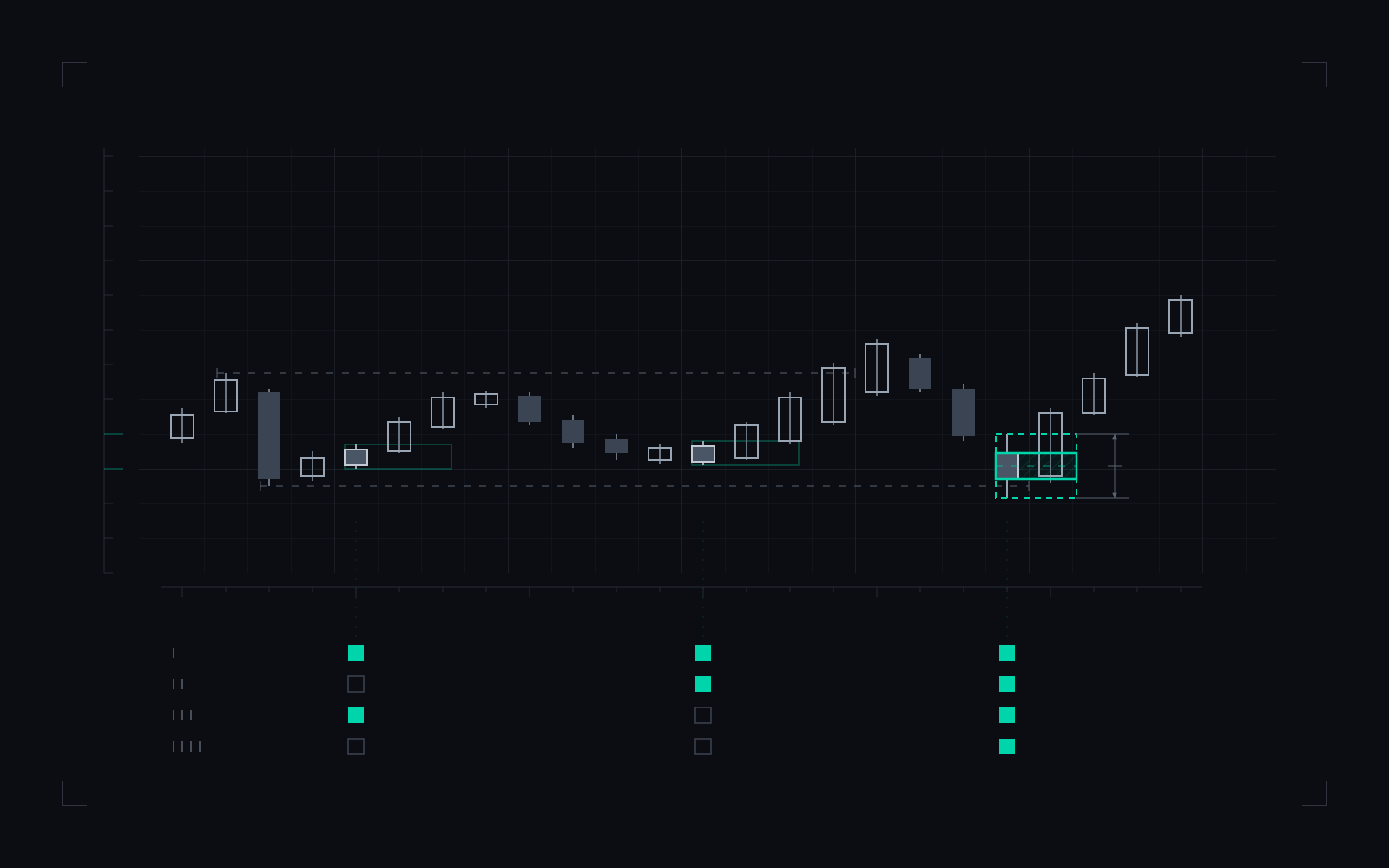
The selection rule is stated easily: the last candle closing against the direction of a subsequent qualifying move — the final down-close before the run higher, or the final up-close before the drop. Everything contestable lives in the word qualifying, and the taxonomy handles it with a ladder of rungs: the last-opposing candle alone; or one whose move also breaks structure; or whose move prints a fair value gap; or whose move followed a liquidity sweep of a prior extreme. Each rung marks a different population of order blocks on the same chart, which is why a block quoted without its rung is not an identification anyone else can reproduce. The zone’s boundaries carry their own election — full range or body only — and the body’s midpoint is tracked as the mean threshold, the interior line revisits are graded against.
The narrative attached to the shape: institutions cannot enter at one price, so they accumulate against the direction they intend, and the last opposing candle is the visible residue of that accumulation — hence a revisit is expected to find the same interest again. That is a story about intent told from geometry, and it belongs to the storyteller. What the geometry actually gives is a reproducible zone-selection procedure, which is more than most drawing conventions can say — a supply or demand zone drawn by eye moves with the eye, while a stated-rung block does not.
Where a block fails, the vocabulary continues without it: consumed after a sweep and a structure break it becomes a breaker block; consumed from a failure swing without the sweep, a mitigation block. The names encode the object’s history, which is the taxonomy at its most systematic.
Bullish and bearish, worked
A bullish order block is the last down-closing candle before a qualifying move up, expected to act as support when price returns. A bearish order block is the last up-closing candle before a qualifying move down, expected to act as resistance. The selection rule and every rung apply identically to both.
A worked case, with constructed numbers. A down candle opens at 1.0835, closes at 1.0822, and prints a high of 1.0838 and a low of 1.0818. The next candles rally to 1.0880, leave a fair value gap on the way, and close above the prior swing high at 1.0865. Under the rung that requires a structure break, the down candle is a bullish order block. Drawn from its body, the zone runs from 1.0822 to 1.0835, thirteen pips, with a mean threshold of 1.08285; drawn from its full range it runs from 1.0818 to 1.0838, twenty pips. One candle, two conventions and two different zones, which is why the boundary election travels with every block.
Identifying one, step by step
- Declare the timeframe and the rung. The same tape marks different blocks at different aggregations, and each rung admits a different population.
- Find a qualifying move. Under the stated rung: any move, a move that breaks structure, a move that prints a fair value gap, or a move that follows a sweep of an extreme.
- Walk back to the last opposing close. The last down-close before a qualifying rally, or the last up-close before a qualifying decline.
- Draw the zone and its midpoint. Body or full range, by the stated election, with the mean threshold marked.
- Carry it forward under a respect rule. A return that turns inside the zone is respected; a trade through its far edge, by close or by wick as the stated rule elects, is a violation, and the block’s later history, as a breaker or a mitigation block, begins there.
Valid, invalid, and the look-ahead trap
Popular filters for telling a real block from a weak one fall into two kinds. Some are selection rules that can be applied the moment the move completes: the move broke structure, arrived with displacement, followed a sweep of an extreme, or held beyond the block’s range for a stated number of candles afterwards. Each is a rung or an extra election, and each can be stated in advance.
Others cannot. A filter that says a real block is one price comes back to, or one that produced a clean reaction on the retest, can only be applied after the return has happened. Counting only those blocks is selecting on the outcome, and a study built that way will find that the blocks it kept behaved well, because the ones that did not were removed before the count began. The same trap hides in the complaint that most traders over-mark blocks: the cure is a rung stated before the chart is read, not a judgement made after it.
The order block family
The vocabulary names what happens to a block after it prints, and each name is a distinct construction with an entry of its own:
- Breaker block. A block consumed by a move that first swept a prior extreme and then broke structure, after which the failed zone is expected to work in the opposite role.
- Mitigation block. The same failure and flip, reached from a failure swing with no sweep first.
- Propulsion block. A block that forms while price trades back into an earlier block: the candle that revisits the older zone, holds it and drives price away.
- Rejection block. Not a candle body at all, but the wick of a candle at a swing high or low, between its body and the wick’s tip.
Two words in common use describe states rather than objects. An unmitigated block is one price has not yet returned to; a mitigated block is one price has come back into, whether or not it held. Neither word names the mitigation block, and the shared root makes the two easy to confuse.
Order blocks, rejection blocks and supply and demand zones
Three zone conventions are often drawn on the same candles. An order block is one candle, the last to close against a qualifying move, drawn from its body or its full range. A rejection block is drawn from a wick: the part of a swing candle’s range that price reached and left, between the body and the wick’s tip. A supply or demand zone is drawn around the base a strong move departed from, which may be one candle or a small cluster, with boundaries set by a base rule or by eye. The order block is the most tightly specified of the three, because its selection rule names exactly one candle; the supply and demand zone is the loosest, because the base is chosen. Where the three overlap on a chart, they are three descriptions of one area, not three confirmations of it.
With fair value gaps
The move that qualifies a block often leaves a gap just beyond it, and teaching reads the two together: the block as the origin of the move, the gap as the imbalance it left. That raises an election readers often skip. Entering at the gap’s edge, at its consequent encroachment, or at the block’s mean threshold are three different trades with different stops, and a result for one says nothing about the others. The ICT unicorn model is the case where a gap overlaps a breaker block formed in the same move, and the entry is confined to the prices the two share.
Timeframes and refinement
The definition prefers no timeframe; every block is quoted with the one that made it. Teaching commonly works across two: a block located on a higher timeframe, such as the four-hour or daily chart, and a block inside it on a lower timeframe used for the entry. The refined block is narrower, which tightens the stop and also makes the zone easier to miss, since price can turn inside the higher-timeframe block without ever reaching the lower-timeframe one. Refinement is a rule with a cost on both sides, and a result quoted for refined entries does not describe unrefined ones.
Trading one, as taught
The taught trade carries three elections, and each one changes the result. The entry: at the first touch of the zone’s near edge, at the mean threshold, or after a lower-timeframe confirmation such as a market structure shift inside the zone. The stop: beyond the far edge, or beyond the swing the qualifying move started from. The target: commonly the resting liquidity on the other side, the prior swing high or low that the draw on liquidity names, or the next opposing block. A first-touch entry is taken at every block price reaches, including the ones price goes straight through, which a confirmation rule would skip; a confirmation entry is taken on fewer blocks, and later. None of that is a property of the block. It is the trade built on the block, and it travels with any result.
The order block indicator draws blocks by the same ladder, with the rung, the full-range or body election and the mean threshold line stated on the chart, so that a block on a screen can be traced back to the rule that selected it.
The same rule in gold and index futures
The rule is unit-free, so the arithmetic changes and nothing else does. Constructed numbers again. In gold, quoted in dollars an ounce, a one-hour down candle opens at 3,412.40, closes at 3,405.10, and prints a high of 3,414.00 and a low of 3,402.80 before a rally that closes above the prior swing high. The body zone runs from 3,405.10 to 3,412.40, 7.30 wide, with a mean threshold of 3,408.75; the full range runs from 3,402.80 to 3,414.00, 11.20 wide, and a stop beyond the far edge sits 2.30 lower under the full-range election. In an equity index future that trades in quarter-point ticks, a five-minute down candle with a body from 21,420.25 to 21,431.50 and a range from 21,416.00 to 21,433.75 gives a body zone 11.25 points wide and a full-range zone 17.75 points wide, with the far edges 4.25 points apart. Its body midpoint, 21,425.875, falls between ticks, so a mean-threshold order has to be rounded to a price the contract can trade, and the direction of the rounding is one more election.
Markets and the volume question
The selection rule needs nothing but candles, so it applies to any market that prints them. Some listings add a volume spike at the block as a further sign of large participation. In spot currency markets there is no consolidated volume, only one venue’s or one broker’s activity, so that filter measures a feed rather than the market; the difference is the subject of this glossary’s order flow entry. Where volume is exchange-reported, as in futures, the filter at least measures the same thing everywhere.
Common misuses
Four habits make order-block claims impossible to check. Marking a block on every opposing candle, which produces zones everywhere and a match for any reaction. Changing the rung after the chart has moved, so that the block that held is always the one the rule selected. Treating body and full range as interchangeable, which lets one block be two sizes at once. And quoting a result without its timeframe, which leaves the reader unable to find the same blocks at all.
What was measured
On the question that matters — whether revisits actually react — this site did the unusual thing and measured one version of it: do order blocks predict anything tested block-revisit behaviour on this estate’s own data and published the result with its hash-verified artifact, including what could not be established and why. That page, not this one, is where the evidence lives; a glossary owes the definition, the two lenses, and the honesty to keep the two apart.
Where it sits in the ICT sequence
The ICT vocabulary in the order the method is taught, with a step for each kind of object.
- Step
- 06 of 08 Blocks: the candles that mark a return zone, and what became of them
- Also at this step
- Breaker block, Mitigation block, Rejection block, Propulsion block
- Before it
- Volume imbalance
- After it
- Breaker block
The shape, drawn
The smallest arrangement the definition admits. It is a drawing of a rule, not a reading of a market — nothing here is measured, and the table below it is the authoritative version.
The candle the rule selects, and the elections that selection still carries: which of the down-closing candidates qualifies depends on the rung applied, and the zone is either the candle’s full range or its body alone.
Selecting a candle establishes which object the rule names. It does not establish that the zone holds, or that price reacts to it at all.
Order block, bullish form: what the definition states, in full.
| Element | What the definition states |
|---|---|
| Selection | The last opposing candle before a move that qualifies under the validation rung in force. |
| ZoneTwo conventions are in circulation and they enclose different areas: the candle’s full range, or its body only. | election pending |
| Mean threshold | The midpoint of the block candle’s body, whichever zone convention is elected. |
| Validation rungLast-opposing alone, plus a structure break, plus an imbalance, or plus a prior sweep. The rungs do not nest — a structure break and an imbalance admit different candidates, so the choice changes the population rather than narrowing it. | election pending |
| InvalidationWick-through versus close-through is an election, not a fact. | election pending |
| Not established | Whether the zone holds, how often it is revisited, or what a revisit is worth. |
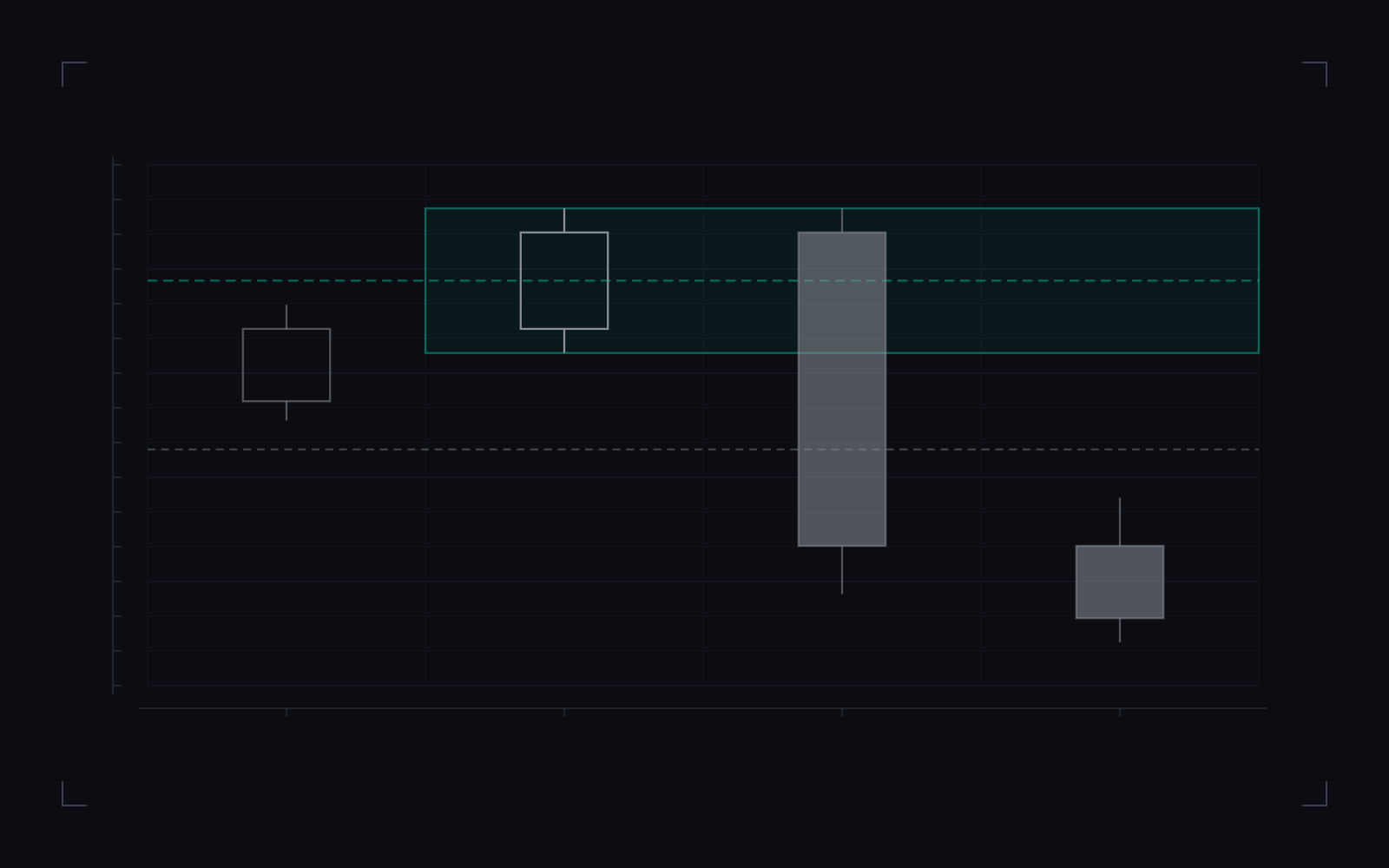
- Rising candles before the move. A rising body is hollow, as in the bullish form.
- The last up-closing candle before the move down. The rule selects this one.
- The prior swing low. The move’s close beneath it is the structure break the rung asks for.
- The bearish order block: the selected candle’s range carried forward, full range or body alone by election.
- The mean threshold: the midpoint of the block candle’s body.
The mirror selection: the last up-closing candle before a move down that closes beneath the prior swing low. The zone carries the same full-range or body-only election as the bullish form.
Selecting the candle establishes which object the rule names on the way down. It does not establish that a return from below stalls in the zone.
Order block, bearish form: what the definition states, in full.
| Element | What the definition states |
|---|---|
| Selection | The last up-closing candle before a move down that qualifies under the validation rung in force. |
| Structure breakUnder the rung that requires one. The imbalance and prior-sweep rungs admit different candles. | A close beneath the prior swing low. |
| ZoneFull range or body alone, the same election the bullish form carries. | election pending |
| Expected role | Resistance on a return from below. |
| Not established | Whether a return from below stalls in the zone, or how often it does. |
Commonly confused with
Neighbouring concepts that get used interchangeably, and the distinction that actually separates them.
- A supply or demand zone
Supply-and-demand drawing marks the base of a departure — often several candles of consolidation — by eye and by departure strength. The order block is one specific candle selected by a stated rule: the last one closing against the move. Overlapping intuitions, different selection procedures, different zones on the same chart.
- A support or resistance level
Classical levels are horizontal prices earning their status through repeated touches. An order block is a zone with two boundaries from a single candle's geometry, created by one event and expected to matter on first revisit — before any touch history exists.
- Breaker block
A breaker is an order block that failed — consumed by a move that swept a prior extreme and broke structure — after which the taxonomy expects it to work in the opposite role. Every breaker was an order block first; the failure and the flip are what change the name.
- Mitigation block
The same flip construction as the breaker but without the preceding sweep — the origin is a failure swing rather than a raid on an extreme. The sweep-versus-no-sweep distinction is the entire difference, and the taxonomy keeps separate names for it.
How to measure it in your own data
A definition you cannot test is a definition you have to take on trust. This is the shortest honest route from the concept to a number you computed yourself.
- Records you need
Candle data at a declared timeframe, plus the stated qualifying rule for the move that follows — the validation ladder rung in use — and the boundary election: full candle range, or body only.
- What you compute
Identify candles closing against the subsequent move; qualify them by the declared rung — last-opposing candle alone, or additionally requiring a structure break, a fair value gap in the move, or a prior sweep of an extreme. Zone boundaries per the stated election; the body midpoint is tracked as the mean threshold. State respected or violated on revisit by the declared touch rule.
- What the answer tells you
A final down-close before an impulsive run higher — or the mirror — with the zone drawn from that candle and a later return trading into it. Whether the return reacts there more than at a comparable arbitrary level is the measured question, and this site has published one answer to it.
Questions and answers
What is an order block in trading?
The last candle that closed against a move which then qualified — by nothing further, or by breaking structure, printing an imbalance, or following a sweep, depending on the rule in use. The taxonomy reads it as where positions were built before the move and expects revisits to react there.
How is an order block identified precisely?
By a selection rule plus a validation rung, both stated: the last opposing close before the move, qualified by nothing further, or by a break of structure, or by a fair value gap printing inside the move, or by a prior liquidity sweep. Each rung marks a different set of candles, which is why an unstated rule cannot be checked.
Do order blocks actually predict anything?
This site tested one operationalisation of that question on its own data and published the result with the artifact — the research page linked from this entry carries what was found, what survived, and what could not be established. A definition is not evidence; the linked measurement is what evidence looks like either way.
What is the difference between bullish and bearish order blocks?
Mirror geometry. A bullish order block is the last down-close before a qualifying move up — the zone expected to hold as support on revisit. A bearish order block is the last up-close before a qualifying move down. One selection rule, two orientations; the validation rungs apply identically to both.
What is the mean threshold of an order block?
The midpoint of the block candle's body — the taxonomy's reference line inside the zone, with revisits above or below it read differently. It is a defined line with an undefined privilege: whether the midpoint matters more than any other interior level is a measurable claim, not a given.
What is the difference between an order block and a rejection block?
The part of the candle the zone is drawn from. An order block is drawn from the body or the full range of the last candle closing against a qualifying move. A rejection block is drawn from the wick of a candle at a swing high or low, between the body and the wick's tip, the stretch of range price reached and refused. The taxonomy expects price to react at both; they are built from different evidence on the same chart.
Which timeframe is best for order blocks?
None by definition. An order block is identified on candle data at a declared timeframe, and the same tape aggregated differently marks different last opposing candles, so a block is quoted with its timeframe. Teaching often locates a block on a higher timeframe and refines the entry to a block inside it on a lower one, which narrows the zone and makes it easier to miss. Whether blocks from one aggregation react more reliably than another's is a measured comparison, not something the selection rule settles.
How do you identify a valid order block?
By rules stated before the chart moves on: a declared timeframe, a qualifying move under a stated rung (a structure break, a fair value gap in the move, or a prior sweep), the last opposing close before that move, and a boundary election. Filters that need price to come back to the block first select on the outcome, and cannot tell a valid block from a lucky one.
What happens when an order block fails?
It is not discarded. Consumed after a sweep and a structure break, it is renamed a breaker block and expected to work in the opposite role; consumed from a failure swing without the sweep, a mitigation block. A candle that revisits a block and holds it can become a propulsion block, stacked on the original.
Where is the stop placed on an order block trade?
Conventionally beyond the far edge of the zone, sometimes beyond the mean threshold for a tighter version, and sometimes beyond the swing the qualifying move started from. Each convention changes both how often the position is stopped and what it risks, so a result quoted without its stop rule cannot be compared with another.
Related terms
Derived from the links this entry makes and the entries that link back to it.
Where the term is in build
Detector datasheets whose concepts include this term, or whose published copy uses it. Each one states the build state it has reached and the parameters it exposes, and carries no measured verdict.