26 / 97
Draw on liquidity (DOL)
Written DOL throughout.
Working definition
The pool of resting orders price is expected to reach next, such as an old high or low or an unfilled gap. ICT uses it as the destination a directional bias points at.
Every chart has more than one place price could go next, and the draw on liquidity is the ICT habit of choosing one of them in advance.
The nomination, stated
Resting orders sit at obvious prices on both sides of the market: above old highs, below old lows, at equal highs and lows, and inside unfilled gaps. The buy-side and sell-side liquidity entry lists them as a map. The draw on liquidity is a nomination on that map: the one pool the method expects price to reach next. Once the draw is named, the day’s bias follows from it, bullish if the draw sits above price and bearish if it sits below.
The nomination has inputs, and each is a parameter. The timeframe the pools are read on, usually daily or four-hourly. The candidate set, meaning which pools count. The selection rule, meaning how the most recent structure and displacement point at one of them. And the horizon, how long price has to reach the draw before the nomination is scored as missed.
External and internal range
Teaching sorts the candidates into two kinds. External range liquidity is the orders beyond a dealing range’s high and low. Internal range liquidity is the imbalances inside the range, the unfilled fair value gaps price left on the way. The taught rhythm is that price travels from one kind to the other, running an external pool and then returning to an internal gap, or filling a gap and then running for the range’s edge. The rhythm is often used to choose the draw: after an external pool has just been taken, the next draw is expected to be internal.
A worked nomination
Constructed numbers. EUR/USD sits between yesterday’s high at 1.0950 and an unfilled daily gap from 1.0880 to 1.0895. This morning price trades up to 1.0958, above yesterday’s high, closes back beneath it in a liquidity sweep, and the four-hour chart prints a bearish market structure shift. By the rotation rule, the external pool above the range has just been taken, so the draw is internal: the gap. The nomination is met if price trades into 1.0895 before it trades back above 1.0958, and missed otherwise.
Scoring a draw
A nominated draw is a forecast, and forecasts about which of two prices is reached first have a demanding baseline. The nearer pool is reached first often for no reason except that it is nearer, and with only two candidates one of them usually wins within a day or two. A nomination rule carries information only if it picks the pool reached first more often than a rule that simply names the nearest one, or picks at random among pools at comparable distance. The detector campaign registers exactly that scoring, a draw-on-liquidity nominator with a resolution ledger, in the claims ledger. Its verdict renders on that row, and the two lenses keep the nomination, which is a stated rule, apart from its accuracy, which is a measured rate.
Where it sits in the ICT sequence
The ICT vocabulary in the order the method is taught, with a step for each kind of object.
- Step
- 03 of 08 Liquidity: the resting orders, and whether price has taken them
- Also at this step
- Buy-side and sell-side liquidity, ICT daily bias, Liquidity sweep, Inducement, Judas swing, Turtle soup, Candle range theory (CRT), SMT divergence
- Before it
- Buy-side and sell-side liquidity
- After it
- ICT daily bias
The shape, drawn
The smallest arrangement the definition admits. It is a drawing of a rule, not a reading of a market — nothing here is measured, and the table below it is the authoritative version.
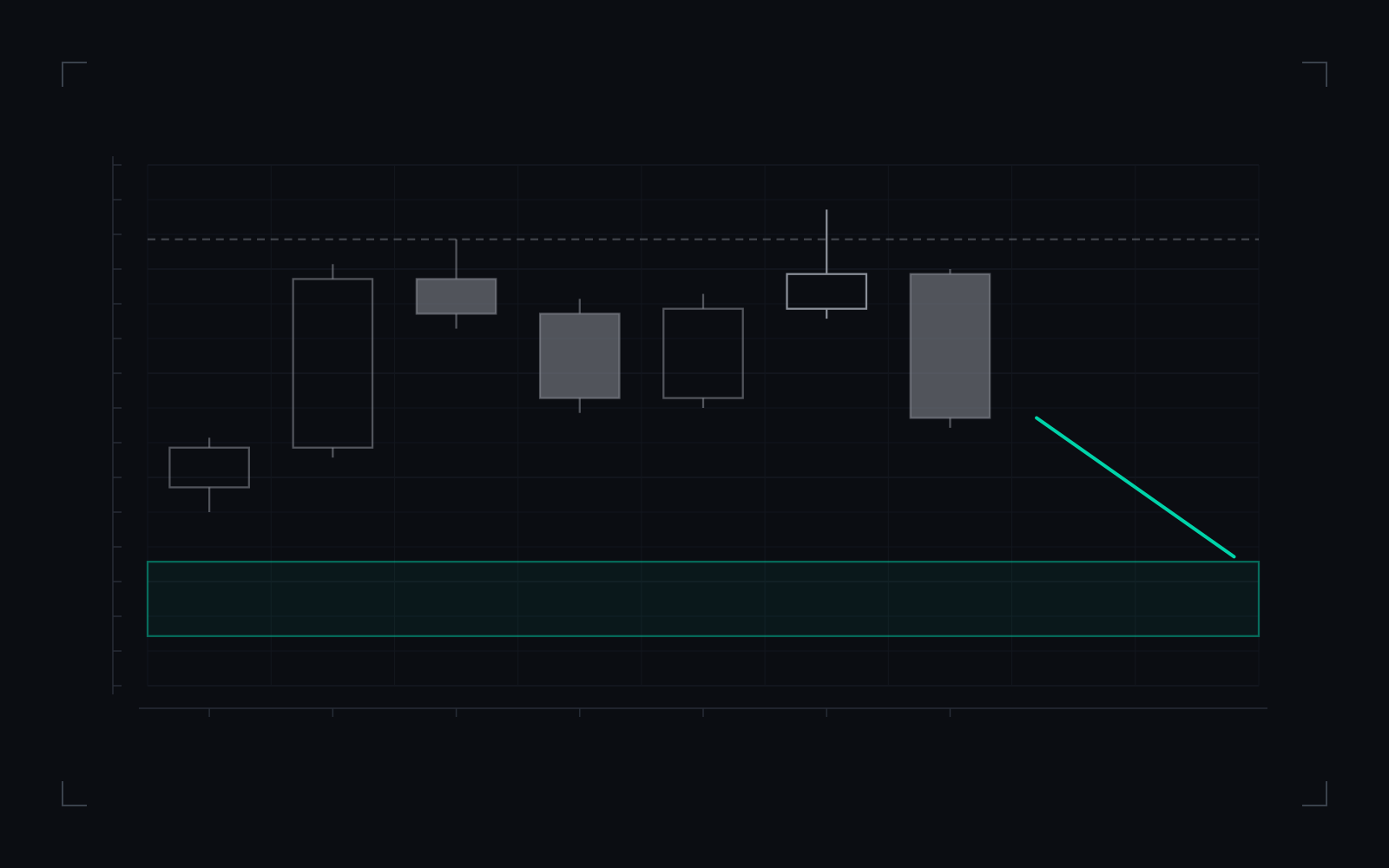
- The prior high: buy-side liquidity, the external pool above the range.
- The candle that trades above the high and closes back beneath it: the external pool has been taken.
- An unfilled gap below, left by earlier trade: internal range liquidity.
- The nomination: the pool the rule names next. A stated expectation, not a path price has taken.
A nomination between two candidates: the pool above the range has just been swept, so the rotation rule names the unfilled gap below as the draw. Nothing to the right of the last candle has happened.
Drawing a nomination establishes what the rule chose. It does not establish that price reaches the chosen pool first, or more often than the nearest pool would be reached.
Draw on liquidity (DOL): what the definition states, in full.
| Element | What the definition states |
|---|---|
| Candidates | Pools under stated rules: prior highs and lows, equal highs and lows, unfilled fair value gaps. |
| External range liquidity | Orders beyond a dealing range’s high and low. |
| Internal range liquidity | Imbalances inside the range, such as unfilled gaps. |
| Selection ruleHow structure, displacement and the last pool taken pick one candidate. Stated in advance, or any outcome fits. | election pending |
| HorizonHow long price has to reach the draw before the nomination is scored as missed. | election pending |
| Not established | That the nominated pool is reached first more often than the nearest one, or a random one at comparable distance. |
Commonly confused with
Neighbouring concepts that get used interchangeably, and the distinction that actually separates them.
- Buy-side and sell-side liquidity
Buy-side and sell-side liquidity are every pool on the chart, above and below price. The draw on liquidity is the one the method expects price to reach next. The pools are a map; the draw is a nomination on it.
- Daily bias
Bias is the expected direction for the day. The draw on liquidity is the price that direction is expected to reach. Teaching usually derives one from the other: name the draw, and the bias is whichever way it lies.
- A price target
A target in the ordinary sense is any objective a trader sets. The draw on liquidity is chosen by rule from resting-order candidates, an old high or low or an unfilled gap, and it is judged by whether price reaches it first, which makes it a forecast rather than a preference.
- Liquidity sweep
The sweep is what happens when price reaches a pool and closes back inside the range. The draw on liquidity is the prediction that price will reach the pool at all. A draw can be met by a sweep, met by a breakout that holds, or not met.
How to measure it in your own data
A definition you cannot test is a definition you have to take on trust. This is the shortest honest route from the concept to a number you computed yourself.
- Records you need
Candle data at the timeframe the nomination is made on and the one it is judged on; a registry of candidate pools under stated rules, such as prior highs and lows, equal highs and lows and unfilled fair value gaps; the rule that nominates one of them; and a horizon.
- What you compute
At each nomination, record which candidate the rule named and the distance to every other candidate. Score whether the named pool was reached first within the horizon. Compare that hit rate with a naive rule that names the nearest pool, and with one that picks at random among pools at comparable distance, because the nearest pool is reached first often for no reason except distance.
- What the answer tells you
A daily chart with an obvious old high above and a gap below, a bias drawn toward the high, and price later reaching it. The picture persuades after the fact because, with only two candidates, one of them is often reached first anyway; what matters is whether the nomination picks the one reached first more often than distance alone would.
Questions and answers
What is DOL in ICT?
DOL stands for draw on liquidity: the pool of resting orders price is expected to reach next. ICT identifies it on a higher timeframe, usually an old high or low or an unfilled fair value gap, and uses it as the destination a directional bias points at.
What does draw on liquidity mean?
That price is drawn toward places where orders rest. The phrase names both the idea and the specific pool nominated: the draw on liquidity for the day might be the previous day's high, meaning the method expects price to trade there before it reaches the opposite pool.
How do you find the draw on liquidity?
As taught: on a higher timeframe, list the obvious pools either side of price, such as old highs and lows, equal highs and lows and unfilled gaps, and choose the one the current structure and the most recent displacement point toward. That choice is a rule, and stated precisely it can be checked against what price did.
What is the difference between external and internal range liquidity?
External range liquidity is the resting orders beyond a dealing range's high and low. Internal range liquidity is the imbalances inside the range, such as fair value gaps. The taught rhythm is that price travels from one to the other, so a draw is often the opposite kind from the pool just reached.
What is the difference between a draw on liquidity and a bias?
The draw is a price; the bias is a direction. Teaching usually names the draw first and reads the bias from it: if the nominated pool is above price the day is bullish, and if below, bearish. A bias without a named draw cannot be scored, because it never says how far.
Is the draw on liquidity reliable?
Only a scored record can say. The honest scoring compares the nominated pool with the nearest pool and with a random pool at comparable distance, because nearby pools are reached first often for no reason other than distance. A nomination that beats those baselines carries information; one that does not is distance with a name.
Related terms
Derived from the links this entry makes and the entries that link back to it.