94 / 97
Turtle soup
Working definition
A fade of a failed breakout: price trades beyond a prior multi-period high or low, the break fails to hold, and the trade is taken back the other way. Named for the Turtle traders, whose breakout entries it bets against.
Every breakout rule produces a population of breakouts that fail, and turtle soup is a rule for making a meal of them.
Where the name comes from
In the early 1980s Richard Dennis and William Eckhardt trained a group of novice traders, the Turtles, whose best-known entries bought breaks above twenty-day and fifty-five-day highs and sold breaks below the matching lows. Breakout rules of that kind are built to catch the minority of breaks that become long trends, and to absorb many small failures along the way. In Street Smarts (1995), Linda Bradford Raschke and Laurence Connors published a short-term pattern that took the other side of those failures, and named it after the traders it fed on.
The original rule is specific. The market makes a new twenty-day low. The previous twenty-day low must be at least four sessions old, so the level is established rather than a fresh extreme from the day before. Once price has traded beneath that old low, a buy order is placed back at it, and the position is protected just beneath the new low. The short side mirrors it at twenty-day highs. A variant waits one more session, requiring the new low to close beyond the old one before the fade is taken the following day.
How ICT uses the name
The ICT vocabulary kept the idea and loosened the parameters. In ICT usage turtle soup names a failed break of an old high or low more generally, the prior day’s, week’s or session’s extreme, traded through, reclaimed, and read as a raid on the resting orders beyond the level before a move the other way. That is the liquidity sweep with a particular kind of extreme as its reference. It sits beside the judas swing, which adds a session open, and candle range theory, which uses a single higher-timeframe candle’s range, and on some charts all three names describe the same move.
The two parameterisations are not interchangeable. A twenty-day extreme at least four sessions old is rare, deliberately so. A prior day’s high is available every day. Results for one say nothing about the other, which is why the detector campaign registers turtle soup with both parameterisations as separate configurations in the claims ledger.
The pattern on a chart
Worked with constructed numbers. On a daily chart the lowest low of the past twenty sessions is 1.3200, set six sessions ago. Today price falls to 1.3182, a new twenty-day low, then recovers and trades at 1.3205 by the afternoon. Under the original rule the old low was old enough, price traded beneath it and came back through it, so the fade triggers at 1.3200 with protection beneath 1.3182. Under the ICT reading the same day is a sweep of an old low followed by a reclaim. What happens over the following sessions is part of neither definition.
What the fade has to show
The logic of turtle soup is a claim about conditional frequency: breaks of established extremes fail and reverse more often, or further, than breaks in general, and the age condition picks out the ones most likely to. Each half can be tested. The fade can be set against breaks of the same extremes that held, and the four-session condition against breaks of extremes too recent to qualify. A rule that has circulated for three decades has had time to be repeated with confidence, and repetition is not an input a measurement accepts; the two lenses keep the published rule and its performance apart.
Where it sits in the ICT sequence
The ICT vocabulary in the order the method is taught, with a step for each kind of object.
- Step
- 03 of 08 Liquidity: the resting orders, and whether price has taken them
- Also at this step
- Buy-side and sell-side liquidity, Draw on liquidity (DOL), ICT daily bias, Liquidity sweep, Inducement, Judas swing, Candle range theory (CRT), SMT divergence
- Before it
- Judas swing
- After it
- Candle range theory (CRT)
The shape, drawn
The smallest arrangement the definition admits. It is a drawing of a rule, not a reading of a market — nothing here is measured, and the table below it is the authoritative version.
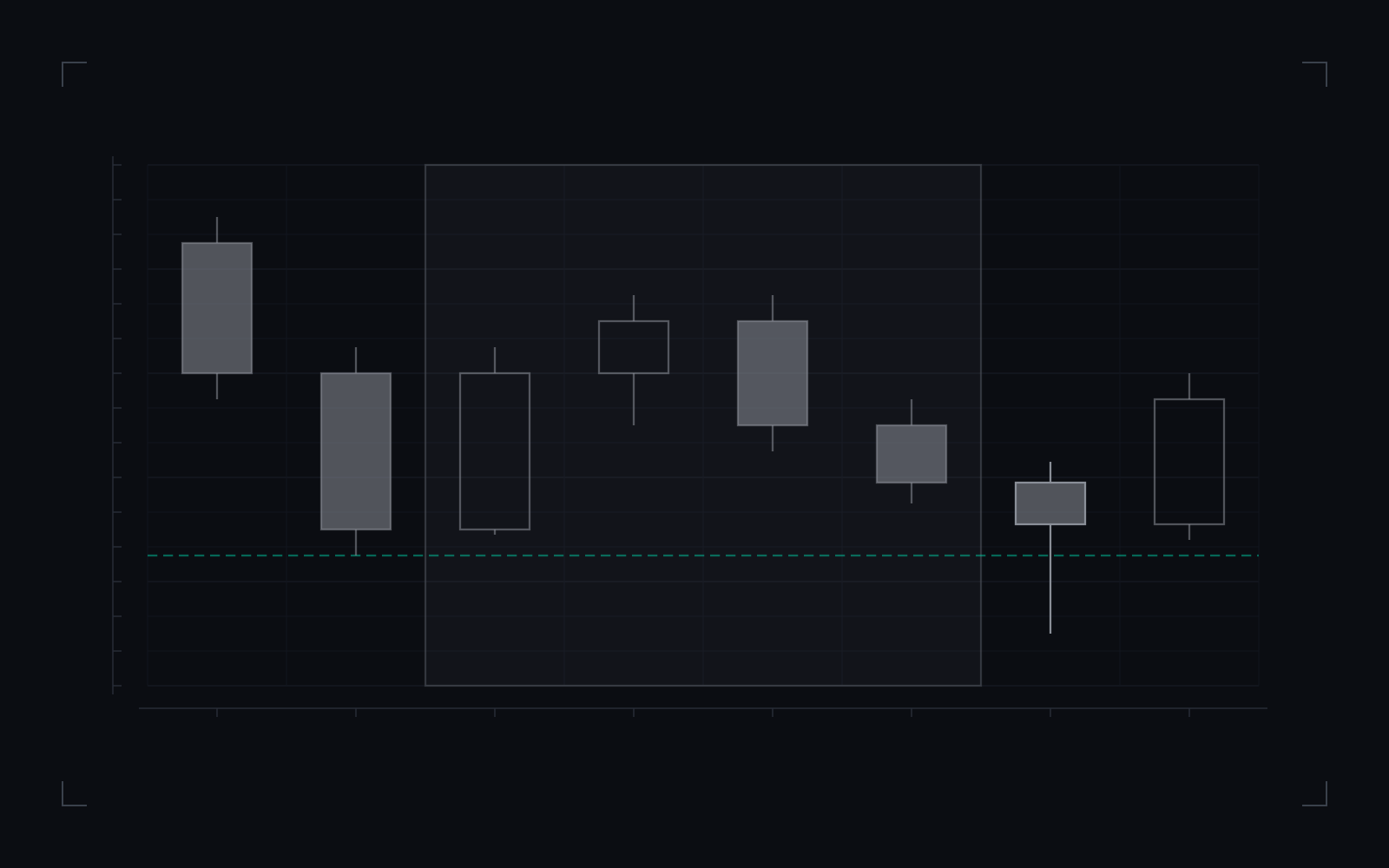
- The lowest low of the lookback, set by the second candle. In the original rule it must be at least four sessions old when it is broken.
- The sessions between the old low and the break: the age condition, drawn as a span.
- The session that trades beneath the old low and closes back above it: the failed break the pattern takes the other side of.
- Sessions trading down toward the old low, drawn with filled bodies.
The failed break the pattern fades: an established low, sessions of trade above it, then a session that trades beneath the low and closes back above it.
Drawing the failed break establishes that the arrangement occurred. It does not establish that the reclaim holds, or that fading it earns anything.
Turtle soup: what the definition states, in full.
| Element | What the definition states |
|---|---|
| Lookback extremeTwenty periods in the original rule. ICT usage applies the name to prior-day, prior-week and session extremes as well. | The lowest low, or highest high, of a stated lookback. |
| Age conditionFour sessions in the original rule; ICT usage drops the condition. | The prior extreme is at least a stated number of sessions old when it is broken. |
| Break | Price trades beyond the extreme. |
| ReclaimBack through the level within the same session, or a close beyond it first and the fade on the next session, as in the variant. | election pending |
| Not established | Whether failed breaks of established extremes reverse more often, or further, than breaks in general. |
Commonly confused with
Neighbouring concepts that get used interchangeably, and the distinction that actually separates them.
- Liquidity sweep
The sweep is the general event, a trade through any qualifying prior extreme and a close back inside. Turtle soup is a sweep of one kind of extreme, the highest high or lowest low of a stated lookback, and in its original form it also requires that extreme to be several sessions old.
- The Turtle breakout rule
The Turtle rule bought new twenty-day highs and sold new twenty-day lows, expecting some breaks to run into trends. Turtle soup takes the other side of exactly those breaks, expecting some to fail. Same levels, opposite bets, and the name is the joke.
- Judas swing
The judas swing is tied to a session open: the first push after a declared open runs a pool and reverses. Turtle soup has no clock, only a lookback. An early-session failure at the prior day's high can satisfy both at once.
- Candle range theory
Candle range theory takes one higher-timeframe candle's range as its reference. Turtle soup takes the extreme of a multi-period lookback. With a one-day reference, the two can mark the same failed break of the prior day's high or low.
- A false breakout
False breakout is the classical description of the outcome, any break that does not hold. Turtle soup is a rule for trading it, with the lookback, the minimum age of the extreme and the entry back at the level all specified.
How to measure it in your own data
A definition you cannot test is a definition you have to take on trust. This is the shortest honest route from the concept to a number you computed yourself.
- Records you need
Daily or intraday candle data; the lookback that defines the extreme, twenty periods in the original rule; the minimum age of the prior extreme, four sessions in the original; the reclaim rule; and the horizon over which the fade is judged.
- What you compute
Flag each period that trades beyond the lookback extreme when the prior extreme is at least the stated age, and record whether price came back inside and how far it then travelled. Compare those outcomes with breaks of the same extremes that were too recent to qualify, and with breaks that held, so that the age condition and the fade are each tested against something.
- What the answer tells you
A market pressing to a new twenty-day low, trading a little beneath the old one, and recovering back above it within the session or the next. Whether that recovery persists more often than after breaks of fresh extremes is the question the rule's name leaves open.
Questions and answers
What does turtle soup mean in trading?
A fade of a failed breakout. Price trades beyond an established high or low, fails to hold there, and the trade is taken back through the level in the other direction. The name is a joke at the expense of breakout traders, whose failed entries the pattern feeds on.
Why is it called turtle soup?
Because it feeds on the Turtles, the traders Richard Dennis and William Eckhardt trained in the early 1980s, whose best-known entries bought breaks of twenty-day highs and sold breaks of twenty-day lows. The fade of those breaks was named after the traders whose entries it took the other side of.
Who created the turtle soup strategy?
It was published by Linda Bradford Raschke and Laurence Connors in Street Smarts (1995), as a short-term pattern fading failed breaks of twenty-day extremes. The ICT community later adopted the name for failed sweeps of old highs and lows more generally.
What are the turtle soup rules?
In the original: the market makes a new twenty-day low; the previous twenty-day low is at least four sessions old; once price has traded beneath that old low, a buy order is placed back at it, with protection just under the new low. The short side mirrors it at highs. A variant waits for the new low to close beyond the old one and takes the fade the next session.
How is ICT turtle soup different from the original?
ICT usage keeps the idea, a failed break of an old extreme taken back the other way, and loosens the parameters, applying the name to failed sweeps of the prior day's, week's or session's high or low without the twenty-day lookback or the four-session age. The two versions mark different events and have to be tested separately.
Is turtle soup trading effective?
Any outcome depends on the lookback, the age condition, the entry and exit rules, costs and the market, and a figure quoted without all of them cannot be checked. What can be measured cleanly is whether failed breaks of qualifying extremes travel back further than failed breaks of extremes that do not qualify.
Does the turtle trading strategy still work?
That question is about the breakout system turtle soup bets against, not about turtle soup itself. Both are rules whose results depend on the period, the market and the costs, which is what any measurement of either has to hold fixed.
Related terms
Derived from the links this entry makes and the entries that link back to it.