93 / 97
Trailing Drawdown
Working definition
A drawdown limit measured from an account's high-water mark rather than its starting balance, so that the termination floor rises as the account makes new highs and never retreats.
A static drawdown limit asks one question: how far below the starting balance is the account allowed to fall? A trailing drawdown asks a harsher one: how far below its best moment is the account allowed to fall? The floor is defined as the high-water mark minus a fixed allowance, and it ratchets — it moves up and never back down, so the account’s past success continuously raises the bar for its survival. What counts as the high-water mark is the detail that decides accounts, and it is not uniform: under an intraday rule the mark follows equity including unrealised profit, so a floating high you never banked still drags the floor up; under an end-of-day rule it follows a daily balance, so the same floating high does not move the floor at all. Which one governs is a property of the rule text rather than of the phrase “trailing drawdown”.
The rule is standard in prop-firm evaluations, and its variants differ in one detail that dominates everything else: what counts as the high-water mark. End-of-day trailing uses the closed daily balance. Intraday trailing uses the equity peak including open positions — meaning an unrealised profit spike that was never banked still raises the floor. Under that variant, a winning trade that surges and then retraces can single-handedly end the evaluation: the surge lifts the floor, the retrace crosses it, and the account is breached by a trade that closed green. The account is killed by its own unrealised high.
The arithmetic deserves more respect than it gets. The allowance quoted in the rules is not the room the trader has; the room is the allowance minus the current distance below the high-water mark, and it shrinks with every new peak. Some rules stop the ratchet once the floor reaches the starting balance, which caps the damage; others state no ceiling at all and the floor keeps climbing for as long as the account does. Whether yours locks is worth reading rather than assuming, because the two produce very different accounts from the same run. Position sizing that conditions on account balance is therefore conditioning on the wrong variable — the operative quantity is distance-to-floor, restated after every equity high. A ratcheting floor also converts volatility itself into risk: the same drawdown excursion that a static limit absorbs can breach a trailed one, so the risk of ruin against a trailing barrier is strictly higher at identical sizing. The Prop-Evaluee Risk Guardian I am building is intended to compute that halt distance live, against the evaluation’s actual rules rather than the trader’s recollection of them.
The trailing drawdown calculator computes that distance from your own numbers and shows the arithmetic. If you are not sure which variant your agreement describes — and the phrase alone does not say — work out which drawdown rule you have first: it classifies from the rule text, and where the text does not settle it, computes the floor under every reading still possible. The distance is only half the question — the other half is how likely your sizing is to cross it before the evaluation ends, which is what the risk of ruin calculator computes.
The shape, drawn
The smallest arrangement the definition admits. It is a drawing of a rule, not a reading of a market — nothing here is measured, and the table below it is the authoritative version.
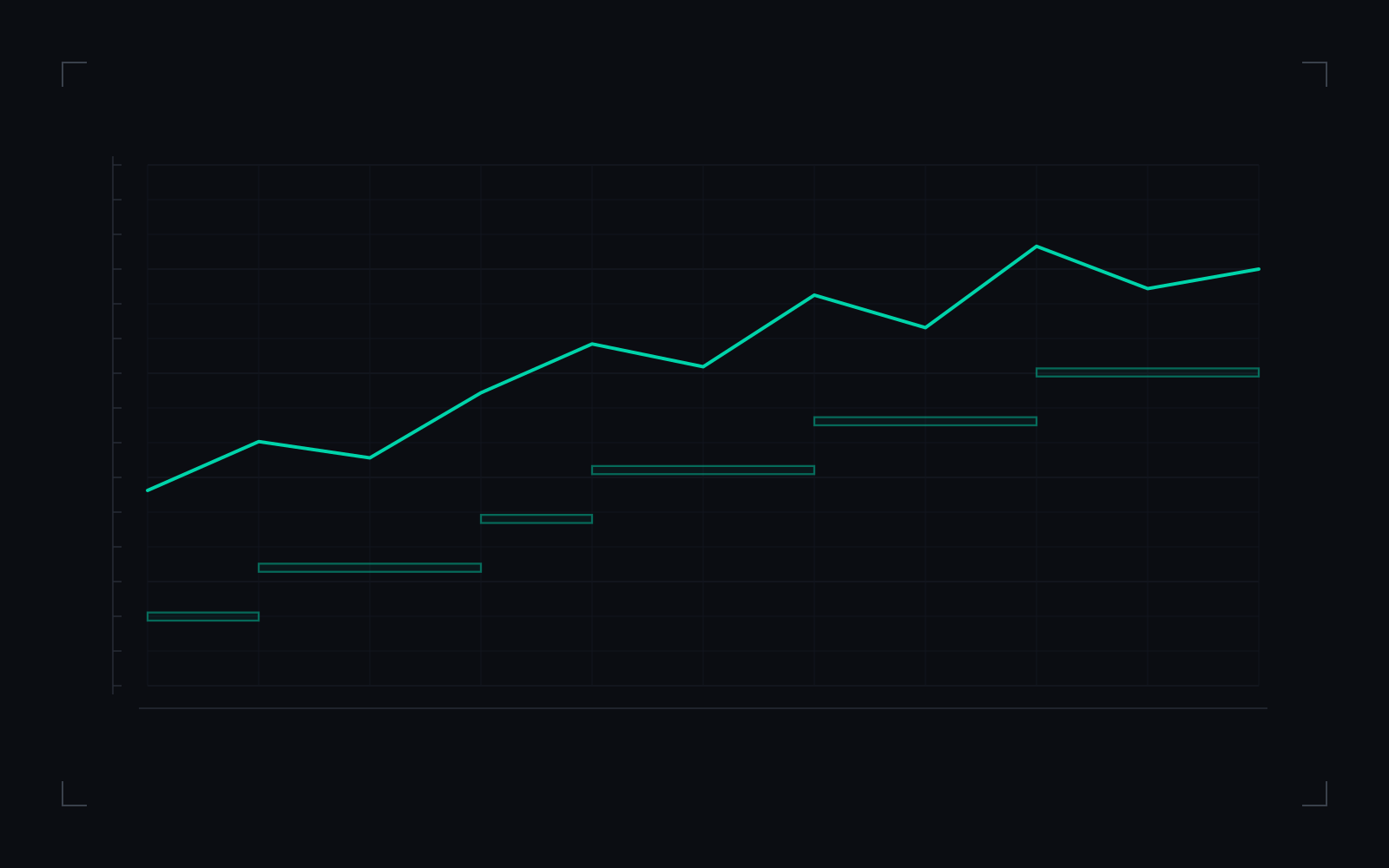
- The account’s equity path.
- The trailing floor: it steps up at each new equity high, by the account’s fixed drawdown allowance, and never steps down.
A floor that ratchets: the equity path rises, and at each new high the termination floor steps up behind it and never retreats. The vertical gap between path and floor is the room — and it is refilled only from above.
Drawing the ratchet establishes the mechanism. It does not establish which of the several trailing architectures a given agreement uses — the phrase alone does not say.
Trailing Drawdown: what the definition states, in full.
| Element | What the definition states |
|---|---|
| Reference | The high-water mark, not the starting balance. |
| Behaviour | The floor rises with each new high and never retreats. |
| ArchitectureIntraday versus end-of-day marks, and whether the floor locks at breakeven, are distinct architectures wearing one phrase. | election pending |
| Not established | Which architecture any particular agreement uses — the rule text decides, and it frequently does not say. |
Commonly confused with
Neighbouring concepts that get used interchangeably, and the distinction that actually separates them.
- Static drawdown limit
A static limit asks how far below the starting balance you may fall, and the floor never moves. A trailing limit asks how far below your best moment you may fall, and the floor ratchets up behind every new high. Under the second, past success permanently raises the bar for survival.
- Drawdown
Drawdown is a description of an equity path. A trailing drawdown is a rule imposed on top of it, with a barrier that moves. The same excursion that a static limit absorbs can breach a trailed one, so the rule changes the risk without the strategy changing at all.
- End-of-day versus intraday trailing
The single detail that dominates everything else. End-of-day trails the closed daily balance; intraday trails the equity peak including open positions, so an unrealised profit spike that was never banked still lifts the floor. Same rule name, materially different account.
- Your account balance
Sizing that conditions on balance is conditioning on the wrong variable. The operative quantity is distance-to-floor, which must be restated after every equity high — and which is not the allowance quoted in the rules.
How to measure it in your own data
A definition you cannot test is a definition you have to take on trust. This is the shortest honest route from the concept to a number you computed yourself.
- Records you need
The evaluation's actual rule text — trailing basis, allowance, whether the floor locks — plus your equity series at the granularity the rule uses. Intraday rules require intraday equity including open positions, not closed balances.
- What you compute
Track the high-water mark on the basis the rule specifies, subtract the allowance to get the floor, and compute distance-to-floor after every new peak. That distance, not the headline allowance, is the room you actually have. The subtraction is short enough to do on paper.
- What the answer tells you
The room shrinks with every new peak. Some rules stop the ratchet once the floor reaches the starting balance; others state no ceiling, and the floor keeps climbing for as long as the account does — read yours rather than assume. Under intraday trailing a winning trade that surges and then retraces can end the evaluation on its own — the surge lifts the floor, the retrace crosses it, and the account is breached by a trade that closed green. Risk of ruin against a trailing barrier is strictly higher than against a static one at identical sizing.
If this has already cost you
If a trailing rule has already ended an evaluation, the arithmetic behind that breach can be reconstructed from your own account record.
- Prop-Breach Forensics“Why did my prop evaluation actually fail?”Will not establish: Whether the firm’s rules are fair, or whether you would have passed with different luck. It reconstructs what happened; it does not adjudicate the firm.
- Payout-Denial Recompute“Does the arithmetic behind my denied payout actually hold?”Will not establish: Whether the firm must pay. A recomputation shows whether the stated condition was met under the stated rules; contract interpretation and enforcement belong to the firm, a regulator where one exists, or your own adviser — armed with arithmetic instead of assertion.
Intake is not open yet, so none of these can be commissioned today. They are listed here so you know the measurement exists and what it would and would not settle — the launch list hears first.
Work it out yourself
Free calculators that take this concept as an input. Each shows its working, so the number it gives you can be checked rather than taken on trust.
Questions and answers
How can a winning trade breach my account?
Under intraday trailing, where the high-water mark includes unrealised equity. A trade that surges lifts the floor by the amount of the surge; if it then retraces, the floor it just raised is still there and the retrace can cross it. The account is killed by its own unrealised high, on a trade that closed in profit.
Is the quoted allowance the room I have?
No, and this is the arithmetic most traders get wrong. The room is the allowance minus your current distance below the high-water mark, and it shrinks with every new peak. Reading the headline number as available room systematically overstates how much adverse movement the account can absorb.
Should I size positions off my account balance?
Not under a trailing rule. Balance is the wrong variable, because the barrier moves independently of it. The quantity that governs survival is distance-to-floor, restated after every equity high — and the two can diverge sharply during a good run, which is exactly when sizing tends to increase.
Is a trailing drawdown riskier than a static one?
Yes, at identical sizing, and it is a structural difference rather than a matter of degree. A ratcheting floor converts volatility itself into risk: the same excursion a static limit absorbs can breach a trailed one, because the trailed floor climbed while the equity did.
Related terms
Derived from the links this entry makes and the entries that link back to it.
Where the term is used
Instrument pages whose published copy uses this term. Each page states what it measures and what it does not establish.
In the research
Trailing Drawdown comes up in six research notes on this site, and this entry lists three of them.