37 / 97
High-Water Mark
Working definition
The highest value an account has previously reached, held as a reference point so that a fee, a threshold or a termination floor is measured against the account's best moment rather than its starting value.
A high-water mark is the highest value an account has previously reached, kept as a reference point. It ratchets: it rises when a new high arrives and it never comes back down, so a good period raises the reference permanently while a bad one leaves it exactly where it was. That asymmetry is not a side effect of the definition, it is the whole reason the mark exists — in every context that uses one, the point is to stop the same ground being counted twice.
The convention appears in two places that look unrelated and are structurally identical. In fund management the mark governs performance fees: a manager charges on gains above the previous best rather than on gains from wherever the fund happens to be, so a fund that fell and recovered does not earn a fee for undoing its own loss. In evaluated and funded trading the same mark governs a termination floor: the level below which an account is closed sits a fixed allowance beneath the mark, so past success raises the bar for survival. One asymmetry, pointed at compensation in the first case and at survival in the second.
The detail that decides accounts is what counts as “value” when the mark is set, and the phrase itself does not answer it. Under a closing-balance convention only realised results move the mark, so a position held through a spike and closed lower leaves the reference untouched. Under a live-equity convention the mark follows equity including open positions, so an unrealised high you never banked raises it — and having raised it, keeps it there. On any account that has ever carried a winning position through a swing, those two conventions produce different marks, and every rule built on top inherits the difference.
That is why the mark is worth computing rather than assuming. Walk the value series forward holding the largest figure seen so far; the running maximum is the mark at every point, and your distance below it is the input any dependent rule needs. Doing it twice — once on closing balances, once on intraday equity — measures the ambiguity directly. Where the two answers differ, a rule keyed to the second is assessing you against a number that was never in your account at the close of any day.
The mark is a level, not a distance. Maximum drawdown is the largest gap ever observed between the running mark and what followed it, which makes the mark an input to that measurement rather than a synonym for it. And a trailing drawdown is one rule built on the mark rather than the mark itself — two accounts can share a mark and have very different floors, because the allowance subtracted from it differs.
If you are working out which rule governs you, which drawdown rule do you have classifies from the rule text and computes the floor under each reading that remains possible. The trailing drawdown calculator computes the distance once you know, and the maximum drawdown calculator walks a series for the deepest gap below its own running mark.
The shape, drawn
The smallest arrangement the definition admits. It is a drawing of a rule, not a reading of a market — nothing here is measured, and the table below it is the authoritative version.
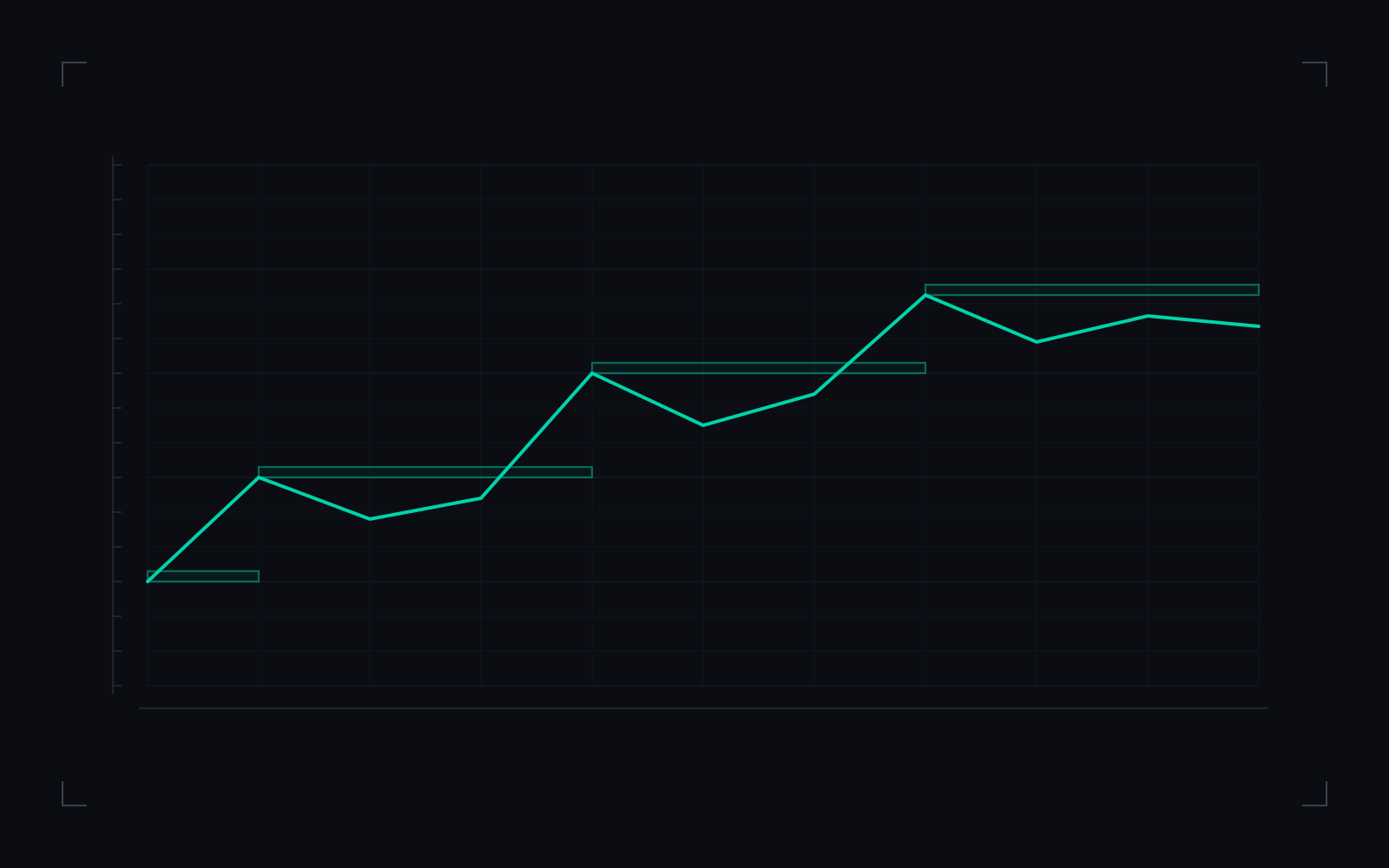
- The account’s equity path.
- The high-water mark: flat while the path is below it, stepping up the moment the path exceeds it. It carries no memory of how long the path spent underneath.
The best moment, held: the equity path wanders, and the mark steps up only when the path exceeds it. Everything measured against the account — a fee, a threshold, a floor — is measured from the mark, not from where the account started.
Drawing the mark establishes the reference. It does not establish what any particular agreement measures against it.
High-Water Mark: what the definition states, in full.
| Element | What the definition states |
|---|---|
| Definition | The highest value the account has previously reached. |
| What reads from it | Fees, thresholds and termination floors — measured from the best moment, not the starting value. |
| Not established | Which of those any given agreement actually ties to the mark; the agreement’s text decides. |
Commonly confused with
Neighbouring concepts that get used interchangeably, and the distinction that actually separates them.
- Peak equity right now
A high-water mark is a record that persists; current peak equity is a reading that does not. The mark survives every subsequent decline — that is the entire point of holding it — so an account far below its best is still measured against that best, and the gap between the two is the quantity that governs both fees and floors.
- The starting balance
A starting balance is fixed at inception and is the same number forever. A high-water mark begins there and ratchets upward, so the two coincide only until the first new high. Rules written against a starting balance and rules written against a high-water mark diverge from that moment, permanently and in one direction.
- Trailing drawdown
The high-water mark is the reference point; a trailing drawdown is one rule built on top of it. The mark says where the account has been, the rule says how far below that it may fall. Two accounts can share a mark and have entirely different floors, because the allowance subtracted from it differs.
- Maximum drawdown
Maximum drawdown is the largest gap ever observed between a running high-water mark and the value that followed it. So the mark is an input to the measurement rather than a synonym for it — the mark is a level, the drawdown is a distance travelled from that level.
How to measure it in your own data
A definition you cannot test is a definition you have to take on trust. This is the shortest honest route from the concept to a number you computed yourself.
- Records you need
Your account's value series, at the granularity whatever rule you care about actually samples, plus the rule text naming what "value" means. That last item does most of the work: a mark that tracks closing balances and a mark that tracks live equity including open positions are different numbers on the same account.
- What you compute
Walk the series forward holding the largest value seen so far and never letting it fall. That running maximum is the high-water mark at every point. Subtract it from the current value to get your distance below the mark, which is the input every rule built on it needs.
- What the answer tells you
Compare the mark computed on closing balances against the mark computed on intraday equity. If they differ, you have held a position through an unrealised high, and any rule keyed to the second is measuring you against a number you never banked. The size of that difference is the cost of the ambiguity, and it does not decay — the mark keeps it permanently.
If this has already cost you
If a floor keyed to your high-water mark ended an evaluation, which value set that mark — a closing balance or an unrealised equity high — is answerable from your own account record.
- Prop-Breach Forensics“Why did my prop evaluation actually fail?”Will not establish: Whether the firm’s rules are fair, or whether you would have passed with different luck. It reconstructs what happened; it does not adjudicate the firm.
- Payout-Denial Recompute“Does the arithmetic behind my denied payout actually hold?”Will not establish: Whether the firm must pay. A recomputation shows whether the stated condition was met under the stated rules; contract interpretation and enforcement belong to the firm, a regulator where one exists, or your own adviser — armed with arithmetic instead of assertion.
Intake is not open yet, so none of these can be commissioned today. They are listed here so you know the measurement exists and what it would and would not settle — the launch list hears first.
Work it out yourself
Free calculators that take this concept as an input. Each shows its working, so the number it gives you can be checked rather than taken on trust.
Questions and answers
Does a high-water mark ever go down?
No, and that is what makes it a mark rather than a reading. It only ever rises or stays where it is. A rule that reduced it after a decline would be a different rule with a different name, and the asymmetry is the source of everything else — good periods raise the reference permanently, bad periods do not lower it at all.
What counts as the "value" that sets the mark?
Whatever the governing rule says, and the two conventions are not close. Under a closing-balance convention only realised, banked results move the mark. Under a live-equity convention an unrealised profit spike moves it too, and moves it permanently even if the position closes for less or for nothing. The phrase "high-water mark" on its own does not tell you which.
Why do performance fees use one?
To stop a manager being paid twice for the same gains. Without a mark, a fund that fell and then recovered would charge a performance fee on the recovery, which is a fee for undoing its own loss. The mark means fees resume only above the previous best — the same asymmetry as a trading floor, pointed at compensation instead of survival.
Is the mark the same as the level I need to get back to?
For fees, yes: that is the level above which performance charging resumes. For a drawdown rule, no — there the mark is where the floor is measured FROM, and the floor sits an allowance below it. Confusing the two overstates how far you must climb and understates how far you may fall.
Related terms
Derived from the links this entry makes and the entries that link back to it.
Where the term is used
Instrument pages whose published copy uses this term. Each page states what it measures and what it does not establish.
In the research
High-Water Mark comes up in two research notes on this site.