36 / 97
Hard Breach
Working definition
A rule breach whose stated consequence is the end of the account: the condition fires, the account is closed or its open positions are liquidated, and the programme is over subject to whatever the agreement says follows.
A hard breach is a rule violation whose stated consequence is the end of the account. The condition fires, the account is closed or its open positions are liquidated, and the programme is over subject to whatever the agreement says happens next.
The word doing the work here is hard, and it does not describe the trading. It describes the consequence. A hard breach is not a worse violation than a soft one, not a larger loss, and not evidence of anything about how the account was traded — it is a breach the agreement chose to attach a terminal outcome to. The same numeric threshold, crossed by the same trade, can be terminal under one programme’s terms and a warning under another’s.
The hardness is in a different sentence
The hardness sitting in a separate sentence is the structural point, and almost everything practical follows from it. A rule of this kind is written in two parts that are usually not adjacent in the document: a sentence defining the condition, and a sentence stating what happens when the condition is met. The first carries the number and gets quoted in marketing material. The second decides your situation and frequently sits several sections away, under a heading about consequences, violations, or termination.
Reading the first and assuming the second is the mistake almost everyone makes, and it runs in both directions. People treat every rule as terminal and abandon accounts that were only suspended; people treat every notification as opening a conversation and wait for a review that was never coming. Neither is a reading error about the number. Both come from never having located the second sentence.
So the operative question after a notification is not how badly did I breach but what does this document say happens when this particular condition is met — and the qualifier matters, because a document may state different consequences for different conditions rather than one rule for all of them.
Why some conditions are more predictably terminal than others
There is a functional argument, and it is worth having because it tells you where to expect the answer rather than what the answer is.
A drawdown floor and a daily loss limit exist to cap the exposure of whoever is providing the account. A cap that leaves the account running after it is crossed has not capped anything — the purpose of the rule pushes towards a terminal consequence. A condition about how you traded — a method restriction, a minimum number of active days, a limit on how much one day may contribute — has no such arithmetic behind it. Its consequence is a policy choice by whoever wrote the document, not something forced by what the rule is for. That is why consistency conditions are the ones where a non-terminal consequence most visibly turns up in published terms: where publishers state one at all, it is not always termination.
None of that is a prediction about your agreement. It tells you which sentences are worth the most careful reading, and it explains why the answer to “is this terminal” genuinely varies rather than being an industry constant somebody could look up for you.
What a hard breach is not
A hard breach is not a report to anyone. There is no register, no authority informed, and nothing that carries to another firm or to a broker. A breach here is the triggering of a condition in an agreement between two parties — an ordinary outcome of trading against a threshold both parties knew about in advance, not a finding against you and not a legal event with any existence outside that agreement. The distress attached to the word is largely inherited from its other senses, and it is worth setting down before working out what actually happened.
It is also not, on its own, an explanation. “Breached” tells you a condition fired. It does not tell you which one, and the conditions that can fire behave differently enough that the label carries almost no information by itself — the full taxonomy is set out in what a funded trading account breach means. Only some of those conditions are about losing money at all.
The arithmetic survives the account
A terminal consequence ends the arrangement. It does not end the checkability of what happened, and that is the part most worth knowing.
Given the rule text and your own account record, the floor the rule implies can be recomputed and compared against what the record shows. That establishes whether the stated rule, applied to your account, produces the recorded outcome — and where the rule text is ambiguous, it can be computed under each reading it will bear. This is a closed question with a definite answer and it requires nobody’s cooperation.
One detail regularly surprises people at this stage. Where the consequence includes liquidating open positions, the final balance is whatever those positions realised when they were closed, which need not equal the level whose crossing triggered the closure. A floor is a threshold; a liquidation is a transaction. The gap between them is arithmetic and recoverable, and mistaking it for evidence of something else is a common way to spend energy on the wrong question.
What is not recoverable from your own record is anything about intent, about whether a quote was fair, or about what would have happened otherwise — the limits are set out in what a trading statement can prove. So the useful first question is not “was this fair” but does the rule, as written, produce this outcome on my numbers? If it does, the disagreement is with the rule rather than with its application, which is a different conversation entirely. If it does not, that is a specific, arithmetic, checkable discrepancy.
Where to start
If a drawdown floor was involved, work out which drawdown rule you actually have before recomputing anything — static and trailing are five architectures rather than two, and the phrase in an agreement does not say which one applies. If the account closed while the position was in profit, that has its own well-defined mechanism: why an account can be breached while closing in profit. The counterpart to this entry, for a condition that fired without ending anything, is a soft breach.
Where you have concluded the outcome was wrong and want to know who can be asked to look at it, the available routes and the precondition gating each one are set out in where a funded-account breach dispute can go — and the shortest deadline there runs from the payment rather than from the breach, which is worth knowing early.
Where the floor that fired was a broker’s rather than a firm’s, the mechanism differs in kind: a stop-out is an automatic close-out at a margin threshold, not a decision anyone took about conduct. The margin and stop-out calculator computes that threshold from leverage, position size and equity, reports the room left after the cost of closing, and shows the arithmetic.
Where you would rather have the arithmetic behind a breach reconstructed from your own account record than do it yourself, that is Prop-Breach Forensics.
The shape, drawn
The smallest arrangement the definition admits. It is a drawing of a rule, not a reading of a market — nothing here is measured, and the table below it is the authoritative version.
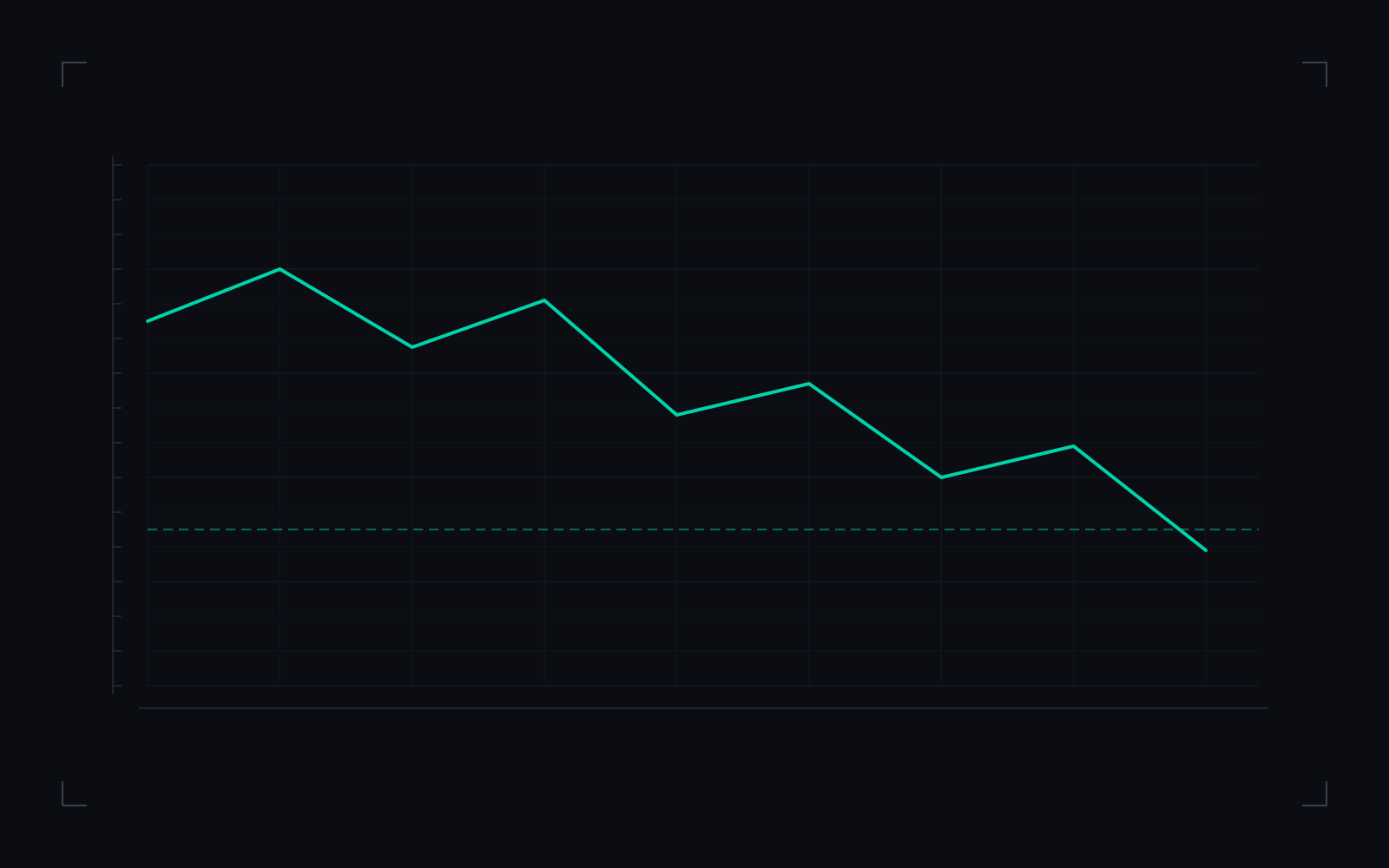
- The account’s equity path, ending where it crosses the floor — a hard breach is a termination, not a warning.
- The floor the agreement fixes. Whether it is static or trailing is a property of the agreement, not of this drawing.
The condition that ends the account, drawn as what it is: a fixed floor, an equity path, and the crossing. The path stops at the crossing because the programme does — whatever the agreement says follows, the account as it was is over.
Drawing the crossing establishes the mechanism. It does not establish that any particular closure applied its own rule correctly — that is arithmetic against the rule text, checkable case by case.
Hard Breach: what the definition states, in full.
| Element | What the definition states |
|---|---|
| The condition | Equity at or through the stated floor. |
| The consequence | The account ends: closed, or its open positions liquidated. |
| The detail that surprises | The final balance is what the liquidation realised, not the floor itself — a floor is a threshold; a liquidation is a transaction. |
| Not established | Fairness. The checkable question is whether the rule, as written, produces this outcome on these numbers. |
Commonly confused with
Neighbouring concepts that get used interchangeably, and the distinction that actually separates them.
- Soft breach
The same trigger word, the opposite outcome. A soft breach is a condition handled as a warning, a suspension pending review, or a constraint on what can be withdrawn rather than on whether the account exists. Nothing about the threshold tells you which you have — the hardness lives in a different sentence of the agreement from the one defining the condition, and reading the first while assuming the second is the error this pair exists to prevent.
- A data breach
Unrelated fields sharing a word. In information security a breach is unauthorised access to a system or to data. Here nothing was accessed by anyone: a numeric or behavioural condition in an agreement was met and the consequence attached to it fired. The collision is purely lexical, and it is why searches for this phrase return pages about password managers.
- A margin call or stop-out
A stop-out is a broker-side mechanism: equity falls below the margin required to hold a position and the position is closed to protect the account from going negative. A hard breach is a programme-side rule outcome that ends the arrangement itself. The two can look identical on a chart — positions closing without your instruction — and they are answerable by different documents. A stop-out leaves an account that can still trade.
- Failing an evaluation
Not every ending is a breach. An evaluation that expires without reaching its target, or one abandoned partway, has ended without any condition being violated. A breach is the crossing of a threshold; running out of time is the absence of an achievement. They carry different consequences and, where a programme offers a retry, different terms for it.
How to measure it in your own data
A definition you cannot test is a definition you have to take on trust. This is the shortest honest route from the concept to a number you computed yourself.
- Records you need
Two sentences from your agreement — the one defining the condition and the one stating what happens when it is met — plus the account's own observable state, the timestamped notification you received, and your account record covering the moment the condition is said to have fired.
- What you compute
Locate the consequence sentence for the specific condition named, rather than for breaches in general; the document may state different consequences for different conditions. Then compare it against what is observably true of the account: whether an order can still be placed, whether positions are still open, whether a balance is still shown. Separately, recompute the condition itself against your record — the floor the rule implies, applied to your numbers.
- What the answer tells you
The state and the notification should agree, and where they do not it is the state that is evidence. An account that still accepts an order was not terminated, whatever the message implied; an account closed with positions liquidated was, whatever a subsequent review is said to be considering. The recomputation answers a separate and narrower question — whether the rule as written produces the recorded outcome on your numbers — and that question has a definite answer that requires nobody's cooperation to reach.
If this has already cost you
If an account has already been closed against a rule, whether that rule applied to your numbers produces the recorded outcome is answerable from your own account record.
- Prop-Breach Forensics“Why did my prop evaluation actually fail?”Will not establish: Whether the firm’s rules are fair, or whether you would have passed with different luck. It reconstructs what happened; it does not adjudicate the firm.
- Payout-Denial Recompute“Does the arithmetic behind my denied payout actually hold?”Will not establish: Whether the firm must pay. A recomputation shows whether the stated condition was met under the stated rules; contract interpretation and enforcement belong to the firm, a regulator where one exists, or your own adviser — armed with arithmetic instead of assertion.
Intake is not open yet, so none of these can be commissioned today. They are listed here so you know the measurement exists and what it would and would not settle — the launch list hears first.
Work it out yourself
Free calculators that take this concept as an input. Each shows its working, so the number it gives you can be checked rather than taken on trust.
Questions and answers
Does a hard breach follow me to another firm?
There is no register of breaches, nothing is reported to any authority, and nothing carries to another firm or to a broker. A breach in this sense is the triggering of a condition in an agreement between two parties, not a finding against you and not a legal event with consequences beyond that agreement. Much of the weight the word carries is borrowed from its security and its contract-law senses rather than earned by what actually happened.
Can a hard breach happen while the account is in profit?
Yes, and there is a specific mechanism for it rather than an error. Where a limit updates on one schedule but is tested on another — updated at the end of the day, tested continuously against floating equity — a day can close above the limit while the account was already ended on the way through. The same is true of any floor tested against the equity path rather than against closing balances.
Why is my final balance different from the level that triggered it?
Because a floor is a threshold and a liquidation is a transaction. Where the consequence includes closing open positions, those positions realise whatever the market gave them at the moment they were closed, which need not equal the level whose crossing triggered the closure. The gap between the two is arithmetic, and it is recoverable from your own record.
Is a hard breach reversible?
Whether any programme offers a reset, a retry, or nothing at all is a matter for that programme's terms, and the answer is not uniform. What is separately available regardless is the arithmetic: given the rule text and your account record, whether the stated rule applied to your numbers produces the recorded outcome is a closed question with a definite answer. A specific discrepancy is worth considerably more than a general grievance.
How is a hard breach different from failing an evaluation?
A breach is the crossing of a threshold that was defined in advance. Failing is the absence of an achievement — the target was not reached, or the period expired. Both end the arrangement, but they are different events under the agreement, they are described in different sentences, and where a programme distinguishes them in what it offers next, the distinction is worth establishing before assuming which one applies to you.
Related terms
Derived from the links this entry makes and the entries that link back to it.
In the research
Hard Breach comes up in two research notes on this site.