09 / 97
Buy-side and sell-side liquidity
Working definition
The ICT names for resting orders on either side of price: buy-side liquidity is the buy orders assumed to sit above prior highs, sell-side liquidity the sell orders assumed to sit below prior lows.
Every stop-loss and every breakout order has to be parked at some price, and in the ICT vocabulary the prices where they gather are the whole map.
Which orders, on which side
Above a prior high sit two kinds of buy order. Traders short from below the high protect themselves with buy stops just above it, and breakout traders place buy-stop entries in the same place to catch a move through the level. Together they are buy-side liquidity. Below a prior low the mirror gathers, sell stops protecting long positions and sell-stop breakout entries, and together they are sell-side liquidity. The sides are named by the orders, not by who benefits. Buy-side liquidity is where buy orders wait, and it is typically consumed by someone selling into them.
That mechanism is the plausible core of the idea. Stops really are conventionally placed just beyond obvious extremes, and when they trigger they become market orders that need someone on the other side. A participant with a large order to sell can fill it most easily where a cluster of buy orders is about to arrive. From there the method builds its central expectation: price is drawn toward these pools, runs them, and often turns once they are spent.
Where the pools form
The candidates are the prices a chart makes obvious. Prior swing highs and lows, under a stated swing rule. Equal highs and equal lows, two or more extremes within a small tolerance of each other, taught as the densest pools because every test of a level adds orders beyond it. Reference extremes: the previous day’s high and low, the previous week’s, and session extremes such as the Asian range, each labelled by its scope. The liquidity pools indicator keeps this registry, with consumed pools greyed and retained so that the history stays visible.
Pools also sort by position relative to a dealing range. Orders beyond the range’s high and low are external range liquidity; the imbalances inside it, such as an unfilled fair value gap, are called internal range liquidity. The taught rhythm is that price alternates between the two, running an external pool and then returning to an internal one, or the reverse.
What happens at the pool
When price trades through a pool and closes back inside the old range, the event is a liquidity sweep, the most common opening move in the ICT sequence. When a minor pool is swept on the way toward a larger opposing one, the taxonomy calls the minor sweep inducement. When price trades through and keeps going, nothing special has happened: the pool was consumed by a breakout that held. The names describe outcomes at the level; the pool is simply where they happen.
A worked picture, constructed and not measured. The previous day’s high is 1.0950, and two intraday highs this morning sit at 1.0948 and 1.0949. The buy-side liquidity is the cluster of orders assumed to rest just above 1.0950. The prior day’s low at 1.0880 marks the sell-side liquidity below. An ICT reading asks which of the two price is drawn toward first. It cannot see the orders, only the prices where convention puts them.
Two collisions with other vocabulary
The first is with the financial industry. There the buy side is the firms that invest capital and the sell side is the banks and brokers that make markets, and neither sense has anything to do with a chart. The second is with this site’s own use of liquidity in market microstructure, where the word means how much can trade near the current price without moving it, read from depth of market and the spread. ICT’s liquidity is inferred from geometry, and most of the stop orders it describes are not displayed in any book before they trigger.
What stays unmeasured
The registry is a hypothesis about where orders rest, and the expectation built on it is a claim about frequency: that marked highs and lows are run more often, or turn price more reliably, than other prices at the same distance. Both halves can be tested on candle data against that baseline, and the pool registry’s row in the claims ledger is where the verdict renders. The two lenses separate them cleanly. Where the orders are assumed to be is a convention; whether price treats those prices differently is a measurement.
Where it sits in the ICT sequence
The ICT vocabulary in the order the method is taught, with a step for each kind of object.
- Step
- 03 of 08 Liquidity: the resting orders, and whether price has taken them
- Also at this step
- Draw on liquidity (DOL), ICT daily bias, Liquidity sweep, Inducement, Judas swing, Turtle soup, Candle range theory (CRT), SMT divergence
- After it
- Draw on liquidity (DOL)
The shape, drawn
The smallest arrangement the definition admits. It is a drawing of a rule, not a reading of a market — nothing here is measured, and the table below it is the authoritative version.
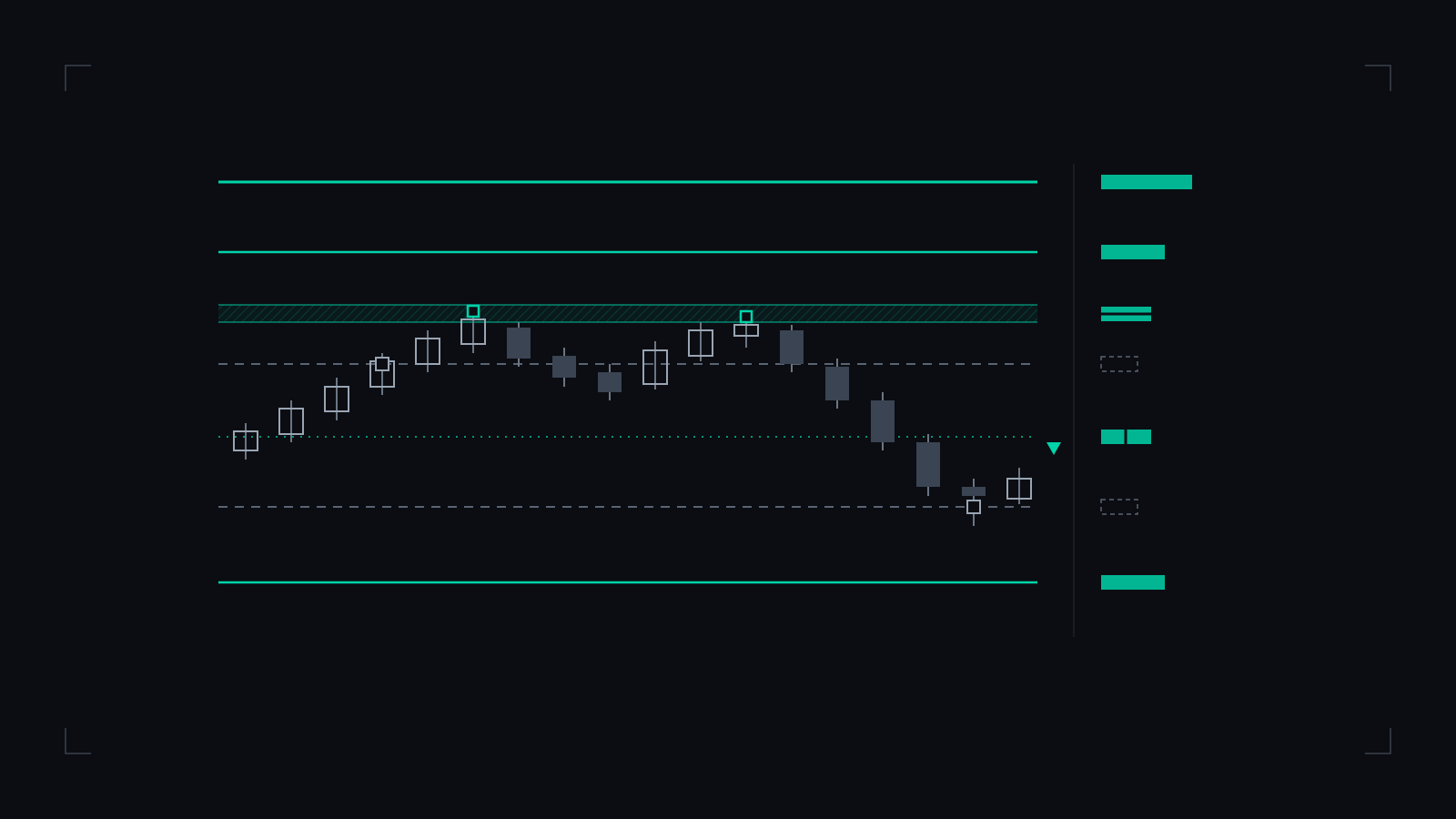
One standing registry. Every pool the definition admits is drawn once and kept — and a pool that has been taken greys out rather than disappearing, so the map shows what was there as well as what is.
Registering a pool establishes that the level existed and when it was taken. It does not establish that price returns to one, or that taking one means anything.
Buy-side and sell-side liquidity: what the definition states, in full.
| Element | What the definition states |
|---|---|
| Members | Swing highs and lows, previous month, week and day extremes, equal highs and lows, and session extremes. |
| Anchor opens | The midnight, 08:30, 09:30, weekly and monthly opens, drawn beside the pools as reference levels with above/below state. |
| Equality toleranceHow near two extremes must sit to register as one pool is a parameter, not a fact about the market. | election pending |
| Spent poolsA level that has been taken is still a fact about the tape; deleting it would edit the past. | Retained and greyed, never removed. |
| Repainting | None. A pool’s STATE changes when it is taken; its history does not. |
| Not established | Whether price returns to a pool, how often, or what a return is worth. |
Commonly confused with
Neighbouring concepts that get used interchangeably, and the distinction that actually separates them.
- The buy side and sell side of the financial industry
In finance the buy side is the firms that invest capital, such as asset managers and pension funds, and the sell side is the banks and brokers that make markets and distribute research. Neither sense is involved here. ICT's buy-side liquidity is a location on a chart, the orders above a high, and the collision is only in the words.
- Depth of market
A depth-of-market display shows the orders actually visible at each price. ICT's pools are inferred from chart geometry rather than read from a book, and most of the stop orders they describe are not displayed to anyone before they trigger.
- Liquidity sweep
Buy-side and sell-side liquidity are the targets. The sweep is the event of price trading through one and closing back inside the range. One is a place; the other is something that happens there.
- Liquidity void
A void is a stretch of price the market crossed with little trade, left behind a one-directional run. Buy-side and sell-side liquidity are prices where orders are assumed to be waiting. The void is thin history; the pool is supposed interest still to come.
- Support and resistance
Classical levels are prices expected to stop a move. In ICT's framing the same prior highs and lows are expected to attract it, because the orders resting beyond them are what larger participants are said to need. Same lines on the chart, opposite expectations.
How to measure it in your own data
A definition you cannot test is a definition you have to take on trust. This is the shortest honest route from the concept to a number you computed yourself.
- Records you need
Candle data at a declared timeframe; a swing rule for what counts as a prior high or low; a tolerance in price or spread units for calling two highs or two lows equal; and the reference extremes being tracked, such as the prior day's, the prior week's and each session's.
- What you compute
Build a registry of candidate pools above and below price from those rules, and record for each whether it was traded through, when, and what price did next. Compare how often marked highs and lows are run with how often arbitrary prices at the same distance are reached, which is the base rate any claim that pools attract price has to beat.
- What the answer tells you
Obvious prior highs and lows, especially two or three highs at nearly the same price or the previous day's extremes, with price later trading through them. The resting orders themselves are invisible on a candle chart; the registry marks where convention says they are, and a measurement asks whether those prices behave differently from others.
Questions and answers
What is buy-side liquidity?
The buy orders assumed to rest above a prior high: buy stops protecting short positions, and buy-stop entries from traders waiting for a breakout. ICT reads that cluster as a target price is drawn toward, because a large seller can fill most easily into orders that are about to arrive.
What is sell-side liquidity?
The sell orders assumed to rest below a prior low: sell stops protecting long positions, and sell-stop breakout entries. It is the mirror of buy-side liquidity, and in the ICT reading it is where a large buyer fills most easily.
What is the difference between buy-side liquidity and sell-side liquidity?
Which side of price the orders rest on, and so which kind of order they are. Buy-side liquidity sits above highs and is made of buy orders; sell-side liquidity sits below lows and is made of sell orders. The sides are named for the orders, not for who benefits from reaching them.
Is this the same as buy side and sell side in finance?
No. In the financial industry the buy side is investment firms such as asset managers, and the sell side is banks and brokers, which is why large investment banks are usually described as sell side. ICT borrowed the words for something else entirely: orders resting above and below price on a chart.
Where does buy-side liquidity form?
Above prior swing highs, above equal highs, above the previous day's and week's highs, and above session highs such as the Asian range high. Equal highs are taught as the densest pools, because a level that has held more than once collects more stops and breakout orders beyond it.
What are the types of liquidity in ICT?
No single canonical list exists. The working distinctions are two pairs: buy-side against sell-side, by which side of price the orders rest on, and external against internal range liquidity, by whether they sit beyond a range's high and low or inside it at imbalances such as fair value gaps.
Why does price go to buy-side liquidity?
The ICT account is that large participants need resting orders to trade against, and a large sell programme is filled most easily into the buy stops above a high. That is a plausible mechanism for why highs get run. It is not a demonstration that they are run more often than chance would produce, and the frequency, unlike the intent, can be measured.
Related terms
Derived from the links this entry makes and the entries that link back to it.
Where the term is in build
Detector datasheets whose concepts include this term, or whose published copy uses it. Each one states the build state it has reached and the parameters it exposes, and carries no measured verdict.