24 / 97
Depth of market (DOM)
Written DOM throughout.
Working definition
The visible ladder of resting limit orders — how much size is bid and offered at each price level away from the touch — as one feed displays it at one moment.
The tape tells you what happened; the DOM claims to tell you what everyone intends — and the claim is exactly as revocable as intentions are.
The object itself is simple: a ladder of resting limit orders, size bid at each level beneath the touch and offered at each level above it, as one venue displays it at one instant. Everything that matters about depth lives in the qualifications. Displayed, because holders of size are not obliged to show it, and iceberg conventions exist to hide it. One venue, because in over-the-counter FX there is no consolidated book — an FX DOM is one broker’s or one ECN’s ladder, a partial market by construction, and a different ladder on the venue next door. One instant, because resting orders are statements of present intent, and intent is revocable until the moment it is hit.
That last qualification carries the family’s central measurement. Size that persists as price approaches, and refills as it is consumed, is depth doing what the display promised; size that thins or vanishes on approach is decoration, and the gap between the two is quote fade — measurable only in recorded books, invisible in screenshots. The interaction between arriving aggression and this resting ladder is the absorb/sweep balance, and what an order pays when the ladder loses is slippage. The whole cost side of this site’s vocabulary is, one way or another, an account of the DOM under stress.
The neighbours divide the record from the posture: the footprint chart shows what transacted at each price, the DOM what waits there, and the productive disagreements between them — heavy prints into an unmoved ladder, deep displays that evaporate untraded — are where most order-flow readings are actually born.
What the ladder cannot do is promise. Book imbalance as a short-horizon signal is among the most-studied objects in microstructure, and the results are notoriously sensitive to venue, horizon and convention — which is not a verdict either way, only the reminder that a DOM reading is a measurement claim, and the two lenses price measurement claims in evidence.
The shape, drawn
The smallest arrangement the definition admits. It is a drawing of a rule, not a reading of a market — nothing here is measured, and the table below it is the authoritative version.
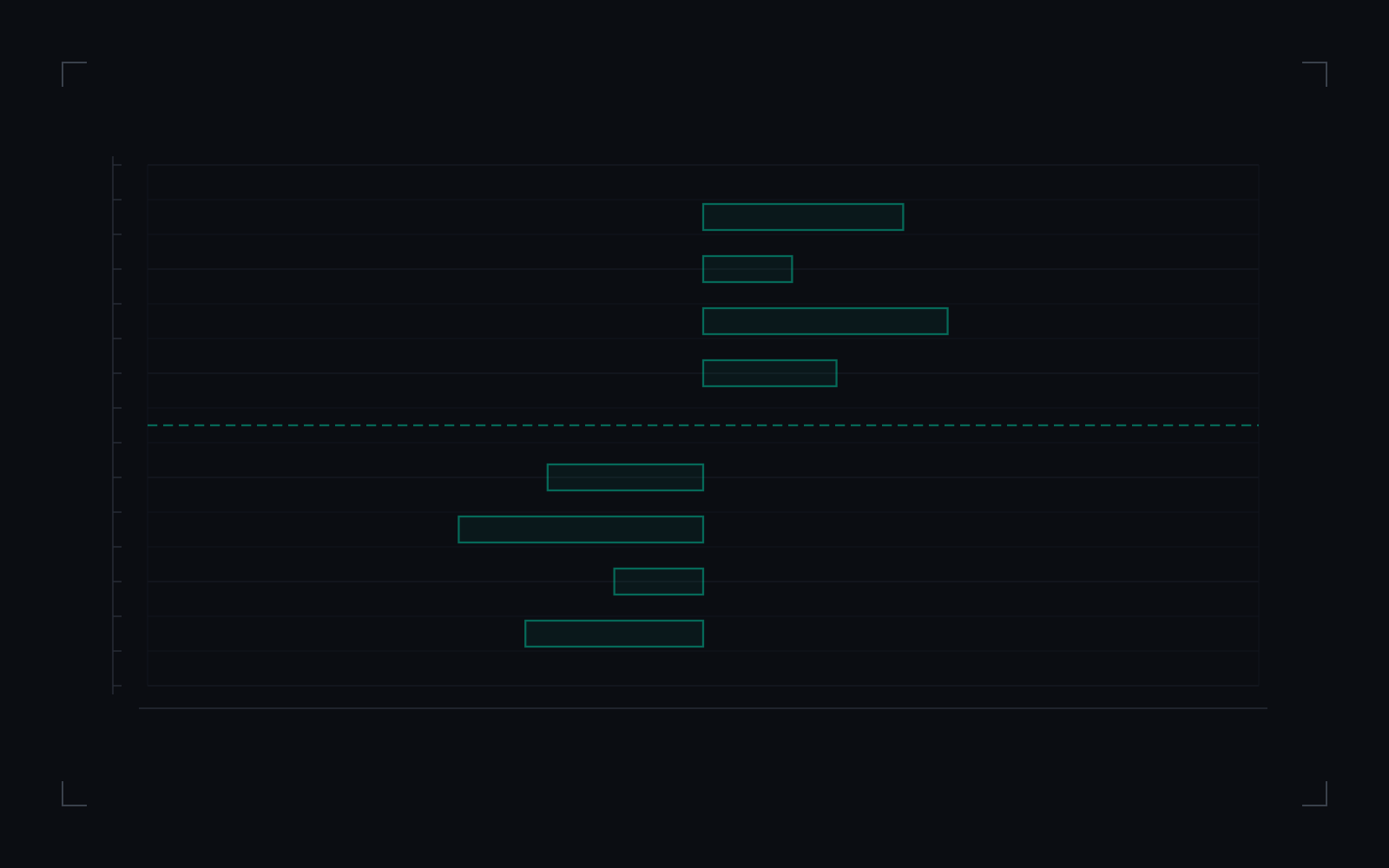
- Resting size at each price level: offers stacked above the mid extending one way, bids below extending the other. Bar length is displayed size, nothing more.
- The mid. The empty band around it is the spread — the first thing a thinning book widens.
One feed’s ladder at one moment: resting size at each level away from the touch, bids extending left, offers extending right, the dashed line between them the mid. Nothing here is the market — it is what one venue chose to display.
Drawing the ladder establishes what a depth display is. It does not establish that displayed size is real, that it will still be there on arrival, or that any two feeds show the same book.
Depth of market (DOM): what the definition states, in full.
| Element | What the definition states |
|---|---|
| What it shows | Resting limit orders by level, as one feed displays them at one moment. |
| Per-feed | OTC FX has no consolidated book. Two feeds can honestly show two different ladders for the same instrument at the same instant. |
| Not established | That displayed size is firm, that it survives your order’s arrival, or anything about intent. |
Commonly confused with
Neighbouring concepts that get used interchangeably, and the distinction that actually separates them.
- Volume
Volume is what traded; depth is what waits. The two connect only at execution, where an incoming order consumes resting size — and a market can print heavy volume through a thin book or sit quiet on a deep one.
- A footprint chart
The footprint records transacted business at each price; the DOM shows intention resting there. History versus posture — and posture can be withdrawn in the milliseconds before it would have mattered, which history cannot.
- Liquidity
Depth is the visible fraction of liquidity: displayed limit orders on one venue's ladder. True liquidity includes what is held back, what refreshes on demand, and what vanishes on approach — so a deep-looking DOM and a liquid market are correlated claims, not the same one.
- Quote fade
Fade is the DOM's characteristic betrayal: size displayed until reached for, then withdrawn. The ladder is a snapshot of stated intent; fade is the measured gap between that statement and what an arriving order actually finds.
How to measure it in your own data
A definition you cannot test is a definition you have to take on trust. This is the shortest honest route from the concept to a number you computed yourself.
- Records you need
Recorded order-book snapshots or incremental book updates with per-level sizes and timestamps — per feed, since each venue's ladder is its own object and OTC FX has no consolidated book to consult.
- What you compute
Top-of-book size over time; cumulative size within a declared number of levels; imbalance between the bid and ask stacks; and the survival of displayed size as price approaches it — the measurement that separates depth from decoration.
- What the answer tells you
A stable book shows displayed size that persists and refills as it is consumed; a decorative one shows levels that thin or vanish on approach. The difference is invisible in a single snapshot and obvious in a recording, which is why depth claims deserve recorded books rather than screenshots.
Questions and answers
What is depth of market?
The ladder of resting limit orders around the current price — size bid at each level below, size offered at each level above — as displayed by one venue or feed at one moment. It is the market's stated intention, in contrast to the tape's record of what actually traded.
Is the DOM reliable in forex?
It is a faithful display of one book — a broker's or an ECN's — and no more. OTC FX has no consolidated book, so an FX DOM is a partial ladder by construction, and the majority of resting interest lives on venues the display cannot see.
Can displayed depth disappear before I trade against it?
Yes, and measurably: displayed size may be withdrawn as orders approach, the behaviour recorded as quote fade. A ladder is a statement of present intent, revocable until hit — which is why depth is best judged from recordings of how size survives approach, not from snapshots of how it looks at rest.
What is a book imbalance?
More resting size on one side of the ladder than the other, within a declared number of levels. Whether imbalance predicts short-horizon direction is one of the most-studied questions in microstructure, and the honest one-line answer is that it is measurement-dependent — convention, horizon and venue all move the result.
Related terms
Derived from the links this entry makes and the entries that link back to it.