10 / 97
Candle range theory (CRT)
Written CRT throughout.
Working definition
A reading of a single higher-timeframe candle's range: when the next candle trades beyond one end of that range and closes back inside it, the theory expects price to travel toward the opposite end.
Candle range theory takes the oldest object on a chart, one candle’s high and low, and hangs an expectation on it.
The event, stated
Pick a timeframe and a candle on it. That candle’s high and low are the reference range. The event the theory names happens on the next candle: price trades beyond one end of the range and then closes back inside it. The end traded through is the swept side; the other end is the one the theory expects price to travel toward. Stated that way the object has three parameters and nothing else: the reference timeframe, the reclaim rule (a close back inside, or only a wick beyond the end), and the horizon within which the far end counts as reached.
That is also why it is one of the easier ideas in this vocabulary to check. Every reference candle proposes an event on schedule. Nobody chooses which candles count after the fact, the events are frequent, and each one either happened or did not.
The three candles
Teaching usually lays the event out candle by candle. Candle one sets the range. Candle two sweeps one end and closes back inside. Candle three is the one expected to deliver price toward the opposite end. On a daily chart that is three days: a range day, a day that runs the prior day’s high and closes back under it, and a day expected to trade down toward the prior day’s low.
Worked with constructed numbers, the rule unchanged. A four-hour candle prints a high of 1.2750 and a low of 1.2680. The next four-hour candle trades up to 1.2764, fourteen pips above the range, and closes at 1.2731, back inside. The high was swept and reclaimed, so by the theory’s reading the objective is 1.2680, the untouched low. Whether the third candle, or any candle within the chosen horizon, gets there is the part the theory asserts and the data decides.
A sweep with a calendar
Structurally, candle range theory is the liquidity sweep applied to a different reference. The sweep entry’s reference is a prior swing high or low, wherever the swing rule finds one. Here it is a candle’s range, which exists whether or not the chart has formed a meaningful swing, and which turns over every period. The reclaim test is shared. On a daily chart the swept end is simply the prior day’s high or low, which is why candle range theory and a turtle soup fade of that extreme can describe the same move under two names.
Most taught versions add a second timeframe. The reference candle comes from the higher one, four-hourly or daily, and the entry from a lower one, where the method looks for a market structure shift toward the far end and a return into a fair value gap left by that shift. Each added condition narrows the events and makes a reported result harder to compare with the plain version.
What the theory owes
The claim is simple enough to state as a comparison. After a reference range is swept and reclaimed, the far end should be reached more often, or sooner, than after candles that swept nothing, and more often than after sweeps of the same size at arbitrary prices. The comparison needs its baseline, because ranges get traversed constantly for no special reason: a candle’s opposite end is often reached simply because price moves about within its ordinary volatility.
The detector campaign behind the candle range theory indicator registers exactly that test, and records each event’s follow-through as it happens rather than as it is remembered. Its verdict renders on the driver’s row in the claims ledger. The two lenses give the honest split: the event is defined and checkable, and its predictive value is a measurement, not a property of the definition.
Where it sits in the ICT sequence
The ICT vocabulary in the order the method is taught, with a step for each kind of object.
- Step
- 03 of 08 Liquidity: the resting orders, and whether price has taken them
- Also at this step
- Buy-side and sell-side liquidity, Draw on liquidity (DOL), ICT daily bias, Liquidity sweep, Inducement, Judas swing, Turtle soup, SMT divergence
- Before it
- Turtle soup
- After it
- SMT divergence
The shape, drawn
The smallest arrangement the definition admits. It is a drawing of a rule, not a reading of a market — nothing here is measured, and the table below it is the authoritative version.
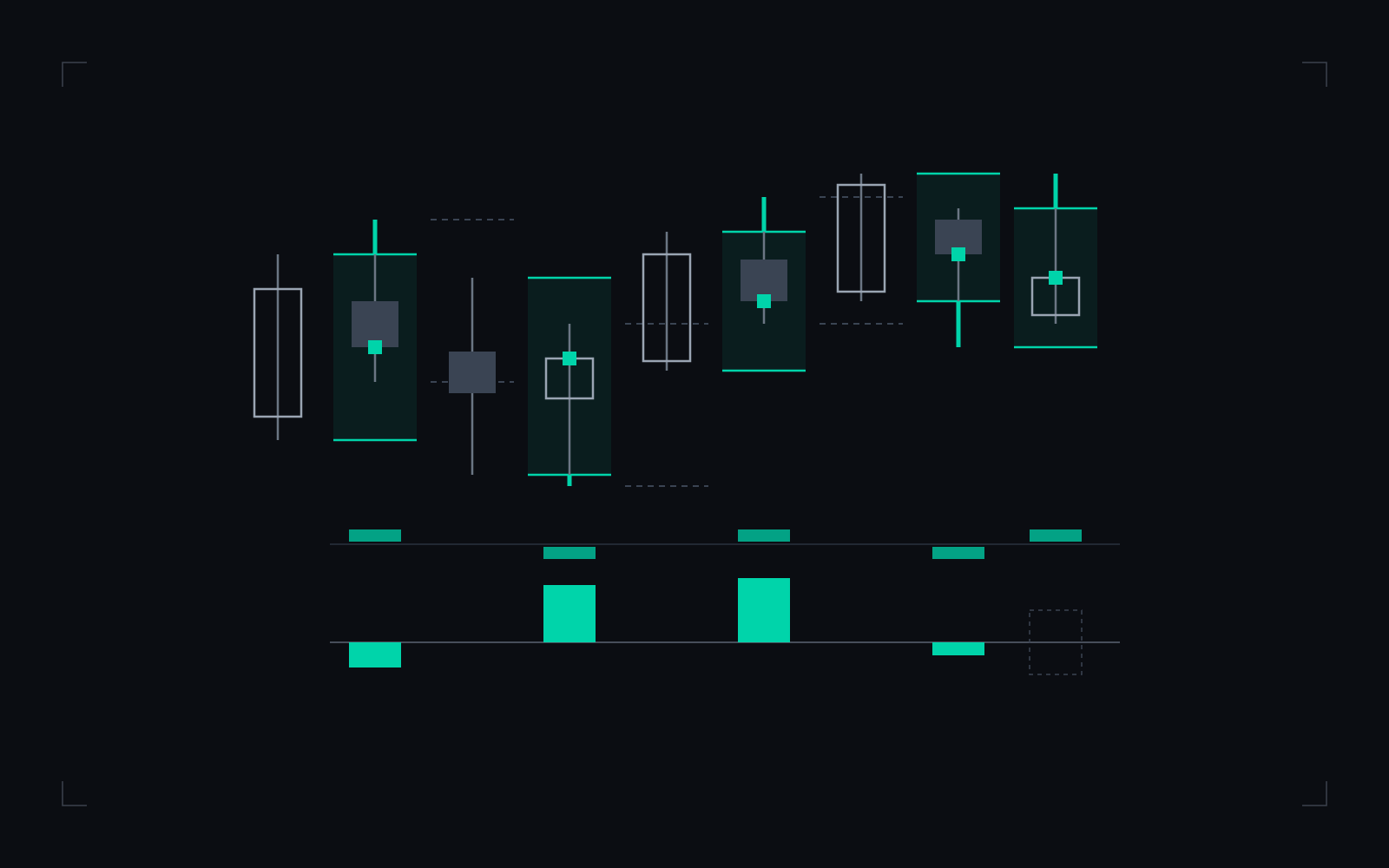
A ledger that does not score. Each reference candle proposes a window, the side that was taken is labelled, and the follow-through is recorded beneath — including the one that has not resolved, which reads as unresolved rather than being dropped or guessed.
Recording an outcome establishes what happened after a proposed window. It does not grade the window, rank it against the others, or establish that a swept reference candle is followed by anything.
Candle range theory (CRT): what the definition states, in full.
| Element | What the definition states |
|---|---|
| Reference grain | H1 or H4. |
| Sweep test | The next candle trades beyond one side of the reference range and closes back inside it. |
| Side labelling | High-swept or low-swept. |
| Follow-through ledgerThe ledger reports what happened after each proposed window. It does not rank the windows, and it does not call any of them correct. | On. Outcomes are recorded, not graded. |
| Unresolved outcomesA window whose outcome has not arrived reads not yet, rather than being dropped from the ledger or given a provisional score — both of which would flatter the record. | Drawn as unresolved. |
| Not established | Whether a swept reference candle is followed by anything in particular. |
Commonly confused with
Neighbouring concepts that get used interchangeably, and the distinction that actually separates them.
- Liquidity sweep
A sweep is taken against a prior swing high or low, wherever the swing rule finds one. CRT takes it against the range of one declared candle on a higher timeframe. The reclaim test is the same; the reference changes, and a candle's range exists on schedule whether or not a meaningful swing has formed.
- Turtle soup
Turtle soup fades a break of a multi-period extreme, originally a twenty-day low. CRT uses one candle's range as its extreme. Where the reference candle is a day, a CRT sweep and a fade of the prior day's high or low in the ICT sense can be the same event under two names.
- Inside and outside bars
Inside and outside bars are classical patterns defined by one candle's range against the previous candle's: wholly within it, or engulfing both ends. A CRT event needs the next candle to break one end and close back inside, which is neither. It trades outside the range on one side only and settles within it.
- Average true range
The range in average true range is a volatility statistic averaged across many candles. The range in candle range theory is one candle's high and low used as a pair of reference prices. Same word, different job.
How to measure it in your own data
A definition you cannot test is a definition you have to take on trust. This is the shortest honest route from the concept to a number you computed yourself.
- Records you need
Candle data at two declared timeframes: the reference timeframe whose candles supply the ranges, often four-hourly or daily, and any lower timeframe used for entries. A stated reclaim rule, a close back inside the range or a wick only, and a horizon within which the opposite end counts as reached.
- What you compute
For each reference candle, test the next candle: did it trade beyond the high or the low and close back inside the range? Label the side swept. Record whether price reached the opposite end within the stated horizon, and compare that rate with the rate after candles that swept nothing, and after sweeps of the same size at other reference prices.
- What the answer tells you
A higher-timeframe candle with a clear high and low, a following candle that pierces one end and settles back inside, and attention turning to the untouched end. How often that end is reached is a count over a list of events, and the list is dense, because every reference candle proposes one.
Questions and answers
What is candle range theory?
A reading of one candle's range on a higher timeframe. When the next candle trades beyond the high or the low and closes back inside the range, the theory treats the swept end as spent and expects price to travel toward the opposite end. The event is precisely checkable; the expectation is the theory's claim.
What does CRT stand for in trading?
Candle range theory. The name refers to one candle's high-to-low range treated as a pair of reference prices, and the theory is the expectation about what follows when one end of that range is swept and reclaimed.
What is the three-candle model in CRT?
The same event described candle by candle. Candle one sets the range. Candle two trades beyond one end and closes back inside. Candle three is the one expected to carry price toward the other end. On a daily chart that is three consecutive days.
How is CRT traded?
As taught: mark the range of a higher-timeframe candle, wait for the next candle to sweep one end and close back inside, then look on a lower timeframe for a structure shift toward the far end, which becomes the objective. That describes the practice. Whether it earns anything after costs is a measured question this page does not answer.
What is the best timeframe or time of day for CRT?
The definition prefers none; it needs one declared. Four-hourly and daily reference candles are the ones most often taught, and some versions add clock conditions, such as reference candles that close at a session boundary. Every time filter is a further parameter, and its value would have to be shown against the unfiltered events.
How accurate is candle range theory, and what is its win rate?
Figures quoted for it rarely state the reference timeframe, the reclaim rule, the horizon or the costs, without which a percentage cannot be reproduced. The informative comparison is how often the far end is reached after a sweep against how often it is reached after candles that swept nothing.
Is CRT part of ICT?
It travels with the ICT vocabulary and uses its sweeps, shifts and gaps. Whether it belongs to the original teaching or grew up around it is a question of attribution this page does not settle. The object is defined here on its own terms because its reference, a single candle's range, differs from the swing extremes the rest of the vocabulary uses.
Related terms
Derived from the links this entry makes and the entries that link back to it.
Where the term is in build
Detector datasheets whose concepts include this term, or whose published copy uses it. Each one states the build state it has reached and the parameters it exposes, and carries no measured verdict.