32 / 97
Fair value gap (FVG)
Written FVG throughout.
Working definition
A three-candle imbalance: the wicks of the first and third candles fail to overlap, leaving a price band the middle candle crossed with one-sided trade. Bullish when the third candle's low sits above the first's high; bearish in mirror.
Of all the vocabulary this taxonomy carries, the fair value gap is the term with the cleanest definition — one comparison, checkable by anyone.
Take any three consecutive candles. If the third candle’s low sits above the first candle’s high, the band between those two prices is a bullish fair value gap; if the third’s high sits below the first’s low, the mirror band is a bearish one. The wicks failing to overlap is the whole test: it means the middle candle — frequently a displacement bar — crossed that band while trade ran one-sided, without the ordinary two-way rotation that would have left wick prints from both neighbours inside it. The gap’s boundaries are exact, its midpoint — the taxonomy calls it consequent encroachment — is their mean, and the object is timeframe-relative: the same tape aggregated differently prints different gaps, so a gap quoted without its timeframe is half a claim.
From the moment it prints, a gap carries a small state machine: untouched until price returns, touched at first re-entry, midpoint reached, filled when the whole band has been re-traded. Under a stated invalidation rule it becomes inverted, at which point the taxonomy hands it to the inverse fair value gap. Serious use states its elections: any minimum-size filter relative to average true range, and whether touches and invalidations count wicks or closes. Different elections, different population of gaps.
The neighbouring objects earn their own boundaries. A liquidity void is a multi-candle stretch of thin traversal — voids often contain gaps, but the void is territory while the gap is a defined three-candle event. A volume imbalance is the adjacent ICT object where candle bodies gap but wicks still overlap, wick overlap being the entire border between the two terms. And an opening gap is a different mechanism altogether: no trade at all between close and open, where a fair value gap prints inside continuous trading.
Bullish and bearish, worked
The bearish gap mirrors the bullish test. When the third candle’s high sits below the first candle’s low, the band between those two prices is a bearish fair value gap. With constructed numbers: a first candle’s low at 1.2650, a sharp middle candle down, and a third candle’s high at 1.2634 leave a bearish gap from 1.2634 to 1.2650, sixteen pips wide, with its consequent encroachment at 1.2642. A later rally that tops out at 1.2640 has entered the gap without reaching its midpoint; a close at 1.2652 is through its far boundary, the event an inversion rule may count.
Timeframes, markets and nesting
A gap is quoted with its timeframe because the timeframe creates it. A one-hour gap can contain several five-minute gaps, and a daily gap can sit above an hourly one with no overlap at all, so a chart read across timeframes carries gaps of different sizes nested inside one another. Teaching usually takes the location from the higher timeframe and the entry from the lower. The object needs only candles, so it exists in any market that prints them. In markets that close overnight or at weekends, the jump between one session’s close and the next open is a different object, an opening gap, and it is kept apart from the imbalance family.
Common mistakes
Four habits make gap claims uncheckable. Drawing gaps from candle bodies rather than wicks, which fails the definition’s own test. Omitting a minimum size, so that every flicker of one-sided trade counts. Treating any return to a gap as confirmation, when returns into a band are common for ordinary reasons. And choosing the entry line, the edge or the midpoint, after seeing where price turned.
What the definition leaves open
The claims attached to the object — that price is drawn back to gaps, that the midpoint is special, that fills arrive on schedule — are distribution statements, and this page deliberately makes none of them. Everything sold as FVG trading inherits that boundary the moment it leaves the definition and starts describing behaviour. The definition is free; the behaviour is a measurement. The two lenses hold here with unusual force precisely because the definition is so clean: nothing about a checkable shape makes the expectations built on it true, and the gap between those two things is where this vocabulary most often overdraws its account.
Where it sits in the ICT sequence
The ICT vocabulary in the order the method is taught, with a step for each kind of object.
- Step
- 05 of 08 Imbalances: the bands price crossed one-sidedly and is expected to revisit
- Also at this step
- Consequent encroachment (CE), Inverse fair value gap (IFVG), Balanced price range (BPR), Liquidity Void, Volume imbalance
- Before it
- Displacement
- After it
- Consequent encroachment (CE)
The shape, drawn
The smallest arrangement the definition admits. It is a drawing of a rule, not a reading of a market — nothing here is measured, and the table below it is the authoritative version.
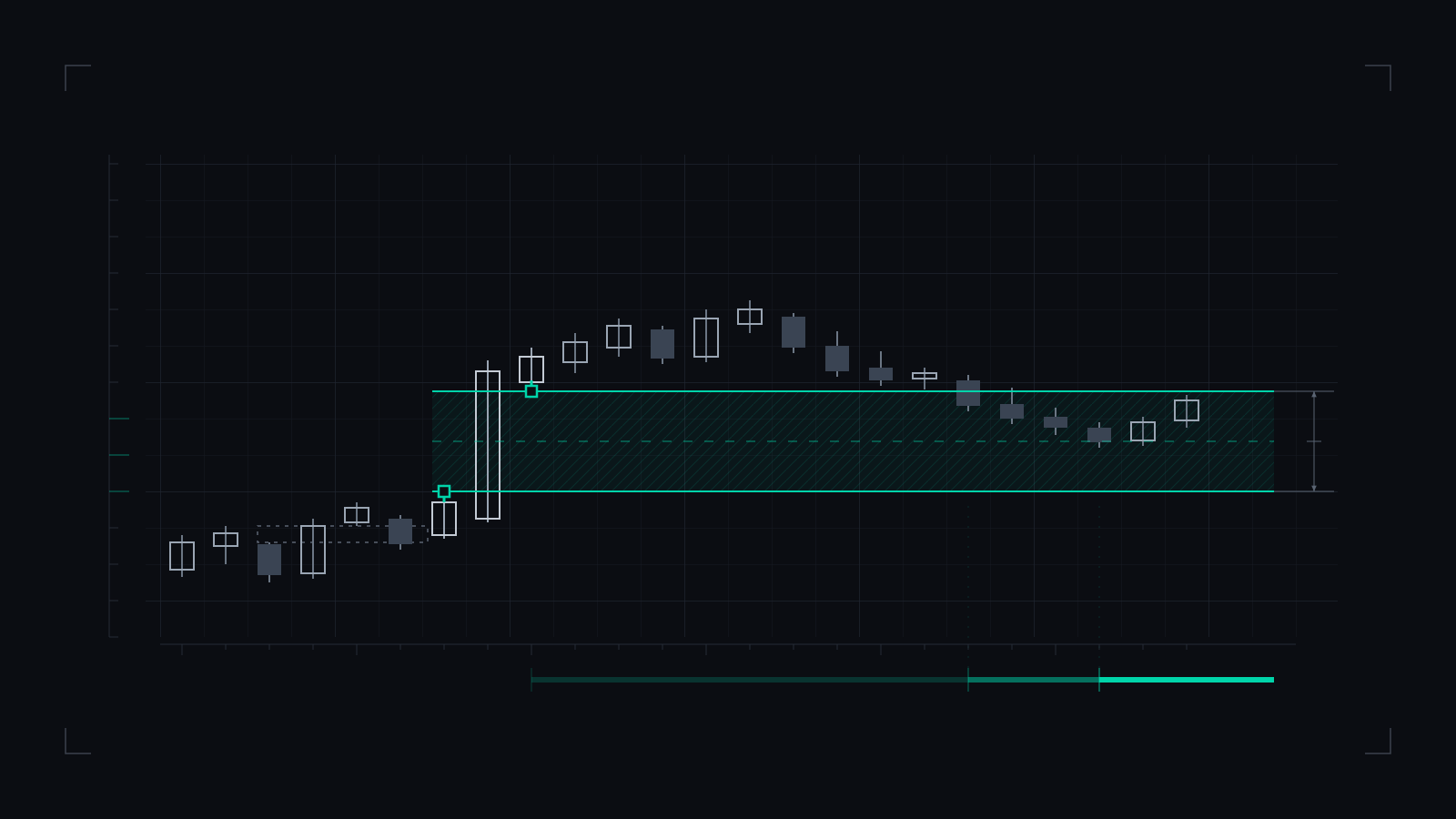
The three-candle arrangement the definition admits: the middle candle delivers far enough that the first candle’s high and the third candle’s low cannot overlap, and the span left between them is the gap.
A drawn gap establishes that the arrangement occurred. It does not establish that price returns to the span, or what follows if it does.
Fair value gap (FVG), bullish form: what the definition states, in full.
| Element | What the definition states |
|---|---|
| Test | Third candle’s low is above the first candle’s high (bullish). Mirrored for bearish. |
| CandlesThe same tape aggregated differently prints different gaps. | Exactly three, consecutive, on one stated timeframe. |
| The gap | The span between those two prices. |
| Fill | Later price trading back through the span. |
| Minimum sizeA floor below which a gap is not drawn is a parameter, not a fact about the market. | election pending |
| Not established | Whether price returns, how often, or what a return is worth. |
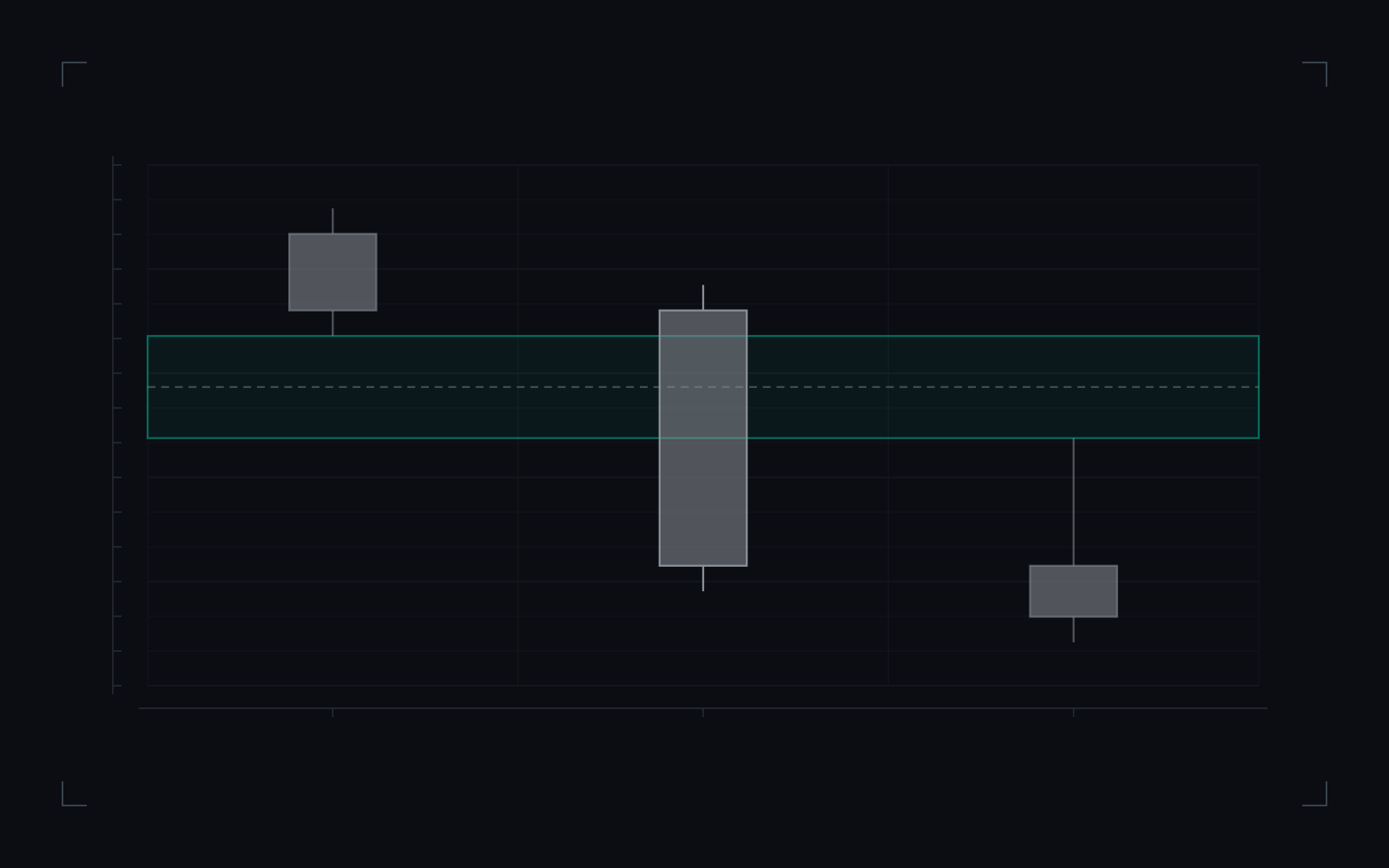
- Three consecutive falling candles. As in the bullish form, the gap belongs to the trio.
- The middle candle delivers the fall, leaving the first candle’s low and the third candle’s high unable to meet.
- The bearish gap: the span between the third candle’s high and the first candle’s low, which only the middle candle traded.
- Consequent encroachment: the midpoint of the span, the mean of its two boundaries.
The mirror arrangement: the middle candle falls far enough that the first candle’s low and the third candle’s high cannot overlap, and the span between them is a bearish gap, drawn with its midpoint.
A drawn bearish gap establishes that the mirrored arrangement occurred. It does not establish that price rallies back into the span, or that the midpoint turns it.
Fair value gap (FVG), bearish form: what the definition states, in full.
| Element | What the definition states |
|---|---|
| Test | Third candle’s high is below the first candle’s low. |
| Boundaries | The first candle’s low above, the third candle’s high below. |
| Consequent encroachment | The mean of the two boundaries. |
| InversionA close above the upper boundary is one stated rule and a wick through it another; the two invert different gaps. | election pending |
| Not established | Whether a rally reaches the span, stops at its midpoint, or closes through it. |
Commonly confused with
Neighbouring concepts that get used interchangeably, and the distinction that actually separates them.
- Liquidity void
A void is a run of consecutive one-directional candles whose whole traversal traded thin — a stretch of territory. The fair value gap is a three-candle test with exact boundaries. A void often contains gaps; the gap is the smaller, sharper object with the checkable definition.
- A session or weekend gap
Opening gaps are discontinuities between one close and the next open — no trading happened in between at all. A fair value gap prints inside continuous trading: the middle candle traded through the band, just one-sidedly. Different mechanics, unhelpfully similar names.
- Volume imbalance
The neighbouring ICT object: a gap between consecutive candle bodies where the wicks still overlap. In a fair value gap even the wicks fail to meet. Wick overlap is the entire boundary between the two terms, which is why definitions that skip it blur them.
- An unfilled gap on a gap scanner
Scanner gaps are usually open-to-close discontinuities on daily bars of exchange-traded instruments. The fair value gap is timeframe-relative — the same tape prints different gaps on different aggregations — and exists in continuously traded markets where a scanner would find nothing.
How to measure it in your own data
A definition you cannot test is a definition you have to take on trust. This is the shortest honest route from the concept to a number you computed yourself.
- Records you need
Candle data at a declared timeframe. The object is aggregation-relative: recompute the same tape at another timeframe and different gaps exist, so the timeframe is part of the claim.
- What you compute
For each consecutive candle triple, bullish when the third candle's low exceeds the first candle's high; bearish when the third's high sits below the first's low. Boundaries are those two wick prices; the midpoint is their mean. Optional elections, stated if used: a minimum size relative to average true range, and wick-versus-close rules for touches and invalidation.
- What the answer tells you
A strong middle candle — often a displacement bar — flanked by two candles whose wicks do not reach each other, leaving a visible band the move crossed without two-way trade. Later price returning into the band and reacting at its edge or midpoint is the taught picture; the frequency of that picture is a measurement, not a definition.
Questions and answers
What is a fair value gap?
A three-candle imbalance where the first and third candles' wicks fail to overlap — the middle candle crossed a band of prices with trade dominated by one side. The band between the two wicks is the gap, and its midpoint is tracked as its own reference.
What is the exact rule for a bullish fair value gap?
The third candle's low sits above the first candle's high; the gap runs between those two prices. The bearish mirror is the third candle's high below the first candle's low. It is one comparison per candle triple, which is what makes the object checkable by two people independently.
What is consequent encroachment?
The taxonomy's name for the gap's midpoint — halfway between the boundaries. Reactions at that line are taught as meaningful, and whether the midpoint behaves differently from any other level inside the gap is a measurable question rather than a settled one.
What does a fair value gap example look like in numbers?
Constructed numbers, real rule. Candle one prints a high of 1.1000; the middle candle rallies hard; candle three's low holds at 1.1012. The wicks never overlap, so the band from 1.1000 to 1.1012 is a bullish fair value gap, and 1.1006 — the mean of the boundaries — is its consequent encroachment. Run the mirror comparison for the bearish case. Any three candles on any timeframe either pass this test or do not.
What is FVG trading?
FVG is the standard abbreviation, and FVG trading names the practice built on the object: waiting for price to return into a gap and treating the edge or the midpoint as an entry reference. The definition half of that is checkable and free; the behavioural half — that returns react there at useful rates — is a distribution claim that needs measurement, and no version of the practice escapes that boundary.
Do fair value gaps always get filled?
No definitional answer exists, and always is doing illegitimate work in the question. A gap is filled when price trades back through the whole band; how often that happens, and how fast, varies with the gap's size and context — a distribution to measure, not a promise to repeat.
Is a fair value gap bullish or bearish?
Either, and the test decides which. The band left when the third candle's low sits above the first candle's high is a bullish gap; the mirror, the third candle's high below the first candle's low, is a bearish one. The orientation describes the imbalance that printed. It does not say what price does next, and reading it as a direction call is the behavioural claim that needs measurement.
Which timeframe is best for fair value gaps?
The definition prefers none, because the object is aggregation-relative: the same tape prints different gaps at different timeframes, so every gap is quoted with the timeframe that made it. Which aggregation's gaps behave most usefully is a comparison to run on data, not a property the definition can supply.
What is the difference between a fair value gap and a liquidity void?
Size and construction. A fair value gap is one three-candle test with exact boundaries; a liquidity void is a run of one-directional candles whose whole traversal traded thin, and it often contains several gaps. The gap is a defined event; the void is a stretch of territory.
What is an inverse fair value gap?
A fair value gap that price has closed through under a stated invalidation rule, after which the same band is expected to work in the opposite role. The inversion has its own entry, because the rule that triggers it decides which gaps invert.
How do you trade a fair value gap?
As taught: wait for price to return into a gap left by a move in the direction of the bias, take the entry at the edge or at consequent encroachment, and place the stop beyond the far boundary or the swing behind it. That describes the practice; the entry line and the stop rule are elections, and each changes what a result means.
Related terms
Derived from the links this entry makes and the entries that link back to it.
Where the term is in build
Detector datasheets whose concepts include this term, or whose published copy uses it. Each one states the build state it has reached and the parameters it exposes, and carries no measured verdict.