46 / 97
Inverse fair value gap (IFVG)
Written IFVG throughout.
Working definition
A fair value gap that price has closed through decisively, after which the taxonomy expects the zone to act in its flipped role — a failed bullish gap treated as resistance, a failed bearish gap as support.
Every zone vocabulary eventually needs a word for its own failures, and the inverse fair value gap is that word for gaps.
The construction is a state transition, not a new shape. A fair value gap prints as a three-candle imbalance with defined boundaries; from there it carries a small state machine — untouched, touched, midpoint reached, filled. Inversion is the further state the taxonomy adds when the gap is not merely filled but closed through decisively: the imbalance that was supposed to matter in one direction failed to, and the same boundaries are now expected to matter in the other. A failed bullish gap becomes expected resistance; a failed bearish gap, expected support.
Everything load-bearing in that sentence sits in the invalidation rule, so a serious use of the term states it. Does a wick through the far boundary invert the gap, or only a close? Any close, or a displacement-quality one? Elections differ across teachers and tools, and different elections mark different gaps as inverted on the same chart — which is precisely why an inversion flag without its stated rule cannot be checked by a second person.
The term keeps close company with the breaker block, and the two are worth separating cleanly: both are role-flip objects, but the breaker’s parent is a failed order block constructed through a sweep-then-break sequence, while the inverse gap’s parent is a failed imbalance. The narratives rhyme — failure converts an object to its opposite — and the geometry does not overlap. A vocabulary that conflates them loses the ability to say which one a chart actually shows.
Bullish and bearish, worked
A bearish inverse gap starts life as a bullish fair value gap that price closes through downward; the band is then expected to resist rallies. A bullish inverse gap is the mirror: a bearish gap closed through upward, expected to support. With constructed numbers: a bullish gap runs from 1.0900 to 1.0912. Later a strong candle closes at 1.0894, beneath the gap’s lower boundary. Under a close-beyond-the-far-boundary rule the gap has inverted. When price rallies back to 1.0909, inside the old band, and turns, the taught reading is the flipped zone doing its new job; the count that matters is how often that happens against a neutral band of the same width.
With other gaps and blocks
Inversion and overlap are different operations on gaps. A balanced price range keeps the prices two opposite gaps share, while an inversion reuses one gap after it failed. The two can appear together: the move that closes through an old gap can leave a new gap of its own in the opposite direction, and where the bands overlap the chart shows a balanced price range and an inverse gap at once. Entries on an inverse gap face the same elections as any gap: the edge or the consequent encroachment, and a stop beyond the far boundary or the swing behind it.
Common mistakes
Calling any filled gap inverted, which erases the difference between completion and failure. Applying a wick-through rule on one chart and a close-through rule on the next. And judging the flip by the revisits that turned, without counting the ones that went straight through.
What the page does not settle
The flip itself. That price closed through a gap is an observation; that the spent zone now works the other way is an expectation stacked on it, and expectations are testable — revisit behaviour at inverted zones against comparable neutral levels is a well-posed measurement, with a row of its own in the claims ledger. The inverse fair value gap is a precisely defined label for a precisely defined failure, and the two lenses keep the label and the claim apart.
Where it sits in the ICT sequence
The ICT vocabulary in the order the method is taught, with a step for each kind of object.
- Step
- 05 of 08 Imbalances: the bands price crossed one-sidedly and is expected to revisit
- Also at this step
- Fair value gap (FVG), Consequent encroachment (CE), Balanced price range (BPR), Liquidity Void, Volume imbalance
- Before it
- Consequent encroachment (CE)
- After it
- Balanced price range (BPR)
The shape, drawn
The smallest arrangement the definition admits. It is a drawing of a rule, not a reading of a market — nothing here is measured, and the table below it is the authoritative version.
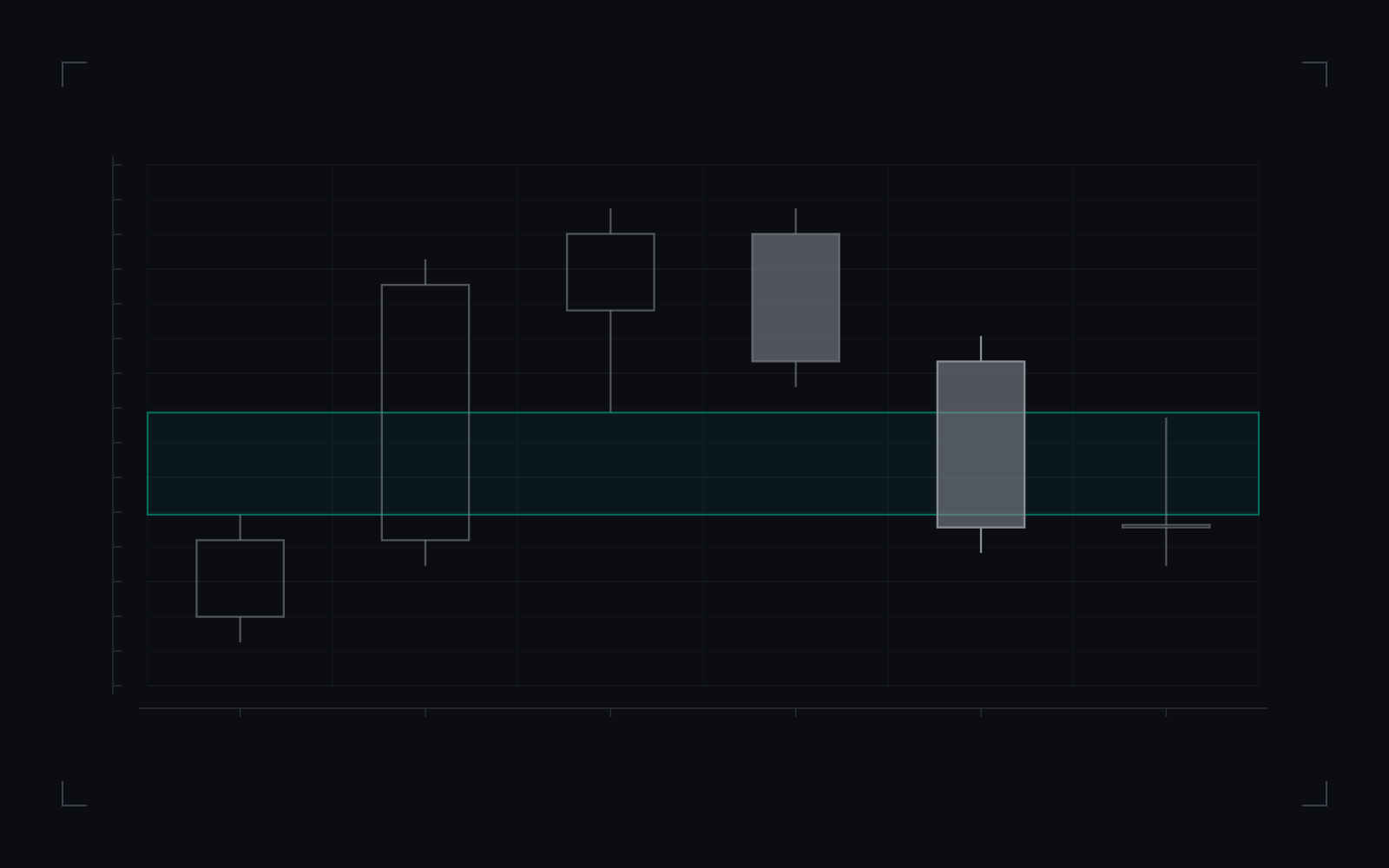
- The original fair value gap — the span the trio left untraded.
- The close through the whole span. A wick through is not enough; the definition asks for a decisive close.
- The return: price probes the underside of the failed gap and closes back off it — the flipped role the taxonomy expects, drawn as an expectation, not a result.
A fair value gap that failed, and the flipped role that follows: the trio forms the gap, a later candle closes through it decisively, and the return that respects its underside is the zone acting in reverse.
Drawing the inversion establishes the sequence the definition names. It does not establish that a failed gap acts in its flipped role, or how often.
Inverse fair value gap (IFVG), bearish form: what the definition states, in full.
| Element | What the definition states |
|---|---|
| Precondition | A fair value gap, formed exactly as its own entry defines. |
| Inversion testWick-through versus close-through is the same election every zone family carries. | A close through the full span. |
| Flipped role | A failed bullish gap treated as resistance; a failed bearish gap as support. |
| Not established | Whether the flipped role holds, how often, or for how long. |
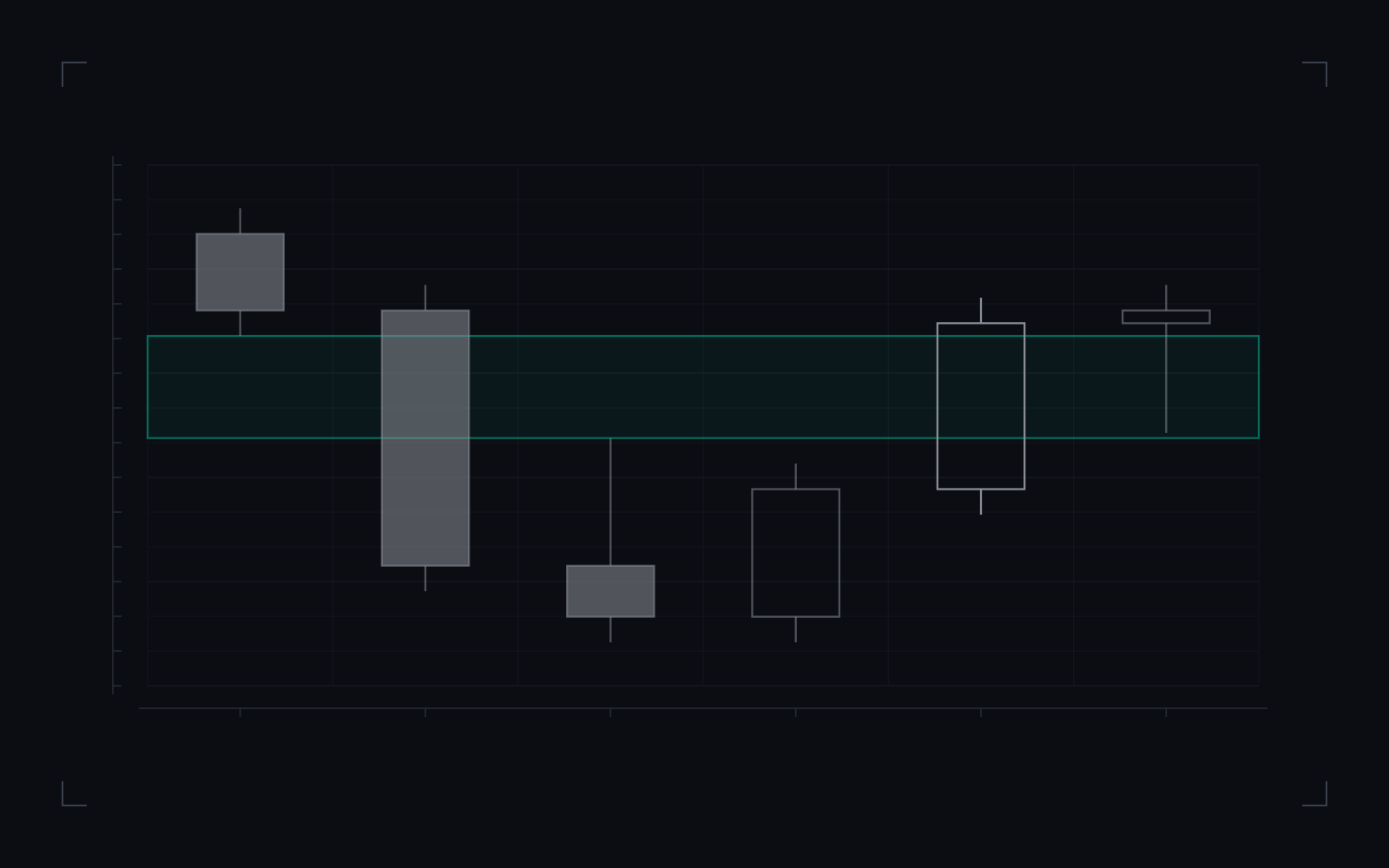
- The original bearish gap: the span between the third candle’s high and the first candle’s low.
- The close above the whole span, which inverts the gap under a close-beyond-the-far-boundary rule.
- The return: price dips back into the span from above and closes above it again, the support role the taxonomy expects, drawn as an expectation, not a result.
The mirror failure: a bearish gap forms, a later candle closes above the whole span, and the return that dips into the span and closes back above it is the zone expected to act as support.
Drawing the mirrored inversion establishes the sequence in the other direction. It does not establish that a failed bearish gap supports price more often than a neutral band would.
Inverse fair value gap (IFVG), bullish form: what the definition states, in full.
| Element | What the definition states |
|---|---|
| Precondition | A bearish fair value gap, formed exactly as its own entry defines. |
| Inversion testThe close-through election of the bearish form, run the other way. | A close above the gap’s upper boundary. |
| Flipped role | Support on a return from above. |
| Not established | Whether returns from above hold the span more often than they hold a neutral band of the same width. |
Commonly confused with
Neighbouring concepts that get used interchangeably, and the distinction that actually separates them.
- Fair value gap
The parent object. A fair value gap is the three-candle imbalance itself; the inverse form exists only after that gap has been invalidated by a decisive close through it. Same boundaries, opposite expected role — the inversion is a state transition, not a new shape.
- Breaker block
Both are role-flip objects, but the parent differs: a breaker is a failed order block — candle-bodied, and defined through a sweep-then-break sequence — while an inverse gap is a failed three-candle imbalance. The taxonomy often cites them together because the flip logic rhymes; the geometry does not.
- A support-resistance flip
The classical flip is drawn at a level — a horizontal price where prior support is retested as resistance. The inverse gap is a zone with two boundaries and a defined midpoint, inherited from the parent gap, and its flip is triggered by a stated invalidation rule rather than by eye.
- A filled gap
Filling is completion: price traded back through the whole imbalance, and under many conventions the object is then spent. Inversion is a claim about what happens after that fill — that the spent zone now works the other way. Fill is the observation; inversion is the additional expectation stacked on it.
How to measure it in your own data
A definition you cannot test is a definition you have to take on trust. This is the shortest honest route from the concept to a number you computed yourself.
- Records you need
Candle data at a declared timeframe, the parent gap's boundaries, and a stated invalidation rule — wick-through versus close-through, and whether the close must land beyond the far boundary or merely inside the gap.
- What you compute
Track each fair value gap's state — untouched, touched, midpoint reached, filled — and flag inversion when the stated invalidation fires. Then, if any claim is being made, record what price does at revisits of the inverted zone against a comparable neutral level, because the flip is an expectation and expectations are testable.
- What the answer tells you
A gap that was expected to hold as an imbalance instead gets closed through with conviction — often by a displacement candle — and later revisits stall at or inside the old boundaries from the other side. That sequence is the taught picture; how often it actually plays out that way is a measurement, not a given.
Questions and answers
What is an inverse fair value gap?
A fair value gap that failed — price closed through it decisively — which the ICT taxonomy then treats as a zone of the opposite character: a failed bullish gap expected to resist, a failed bearish gap expected to support. The boundaries stay where the parent gap put them.
What invalidates a fair value gap into an inverse one?
A stated rule, and the stating matters: common elections are any close beyond the gap's far boundary, or a displacement-quality close through the whole zone. Wick-through versions exist too, and different elections mark different gaps as inverted on the same chart.
Is an IFVG the same thing as a breaker block?
No. The flip logic rhymes — a failed object expected to work the other way — but the parents differ: a breaker comes from a failed order block through a sweep-and-break sequence, while an inverse gap comes from a failed three-candle imbalance. Different geometry, different construction, one shared narrative.
Do inverse fair value gaps work?
The flip is an expectation stacked on an observation, and only the observation is free. How revisits of inverted zones behave against comparable neutral levels is a measurable question, and a definitions page is the wrong place to assert its answer.
Related terms
Derived from the links this entry makes and the entries that link back to it.
Where the term is in build
Detector datasheets whose concepts include this term, or whose published copy uses it. Each one states the build state it has reached and the parameters it exposes, and carries no measured verdict.