66 / 97
Optimal trade entry (OTE)
Written OTE throughout.
Working definition
The retracement band between 62% and 79% of a reference leg — with 70.5% as its midline — where the ICT methodology stages entries in the direction of that leg.
Most retracement vocabulary hedges, and optimal trade entry is interesting precisely because it does not.
The construction commits three numbers to a chart. Over a reference leg — chosen by a stated rule, of which more below — the band spans the 62% and 79% retracement prices, with the 70.5% line tracked as its midline. Price occupying the band means the retracement has surrendered between roughly two-thirds and four-fifths of the leg, which is deep enough that the move looks like it is failing — the psychology the method openly leans on, staging entries where conviction in the original direction is scarcest.
The leg rule carries more of the load than the ratios. The same chart offers many legs, and a band that fits in hindsight can always be found if the leg is chosen after the fact — so the method’s own grammar names the leg in advance: conventionally the move that completed a liquidity sweep and market structure shift sequence, the manipulation leg whose retracement is then measured. The band also composes with range logic: the method wants it sitting in the correct half of the dealing range — the discount when buying, the premium when selling — with equilibrium splitting the two. A band in the wrong half is, by the method’s own rules, not the setup.
The commitment is what earns this object its unusual epistemic status in the cluster: a fixed band is testable in a way a menu is not. A plain Fibonacci drawing offers half a dozen levels and retroactively claims whichever held; a committed band can be run against its neighbours — the boundary-perturbation comparison, outcomes inside 62–79 versus equal-width bands either side of it, under the stated leg rule. That test is well-posed, decisive about whether these particular numbers matter, and conspicuously absent from the sources that teach them. Its neighbouring vocabulary keeps the edges sharp: the crypto world’s golden pocket commits to a different, shallower band, and conflating the two muddies both claims.
A location is not a trigger, and the two lenses close this page as they close the cluster: the band’s construction is exact, checkable, and stated; the proposition that turns favour it is a hypothesis with a known shape of test. Between those two sentences is where every retracement method lives, and honesty about which side of the line a statement sits on is the entire discipline this glossary exists to enforce.
Where it sits in the ICT sequence
The ICT vocabulary in the order the method is taught, with a step for each kind of object.
- Step
- 07 of 08 Range: where in the dealing range an entry sits, and at what retracement
- Also at this step
- PD array
- Before it
- PD array
- After it
- ICT 2022 model
The shape, drawn
The smallest arrangement the definition admits. It is a drawing of a rule, not a reading of a market — nothing here is measured, and the table below it is the authoritative version.
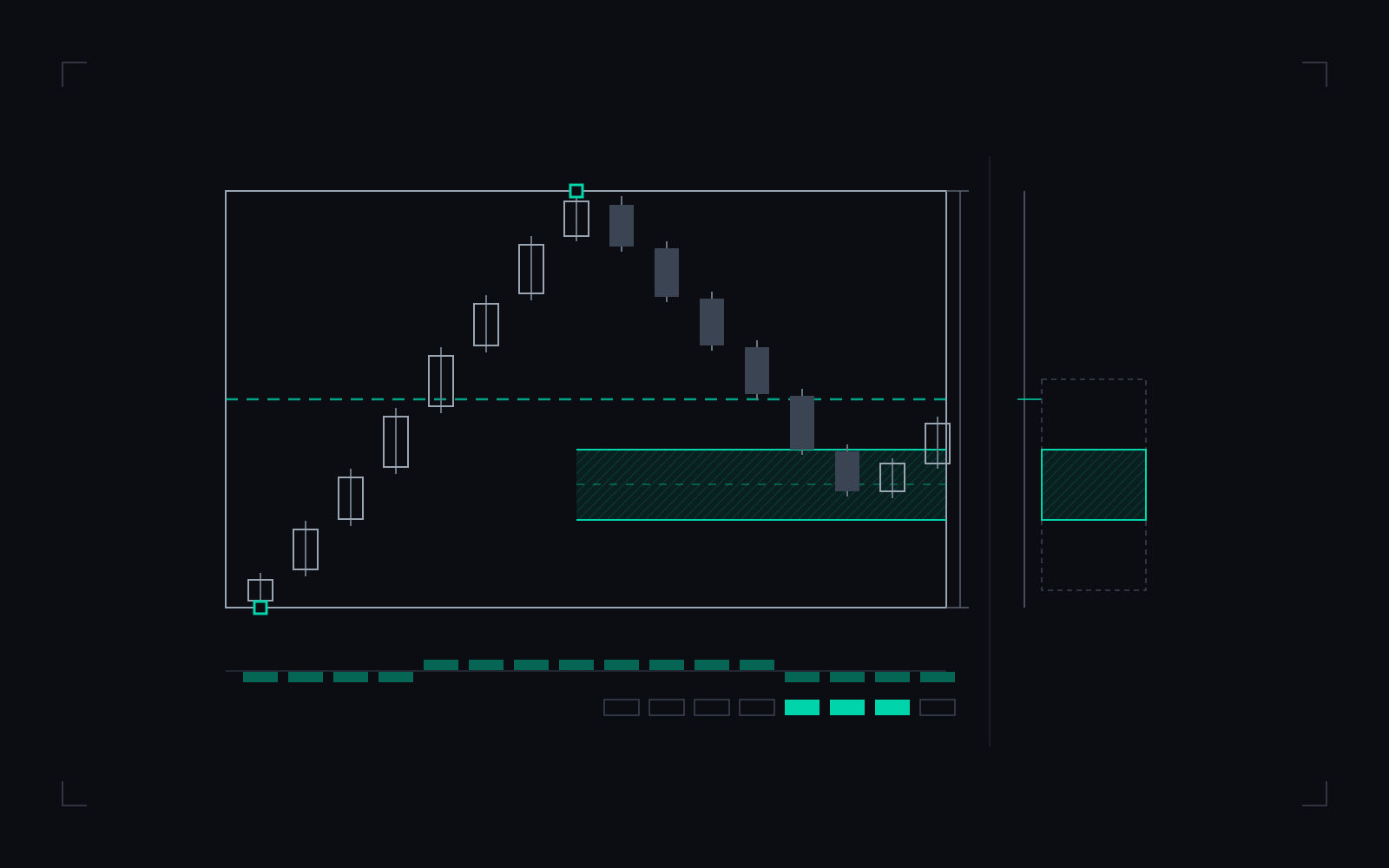
A committed band, and the set it will be compared against. The dealing range, its equilibrium, and one retracement band at stated edges — with the neighbouring bands drawn beside it, because fixed edges can be tested and a menu of levels cannot.
Drawing the band establishes where it sits and how long price spent inside it. It does not establish that the committed band differs from the neighbours drawn beside it — that is the measurement, and it has not been made.
Optimal trade entry (OTE): what the definition states, in full.
| Element | What the definition states |
|---|---|
| Dealing range | Swing-anchored, between qualifying extremes from the line’s one swing engine. |
| Equilibrium | 50% of the range. Above it is premium, below it is discount. |
| The band | 0.62 to 0.79 of the reference leg, midline 0.705. |
| CommitmentA set of ratios wide enough to always contain the price that mattered cannot be wrong, and a rule that cannot be wrong is not a rule. | One band, not a menu. |
| Comparison set | The committed band drawn against its neighbours, so the choice of edges is checkable rather than assumed. |
| Leg ruleWhich leg the band measures is named in advance, because a leg chosen after the fact fits anything. | election pending |
| Occupancy | Per-bar premium, discount and in-band states, so time in a zone is data rather than impression. |
| Not established | Whether the committed band differs from the neighbours beside it. |
Commonly confused with
Neighbouring concepts that get used interchangeably, and the distinction that actually separates them.
- A Fibonacci retracement
The tool is the same — ratios drawn over a leg — but a plain Fibonacci pull offers a menu of levels with no commitment. Optimal trade entry commits: one band, 62 to 79 percent, one midline, and a stated leg-selection rule. The commitment is what makes it testable, which a menu never is.
- The golden pocket
The adjacent crypto-vocabulary band, conventionally 61.8 to 65 percent. It overlaps the optimal trade entry band's shallow edge and stops far short of its deep one. Two different bands sharing one ancestor ratio, routinely conflated in chart commentary.
- Premium and discount
Premium-discount splits a whole dealing range at its equilibrium — above the midpoint is premium, below is discount. The entry band is a narrower zone measured over one leg, and the method wants both at once: the band, sitting in the correct half of the range.
- An entry signal
The band is a location, not a trigger. Occupancy of it fires no event; the method still requires its sequence — the sweep, the shift — to have happened first. Treating band-touch as a signal strips the method's own stated conditions and then blames the band.
How to measure it in your own data
A definition you cannot test is a definition you have to take on trust. This is the shortest honest route from the concept to a number you computed yourself.
- Records you need
Candle data at a declared timeframe and a stated leg-selection rule — which swing low to which swing high, or the manipulation leg of a completed sweep-and-shift sequence, named in advance.
- What you compute
Over the reference leg, the band spans the 62% and 79% retracement prices with the 70.5% line as midline. Occupancy is a per-bar flag. Any claim for the band is then a comparison: outcomes entered inside it versus neighbouring bands of equal width — the boundary perturbation that decides whether these particular numbers matter.
- What the answer tells you
A retracement that gives back roughly two-thirds to four-fifths of the leg before turning — deep enough to look like failure, which is the psychology the method leans on. Whether turns cluster in that band beyond what any deep-pullback band would show is the measurable part, and the specific ratios are the claim under test.
Questions and answers
What is optimal trade entry in ICT?
A committed retracement band — 62 to 79 percent of a reference leg, midline at 70.5 — where the methodology stages entries in the leg's direction, after its preconditions have printed. The commitment to fixed numbers is what distinguishes it from a general Fibonacci pull.
What levels define the OTE zone?
The 62 percent and 79 percent retracements of the chosen leg, with 70.5 percent tracked as the midline. The leg-selection rule matters as much as the ratios: the same chart offers many legs, and an unstated choice makes any band fit in hindsight.
Is OTE just a Fibonacci retracement?
It uses the ratio machinery, but where a Fibonacci drawing offers a menu, this band commits to one zone and one midline. That commitment is a feature for honesty: a fixed band can be tested against its neighbours, while a menu of levels can always claim whichever one worked.
Does the OTE zone actually work?
The well-posed version: do reversals cluster in the 62–79 band beyond what neighbouring bands of equal width show, under a stated leg rule? That boundary-perturbation test is exactly how the claim should be examined, and this page does not pre-empt its answer.
Related terms
Derived from the links this entry makes and the entries that link back to it.
Where the term is in build
Detector datasheets whose concepts include this term, or whose published copy uses it. Each one states the build state it has reached and the parameters it exposes, and carries no measured verdict.