71 / 110
One shot one kill (OSOK)
Written OSOK throughout.
Working definition
An ICT name used for two selection rules: in the guides that teach it, a weekly plan of one trade in the direction of the weekly bias, taken after an early-week move against that bias turns; in the detector campaign's claims ledger, a selector that keeps the single highest-grade composite event of each day.
One shot one kill is a name for taking one trade where several are on offer, and the ICT vocabulary attaches it to two different rules for choosing that one.
Two readings of one name
The weekly plan. In most of the guides that rank for the term, one shot one kill (OSOK) is a plan for a whole week, and one adds that the same model is applied to intraday moves. A weekly bias is written before the week opens, the first days are watched for a move against that bias into resting liquidity, and a single trade is taken in the bias direction once the move turns.
Most of the guides allow one trade a week; one allows one or two setups. Two credit the model to Michael Huddleston, who teaches the vocabulary under the ICT name, and one adds that no single authoritative statement of its rules exists, which is why published versions differ in their details.
The daily selector. In the detector campaign’s frozen definitions, as the claims ledger transcribes them, the name belongs to a driver in the composite-models wave whose row reads “the single highest-grade composite per day”. Its neighbours in that wave are the named sequences: the ICT 2022 model, the judas swing, turtle soup, the smart money reversal, and others. Read as its name and row describe it, the driver ranks the composite events a day has produced and keeps one.
The readings differ in cadence, a week against a day, and in what gets chosen: a trade planned from a bias, against an event picked from a ranked list. None of the guides describes a per-day selector, and the ledger row does not mention the week. The published pages do not say whether the selector is meant as a formal version of the weekly plan, so each is set out below on its own terms.
The weekly plan, stated
The guides describe the plan in five stages, and every number in them is a setting the teaching chose.
- Preparation. Before the week, list the scheduled medium- and high-impact releases for the market. On the weekly chart, mark the highest high and lowest low of a lookback range, name the draw on liquidity inside it, and find a PD array of the bias’s own kind in the half of the range the plan buys or sells from: the discount half for a bullish bias, the premium half for a bearish one.
- Room to run. Check that the distance to the target leaves space for the move the plan aims at, 50 to 75 pips in the guides that give a figure.
- Planning. Wait for price to move against the bias into liquidity while a qualifying release is due.
- Execution. Once that move has turned, drop to a 15-minute chart and enter on a retracement into the optimal trade entry band, inside the London open or New York open kill zone.
- Management. Two guides place a limit 50 pips from entry, close 80% of the position there and hold the remainder toward 75 pips. Another aims at the far side of the week’s projected range and keeps the stop beyond the week’s extreme that the anchor move made. For the stop, one guide instead uses the extreme of the 15-minute swing the entry band is drawn on, and another an order block.
Three of those settings need a note. The lookback. Two guides measure the range over 20 weeks on the weekly chart and call it the IPDA data range, while the IPDA entry records the data ranges as 20, 40 and 60 trading days. Twenty weeks is about a hundred trading days, five times the shortest of those windows, so a plan that names its range without its length cannot be repeated. The band. The optimal trade entry page in this glossary states the band as 62% to 79% of the leg; one guide writes it as 61.8% to 78.6%, a small difference that still moves both edges on every leg. The timeframes. One guide reads the array on the four-hour chart and enters on the 15-minute; another watches the move against the bias on the hourly chart and enters on a five- to 15-minute chart.
The early-week anchor
The planning stage carries the plan’s timing rule. The move against the bias, which two guides call the anchor point, has to form on Monday, Tuesday or Wednesday, and one guide rules out an anchor on Thursday or Friday. In a bullish week the anchor is expected to be the week’s low, made by trading through a visible level where stops are assumed to rest, such as the previous week’s low, and closing back above it: a liquidity sweep. A bearish week mirrors it at the high.
The rule is a claim about when weekly extremes form, and it shares a base rate with the ICT weekly profiles. The days on which weekly highs and lows print have a distribution of their own, measurable over many weeks, and early-week extremes are common in it. A plan that waits for an early-week extreme will find one in many weeks whether or not the bias, the array or the release added anything.
The release condition raises a calendar question. Two guides list the payrolls report among the qualifying releases, and the non-farm payrolls entry records that the report is typically published on the first Friday of the month, which falls outside the Monday-to-Wednesday window of the same week. Which releases count, on which days, and how close to the anchor they must fall is a setting the plan has to write down before its weeks can be scored.
A worked week
Constructed numbers, not a record of any real week. On EUR/USD the 20-week range runs from 1.0620 to 1.1140, with its midpoint at 1.0880. Before the Sunday open price is at 1.0850, in the range’s discount half, and the bias is written as bullish, with an old weekly high at 1.0990 as the draw on liquidity. The array is a four-hour bullish fair value gap from 1.0788 to 1.0805, just beneath the previous week’s low at 1.0812. A release is scheduled for Tuesday at 08:30 New York time, inside the New York open window.
On Tuesday at 08:40 price trades down to 1.0790, into the gap and beneath the previous week’s low, and closes back above 1.0812 within the hour. It then rallies with displacement to 1.0890, breaking 1.0836, the last intermediate lower high on the 15-minute chart: the market structure shift the plan waits for. The leg from 1.0790 to 1.0890 is 100 pips, so its 62% retracement sits at 1.0828, its 79% retracement at 1.0811 and the 70.5% midline at 1.08195. A limit order at 1.0820 fills on the pullback at 09:50, with the stop at 1.0785, five pips beneath the anchor low; the five pips are the buffer election.
The two management rules now part. Under the fixed-pip rule, 80% of the position closes at 1.0870, 50 pips above entry, and the remainder is aimed at 1.0895, 75 pips above it. Under the weekly-range rule the target is the draw at 1.0990. The stop is the same under both. Everything above is a set of drawn prices; which of them trades before 1.0785 is the outcome the plan forecasts. Had Wednesday closed without a qualifying anchor, the week would go into the record as a week with no trade.
The daily selector, stated
The ledger row names what the selector keeps, one composite a day, and what it ranks by, a grade, and the published pages do not spell out how the grade is computed. Any selector of this kind has four settings to state before it can be run:
- The grade: what raises or lowers a composite’s rank.
- Ties: what happens when two composites score the same.
- Empty days: how a day with no composite is recorded.
- The moment of choice: whether the selector commits as composites arrive, or ranks them once the day has closed.
The last setting decides whether the rule can be followed at all. The highest-grade composite of a day is known only after the day ends, so a selector that ranks at the close can count days after the fact, but scoring its pick as a choice made when that composite printed uses information nobody had then, which is look-ahead bias. A selector that commits in real time needs a rule instead, such as the first composite at or above a stated grade, and then it will not always keep the day’s highest grade. The ledger row does not say which of the two the campaign’s selector does.
A constructed day shows the difference, with a grading rule invented for the illustration and not taken from the campaign: one point each for printing inside a kill zone, for agreeing with the written daily bias, and for a shift delivered with displacement. A judas swing completes at 02:40 New York time, inside the London open window and in the bias direction, without displacement: two points. A 2022-model sequence completes at 08:45, inside the New York open window, in the bias direction, with displacement: three points. A turtle soup completes at 13:10, outside every window and against the bias, with displacement: one point. Ranked at the close, the selector keeps the 08:45 sequence. Committing in real time to the first composite with two points or more, it keeps the 02:40 judas swing. Same day, same grading rule, two different selections, which is why the moment of choice belongs in the definition.
The Judas & Silver Bullet Models datasheet draws several of the composites such a selector would rank, each listed with the sweep, shift and array that composed it.
Other things called one shot one kill
The name travels. One published indicator script under the name describes a daily construction: a sweep of the previous day’s high or low, a change in state of delivery, and an entry at a 61.8% retracement aimed at the previous day’s other extreme.
That is closer in cadence to the ledger’s daily reading than to the weekly plan, and it is a third set of rules under the same name. One guide separates the weekly plan from the One Trade Setup for Life, which it describes as a daily model built on session ranges. And the phrase itself is marksman’s language: it promises a hit with each shot, while the plan fixes only how many shots are taken. Searches for it also surface its use in shooting games, a separate subject.
Planning and scoring a week, step by step
- Before the Sunday open, write the bias, the draw on liquidity, the lookback range with its length, and the releases that qualify.
- Mark the pool against the bias: the previous week’s low in a bullish week, its high in a bearish one.
- From Monday to Wednesday, watch for a sweep of that pool inside a stated kill zone, near a qualifying release.
- Require the shift, measure its leg, and mark the 62% to 79% band on the stated entry timeframe.
- Write the entry, the stop, the buffer and the target before the order goes in, naming the management rule.
- Record the week as target first, stop first, open at the Friday close, or no trade, and keep every week in the record.
Common mistakes
Writing the bias after Monday’s move has already shown its direction. Stretching the anchor into Thursday after a quiet start. Calling a 20-week range and a 20-day range by one name without saying which. Carrying a 50-pip target from one pair to another, where 50 pips is a different share of an ordinary week. Leaving the weeks with no trade out of the record, which turns a count of weeks into a gallery of setups. And ranking a day’s composites after the close, then describing the result as a rule someone could have followed.
What the name does not settle
Both readings are selection rules, and a selection rule makes one claim: the candidate it keeps does better than the candidates it discards. For the weekly plan, the count that would test it is the full run of weeks, the empty ones included, each scored under the written management rule and set against the same entry sequence taken on Thursday and Friday, the same sequence without the release condition, and the base rate of early-week extremes.
For the selector, it is a same-day comparison: the kept composite against the day’s discarded composites, and against one drawn at random from the same day. A plan of one trade a week also gathers evidence slowly, at most one trade a week, which is fifty-two or fifty-three a year. The selector driver has a row in the claims ledger, where that verdict renders, and the two lenses keep each rule, which anyone can state, apart from the claim that it chooses well.
Where it sits in the ICT sequence
The ICT vocabulary in the order the method is taught, with a step for each kind of object.
- Step
- 08 of 08 Models: the steps composed into named setups
- Also at this step
- Power of three (PO3), ICT 2022 model, ICT unicorn model, Smart money reversal (SMR), Market maker model (MMXM)
- Before it
- Market maker model (MMXM)
- After it
- Nothing: the sequence ends here
The shape, drawn
The smallest arrangement the definition admits. It is a drawing of a rule, not a reading of a market — nothing here is measured, and the table below it is the authoritative version.
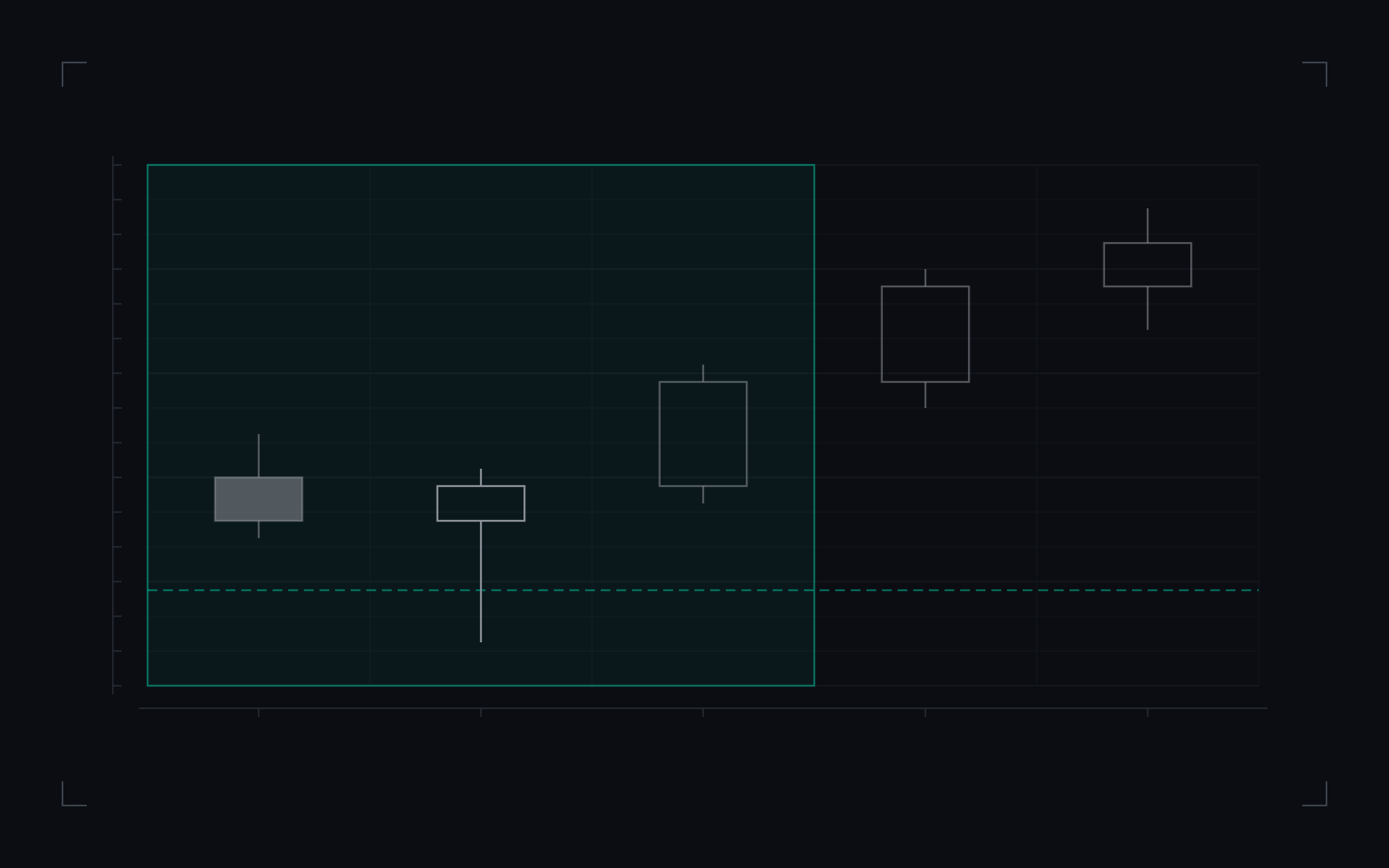
- Monday to Wednesday: the days on which the guides that set a rule allow the anchor.
- The previous week’s low: the pool against a bullish bias.
- Monday, drifting lower before the anchor.
- The anchor: Tuesday trades beneath the previous week’s low and closes back above it.
- The rest of the week, in the direction of the bias written before it opened.
The weekly plan as the guides teach it, on daily candles: a bias written before the week, an early-week candle that trades through the previous week’s low and closes back above it, and one trade in the bias direction for the rest of the week.
The drawing establishes the plan’s timing rule and its anchor. It does not establish that early-week anchors against a written bias do better than the same entries on other days, or than the base rate of early-week extremes.
One shot one kill (OSOK): what the definition states, in full.
| Element | What the definition states |
|---|---|
| Bias | Written before the week opens, with the draw on liquidity and the lookback range. |
| Anchor daysOne guide rules out Thursday and Friday. | Monday to Wednesday. |
| Anchor | A trade through a visible pool against the bias, closed back beyond it. |
| Entry | A 15-minute retracement into the optimal trade entry band inside a kill zone, after a structure shift. |
| Trades | One a week. |
| Qualifying releasesWhich releases count, on which days, and how close to the anchor. | election pending |
| Not established | That the one trade kept does better than the entries passed over, the empty weeks counted. |
Commonly confused with
Neighbouring concepts that get used interchangeably, and the distinction that actually separates them.
- Optimal trade entry
A retracement band, 62% to 79% of a stated leg, which says nothing about the week or the day. The weekly plan uses the band as its entry location and supplies everything around it: the bias, the early-week anchor, the release, the kill zone and the limit of one trade.
- ICT weekly profiles
Templates for the days on which a week's high and low form. The weekly plan leans on the early-week templates among them, the Tuesday and Wednesday low or high of the week, and turns them into a single entry with a stop and a target.
- ICT 2022 model
One entry sequence, whose definition sets no limit on how often it prints. The ledger's selector would rank sequences of that kind and keep one. The weekly plan's trigger belongs to the same family, a sweep and a shift followed by a retracement entry, allowed once a week.
- A trade limit
A cap of one trade a day or a week takes the first setup that qualifies and stops there. A selector compares the period's candidates and keeps the one its grade ranks highest, which can only be known once the period has ended unless the selector states a rule for committing earlier.
How to measure it in your own data
A definition you cannot test is a definition you have to take on trust. This is the shortest honest route from the concept to a number you computed yourself.
- Records you need
Intraday data converted to New York time, on the timeframes the plan names; an economic calendar with release times fixed before each week; and a time-stamped note, written before the Sunday open, of the bias, the draw on liquidity, the lookback range and its length. For the selector reading, every composite event of each day with its time, its grade and the grading rule, stated.
- What you compute
For each week, record whether a qualifying anchor printed from Monday to Wednesday, whether the single trade filled, and whether its target or its stop traded first, keeping the weeks with no trade. Compare with the same sequence taken on Thursday and Friday, and without the release condition. For the selector, compare each day's kept composite with the composites it discarded that day, and with one drawn at random from the same day.
- What the answer tells you
A week that dips beneath the previous week's low around a Tuesday release and rises for the rest of it. Such weeks are easy to collect afterwards, because early-week lows are common anyway; the plan can only be judged on the full run of weeks, the empty ones included, set against the same entries on other days.
Questions and answers
What is one shot one kill (OSOK) in ICT?
A name used for two selection rules. The guides that teach it describe a weekly plan: write a weekly bias, wait for an early-week move against it into resting liquidity, and take one trade in the bias direction once that move turns. The detector campaign's claims ledger uses the name for a selector that keeps the single highest-grade composite event of each day.
How is the ICT one shot one kill strategy traded?
As the guides teach it: list the week's scheduled releases, mark a lookback range and the draw on liquidity on the weekly chart, and watch from Monday to Wednesday for a sweep against the bias near a release. After a structure shift, enter on a 15-minute retracement into the 62% to 79% band inside the London open or New York open kill zone. That describes the practice, not its results.
Which days does the OSOK setup form on?
Monday, Tuesday or Wednesday, in the guides that set a rule, and one of them rules out Thursday and Friday. The rule is a claim about when weekly extremes form. Early-week extremes are common anyway, so a test compares the plan's weeks with the base rate of the days on which weekly highs and lows print.
Where do the stop and the target go in a one shot one kill trade?
The guides differ. Two place a limit 50 pips from entry, close 80% of the position there and hold the rest toward 75 pips; another aims at the far side of the week's projected range. One puts the stop beyond the extreme of the 15-minute swing the entry band is drawn on, one beyond the week's extreme the anchor move made, and a third behind an order block. A target fixed in pips is a different distance in every pair.
Does one shot one kill work?
No definition can say. The claim is that the one trade the plan keeps does better than the trades it passes over. The count that would test it takes every week, the weeks with no trade included, scores each under a rule written in advance, and compares the result with the same entries on other days and without the release condition.
Related terms
Derived from the links this entry makes and the entries that link back to it.