45 / 110
ICT quarterly theory
Working definition
A scheme built on ICT teaching that divides the New York clock into nested quarters, from the year to the 22.5-minute micro quarter, casts each cycle's four quarters as accumulation, manipulation, distribution and continuation or reversal, and treats the price at which its second quarter opens as the true open.
Quarterly theory takes the clock and cuts it into fours at every scale, then gives each of the four pieces a part in a sequence.
The partition
The scheme is a stack of cycles, each divided into four quarters, all on the New York clock:
- The year, in quarters of three calendar months: January to March, April to June, July to September and October to December.
- The month, in four weekly quarters counted from its first Monday. One guide sets aside any partial week before that Monday.
- The week, in four daily quarters: Monday, Tuesday, Wednesday and Thursday. Friday sits outside the cycle; the descriptions give it a role of its own without placing it in a quarter.
- The day, in four six-hour quarters starting at 18:00: 18:00 to 00:00, labelled Asia; 00:00 to 06:00, London; 06:00 to 12:00, the New York morning; and 12:00 to 18:00, the New York afternoon.
- The session, each six-hour quarter in four 90-minute quarters. The London quarter breaks at 01:30, 03:00 and 04:30.
- The micro quarter, each 90-minute quarter in four quarters of 22.5 minutes. The first London 90-minute quarter breaks at 00:22:30, 00:45 and 01:07:30.
From the day down the arithmetic is exact. Six hours is four 90-minute quarters, ninety minutes is four quarters of 22.5 minutes, and a day holds four sessions, sixteen 90-minute quarters and 64 micro quarters that cover it without a gap or an overlap. Above the day it is looser. Calendar quarters run from 90 to 92 days. A month has four or five Mondays, and the descriptions do not say where a fifth week goes. The week’s four quarters cover four of its five trading days.
Where the name comes from
Three of the four pages read for this entry credit it to a trader who publishes as Daye, and one calls that trader a student of ICT teaching; all present it as drawn from that teaching, with its phases taken from power of three. One guide says plainly that it is built on ICT rather than part of it, so the ICT in the name records a lineage. One guide also states the premise behind it: that an algorithm delivers price and takes its cue from each cycle’s first quarter. That is the premise the IPDA entry describes, and nothing in public prices can confirm it.
True opens
A cycle’s true open is the price at which its second quarter opens. Teaching prefers it to the calendar open, on the reading that the first quarter is preparation, which a line drawn after it leaves out. In New York time:
- Year: the first Monday of April.
- Month: the second Monday.
- Week: 18:00 on Monday, which is the start of Tuesday’s trading day when days begin at 18:00.
- Day: 00:00, midnight.
- Sessions: 19:30 for Asia, 01:30 for London, 07:30 for the New York morning and 13:30 for the afternoon.
One guide prints 13:00 for the afternoon session; 13:30 is the time the 90-minute arithmetic gives. The yearly and monthly true opens are the opens of daily candles, so the moment they name depends on the day convention: 18:00 on the Sunday before, or midnight. The day’s true open is the same midnight New York level that the liquidity pools indicator draws among its anchor opens, and the declared open that the judas swing entry gives in its strictest telling.
The phases
The quarters of each cycle carry phases. In the ordering written AMDX:
- First quarter, accumulation: price builds a range.
- Second quarter, manipulation: price trades through one side of that range, the move the judas swing names.
- Third quarter, distribution: the cycle’s move in the other direction.
- Fourth quarter, X: the move continues or reverses.
In the ordering written XAMD, the X comes first and the other three phases follow one quarter later. The true open stays at the second quarter’s open under both. Which ordering a cycle is following is judged from context, a step one guide calls discretionary. One guide adds a rule for the first quarter: a wide first quarter is expected to be followed by a quiet second, and a narrow one by a second that expands.
A worked session
Constructed prices, on EUR/USD, for one day in New York time. The Asia quarter, 18:00 to 00:00, ranges from 1.0852 to 1.0871. Midnight opens at 1.0866, the daily true open. The first London 90-minute quarter, 00:00 to 01:30, trades between 1.0858 and 1.0874, a 16-pip range. At 01:30 the second quarter opens at 1.0861, the London session’s true open.
Between 01:30 and 03:00 price falls to 1.0849: 9 pips beneath the first quarter’s low, 3 beneath the Asia low, 12 beneath the session true open and 17 beneath the daily one. The quarter’s high is 1.0864, and it closes at 1.0863, back inside the first quarter’s range. Between 03:00 and 04:30 price rises to 1.0892, 43 pips above the second quarter’s low.
Read as AMDX, the session fits the taught picture: a range in the first quarter; a run beneath it in the second, which took price below both true opens, where a buyer with a bullish bias is taught to look; and the move up in the third. The fourth quarter, 04:30 to 06:00, is the X. If it carries on to 1.0897, the reading is a continuation. If it falls back to 1.0855, the reading is a reversal. Either way the AMDX reading stands.
The same prices, read the other way
If the fourth quarter falls to 1.0855, XAMD fits as well. The second quarter’s 15-pip range, from 1.0849 to 1.0864, becomes the accumulation; the rally to 1.0892, 28 pips above that range, becomes the manipulation; and the fall becomes the distribution. The second quarter in this example both ran beneath the first quarter’s low and held a range no wider than the first quarter’s, so whichever rule separates a run from a range decides which ordering it supports.
Once the fourth quarter has printed, one ordering or the other fits this session whichever way it went. Before the second quarter opens, the two orderings expect different things of it, a run or a range, and that is the point at which the choice can be written down and later scored.
Where the clock and the market disagree
Halts. Futures stop from 17:00 to 18:00 on weekday evenings, as the new day opening gap entry sets out, and that hour lies inside the afternoon session’s last 90-minute quarter. On a futures chart the quarter from 16:30 to 18:00 holds thirty minutes of trading; of its four micro quarters, the first trades throughout, the second for seven and a half minutes, and the last two not at all. A spot currency feed that quotes through 17:00 fills the same quarter, so one quarter of the clock holds different amounts of trading on different feeds.
Half-minute boundaries. Two of the three boundaries inside every 90-minute quarter fall 30 seconds past a minute, such as 00:22:30 and 01:07:30, and so do half of a day’s 64 micro-quarter starts. No one-minute candle begins there. The guide that sets aside partial weeks illustrates the micro quarters on 30-second candles, and another describes them as about 23 minutes long; either choice is an election.
Daylight saving. Every boundary is a New York wall-clock time, so the grid moves by an hour against UTC, and against any timezone that does not change its clocks on the same dates, exactly as the kill zones do.
Session names. The six-hour quarters borrow session names without matching the windows of the same names elsewhere in the vocabulary. The London quarter runs from 00:00 to 06:00, while the London open kill zone runs from 02:00 to 05:00. The Asia quarter starts at 18:00, two hours before the Asian kill zone. The central bank dealers range, 14:00 to 20:00, crosses the 18:00 boundary into the next day’s first quarter.
Scheduled events. The 08:30 slot of many United States releases falls inside the New York morning’s second 90-minute quarter, the one read as manipulation, and the 09:30 equity open falls inside its third, thirty minutes after that quarter begins. A move in either quarter on a release day may belong to the release.
The ends of the week. When days begin at 18:00, Sunday evening’s trading opens Monday’s quarter. The guide that sets aside partial weeks also sets those Sunday hours aside, and Friday belongs to no weekly quarter, so the weekly grid leaves out trading at both ends of the week by election.
Identifying the quarters, step by step
- Set the chart to New York time through the tz database, not a broker’s server clock or a fixed offset.
- State the day’s start, 18:00 in the descriptions, and mark the six-hour boundaries at 18:00, 00:00, 06:00 and 12:00.
- Divide the session of interest into 90-minute quarters, and into micro quarters if they are used, on candles fine enough to hold the boundaries or under a stated rounding rule.
- Mark the true open at the start of the second quarter, with the first quarter’s high and low.
- Write down the ordering before the second quarter opens, AMDX or XAMD, with the rule that chose it and the rule that tells a run from a range.
- For the week, the month and the year, state how Sunday evening, Friday, partial weeks and fifth Mondays are handled.
Trading it, as taught
Teaching uses the grid in three ways. As a bias line, the true open divides a cycle: with a bullish bias, buying is done below it, and with a bearish bias, selling above it. Price can trade on both sides of an open in the hours after it prints, on rising days and falling days alike, so the rule places an entry once a bias exists and does not supply the bias.
As a sequence, a first quarter’s range and a second quarter’s run through one side of it set up an entry in the third quarter in the other direction. One guide reads the run as a liquidity sweep of the first quarter’s high or low and refines the entry on a lower timeframe, at a fair value gap, at an order block or inside the optimal trade entry band. As a frame, in the same guide, larger cycles set the expectation for smaller ones: the year’s or the month’s quarter is read before the week’s, and the week’s before the day’s. One guide also reads SMT divergence between two correlated markets across a pair of neighbouring 90-minute quarters. Each use is a set of elections, and a result for one set does not carry over to another.
What the quarters are not
ICT quarterly theory’s quarters are not the financial calendar’s quarters, except at the top of the grid, where the two coincide. They are not listed windows, as the kill zones and the macro times are; they are a partition that those windows sit inside.
Every one of the eight macro windows contains a micro-quarter boundary, and five of them contain or end on a 90-minute boundary. Any window longer than 22.5 minutes must contain a micro-quarter boundary, so a macro that lines up with a quarter is a property of the grid, not evidence about either. And a quarter is not an object in price: its open, high and low are those of a stretch of clock time that was fixed before price traded in it.
Common mistakes
Reading the quarters off a broker’s server clock. Copying a table of boundaries rather than computing them; one guide’s table of micro quarters prints boundaries that do not add up to 22.5 minutes. Choosing AMDX or XAMD after the session has shown which one fits. Counting micro quarters on one-minute candles with no rounding rule. Treating the six-hour London quarter as the London session of a kill-zone table. And judging a true open by the days price turned near it, without counting the days it passed straight through.
What the quarters do not settle
The grid is arithmetic: once the clock, the day’s start and the counting rules for the week and the month are stated, two people draw identical quarters and identical true opens. The claims read into it are about behaviour, and each is unmeasured: that a cycle’s second quarter holds its false move and its third quarter its direction; that the true open is a better reference for entries than another open; and, in one guide, that the first quarter’s width sets the second’s.
Each has a count that would test it. For the phases, the count is the share of sessions whose second 90-minute quarter holds the session’s high or low, set beside the same share for the other three quarters, beside hour-of-day base rates and beside the same grid shifted by 45 minutes, with the ordering fixed before the second quarter opens and release days kept apart. For the true open, it is whether the side of the midnight open that price is on says more about the rest of the day than the side of the 18:00 open or of the prior close. The quarterly partition driver’s row covers the session, 90-minute and 22.5-minute quarters and their true opens, and the anchor-opens driver’s row covers the midnight open’s side-of-open state; both sit in the claims ledger, where those verdicts render, and the two lenses keep the grid, which anyone can draw, apart from the phases read into it.
Where it sits in the ICT sequence
The ICT vocabulary in the order the method is taught, with a step for each kind of object.
- Step
- 01 of 08 Time: the hours the method watches
- Also at this step
- Kill zones (ICT), ICT macro times, ICT weekly profiles
- Before it
- ICT weekly profiles
- After it
- New week opening gap (NWOG)
The shape, drawn
The smallest arrangement the definition admits. It is a drawing of a rule, not a reading of a market — nothing here is measured, and the table below it is the authoritative version.
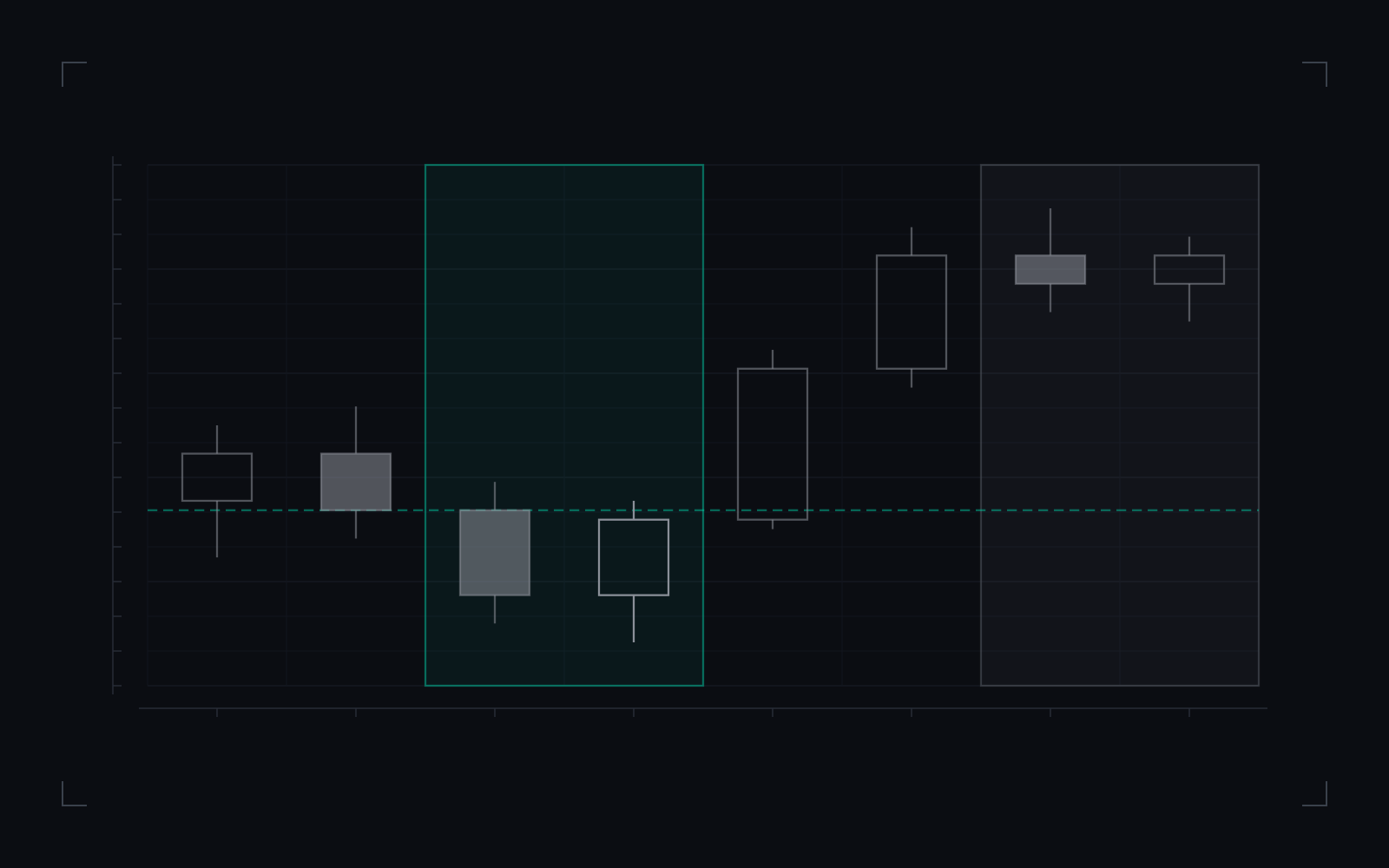
- The second 90-minute quarter, read as manipulation. The unshaded quarters either side are the first, accumulation, and the third, distribution.
- The fourth quarter, the X: continuation or reversal.
- The true open: the price at which the second quarter opens.
- The second quarter’s low, beneath the first quarter’s range, closed back inside it.
- Rising candles, two to a quarter on the session’s clock.
- Falling candles, two to a quarter on the session’s clock.
One six-hour session cut into four 90-minute quarters and read as AMDX: a range in the first quarter, a run beneath it in the second from the true open, the move up in the third, and the fourth left to continue or reverse.
The drawing establishes the grid, the true open and the taught order of phases. It does not establish that a session’s second quarter holds its false move more often than the other quarters, the hour-of-day base rate or a grid shifted by half a quarter.
ICT quarterly theory: what the definition states, in full.
| Element | What the definition states |
|---|---|
| Day’s start | 18:00 New York time. |
| Six-hour quarters | 18:00 to 00:00, 00:00 to 06:00, 06:00 to 12:00 and 12:00 to 18:00. |
| 90-minute quarters | Four to each six-hour quarter; the London quarter breaks at 01:30, 03:00 and 04:30. |
| True open | The first price of a cycle’s second quarter. |
| OrderingAMDX or XAMD, written down before the second quarter opens. | election pending |
| Not established | That a cycle’s second quarter holds its false move, or its third its direction, more often than chance and the clock allow. |
Commonly confused with
Neighbouring concepts that get used interchangeably, and the distinction that actually separates them.
- Kill zones
Kill zones are four named windows covering part of the day. Quarterly theory partitions all of it, and under the convention the kill zones entry states, each kill zone falls inside a single six-hour quarter: the Asian window in the first, London open in the second, New York open and London close in the third. The fourth quarter, from 12:00 to 18:00, holds none of them.
- ICT macro times
Macros are eight listed windows of twenty to thirty minutes at irregular times. Micro quarters are computed, 22.5 minutes each and 64 to a day, and they leave no minute out. Every macro window contains a micro-quarter boundary, and any window longer than 22.5 minutes must, so the overlap is evidence for neither.
- Power of three
Power of three names the phases. Quarterly theory assigns them to clock quarters at every scale, adds a fourth, the X, for continuation or reversal, and allows the XAMD ordering, which starts the sequence one quarter late.
- The IPDA quarterly shift
The IPDA teaching says delivery changes direction roughly every quarter, with no rule for when a shift is due. Quarterly theory gives a phase to each quarter of every cycle, so at the yearly scale it puts the false move in April to June and the real move in July to September. The two claims share a word and would be tested separately.
- ICT weekly profiles
Weekly profiles name the day, Friday included, on which the week's high or low forms. The weekly quarters give Monday to Thursday a phase each and leave Friday outside the cycle. A classic Tuesday low and a Tuesday manipulation quarter can describe the same week from two directions.
How to measure it in your own data
A definition you cannot test is a definition you have to take on trust. This is the shortest honest route from the concept to a number you computed yourself.
- Records you need
Intraday data converted to New York time through the tz database, at a resolution fine enough for the smallest quarter used, which for micro quarters means 30-second candles or a stated rounding rule; the instrument's halts as the feed shows them; a calendar of scheduled releases; and the grid's elections: the day's start, how the week and the month are counted, and the rule that picks AMDX or XAMD.
- What you compute
Assign every candle to its quarter at each scale and record each quarter's open, high, low and close. For each cycle, note which quarter holds its high and which its low. Count how often the second quarter holds one of the two, and compare that rate with the other quarter positions, with the base rate for the same clock position (hour-of-day for session and 90-minute quarters, day-of-week for the weekly quarters, month-of-year for the yearly ones), and with the same grid shifted by half a quarter, keeping release days apart.
- What the answer tells you
A session whose second quarter runs one side of the first quarter's range and whose third quarter moves the other way, which is the taught picture. With two orderings to choose from and a fourth phase that may go either way, sessions that fit are easy to find afterwards; a reading counts only if its ordering was written down before the second quarter opened.
Questions and answers
What is ICT quarterly theory?
A way of dividing time into quarters at every scale on the New York clock: the year into three-month quarters, the month into weeks, the week into days, the day into six-hour quarters, each six hours into 90-minute quarters, and each of those into quarters of 22.5 minutes. The quarters of each cycle are read as phases, and the first price of its second quarter is its true open.
What times are the daily quarters in quarterly theory?
Four six-hour quarters in New York time, starting at 18:00: 18:00 to 00:00, labelled Asia; 00:00 to 06:00, London; 06:00 to 12:00, the New York morning; and 12:00 to 18:00, the New York afternoon. Each divides into four 90-minute quarters, so the London quarter breaks at 01:30, 03:00 and 04:30.
What does true open mean in quarterly theory?
The price at which the second quarter of a cycle opens. The day's is midnight New York time; the session true opens are 19:30, 01:30, 07:30 and 13:30; and the weekly true open is 18:00 on Monday. The monthly one is the open of the month's second Monday, and the yearly one is the open of April's first Monday.
How do AMDX and XAMD differ?
Where the sequence starts. AMDX puts accumulation in the first quarter, manipulation in the second, distribution in the third, and continuation or reversal, the X, in the fourth. XAMD puts the X first and moves the other three phases one quarter later. The true open stays at the second quarter's open under both orderings.
Do the quarters predict what price will do?
The claim that the quarters predict price is unmeasured. The grid is arithmetic; the prediction is that a cycle's second quarter holds its false move and its third quarter its direction. A test counts how often the second quarter holds one of the cycle's extremes, against the other quarters, hour-of-day base rates and a grid shifted by half a quarter, with the ordering chosen in advance.
Related terms
Derived from the links this entry makes and the entries that link back to it.