04 / 110
Asian range
Working definition
The high and low traded between 20:00 and midnight New York time in the convention this glossary uses, which ICT teaching carries into the London and New York sessions as levels the day is expected to trade through on one side before its main move; other guides start or end the window at other hours, and each window draws a different range.
The Asian range is four hours of the New York evening reduced to a high and a low, and ICT teaching spends the rest of the day watching which side of it gives way first.
The window
In the convention this glossary uses, the range is traded from 20:00 to midnight New York time. It opens as the central bank dealers range closes, and it ends at the midnight New York open, which the judas swing entry names as the strictest declared open. The same four hours are the Asian window in the kill zones table. The teaching tells a story about who trades in those hours and why the range they leave is narrow; the construction does not depend on the story, because it is a high and a low measured on a clock.
Other guides draw other windows, and each window gives a different box. One ICT tutorial site gives 20:00 to midnight on its dealers range page and 19:00 to midnight on its Asian range page. Guides to ICT quarterly theory treat Asia as the first six-hour quarter of the New York day, from 18:00 to midnight. One open-source session-range indicator for a charting platform, since discontinued, used 20:00 to 02:00 Eastern time as its default, with every time editable. One breakout guide marks the Asian session from about midnight to 07:00 or 08:00 GMT, leaving the exact start to the broker’s server time. None of these is wrong as a convention, but a range quoted without its window cannot be drawn again.
The session behind the name is wider than any of them. This site’s forex session clock states Tokyo’s session as 19:00 to 04:00 New York time and Sydney’s as 17:00 to 02:00, both editable, with the Asian kill zone from 20:00 to midnight inside them.
The window in other time zones
The window is on the New York clock, so its local time moves when New York changes its clocks. Converted through the tz database:
- UTC: 01:00 to 05:00 on New York standard time; 00:00 to 04:00 on New York daylight time.
- United Kingdom: 01:00 to 05:00 in both seasons, except in the few weeks a year when the two countries’ clocks disagree.
- Nigeria: 02:00 to 06:00, or 01:00 to 05:00 on New York daylight time.
- United Arab Emirates: 05:00 to 09:00, or 04:00 to 08:00.
- Pakistan: 06:00 to 10:00, or 05:00 to 09:00.
- India: 06:30 to 10:30, or 05:30 to 09:30.
- Singapore, Malaysia and the Philippines: 09:00 to 13:00, or 08:00 to 12:00.
For a reader in Singapore the Asian range is a morning range, which is a reminder that the name belongs to the teaching’s clock and not to the reader’s.
Measuring it
Four elections come before any line is drawn. Wicks or bodies: one ICT guide marks the window’s highest and lowest prices, and one breakout guide describes candle bodies as the tighter alternative. The feed: spot currency brokers print different evening prices, so the same night gives different ranges on different platforms, while a futures contract has one exchange’s prints.
The calendar: on Sundays the ICT convention recorded in the new week opening gap entry puts the reopen at 18:00 New York time, while this site’s forex session clock opens the week at 17:00, so Sunday’s window opens two or three hours into the week depending on the feed, with the weekend gap just behind it; holidays shorten or remove the window. The size rule: guides advise skipping a range that is too wide without agreeing on a figure. One breakout guide compares each range with the pair’s usual Asian range; a width stated against average true range would compare pairs more fairly. Either is a parameter someone chose.
One session-range indicator adds a third line at the range’s midpoint. Each added line is another price that a later move can be said to have respected, and a count of reactions has to say which lines it counted.
A worked case
Constructed numbers throughout. On EUR/USD, between 20:00 and midnight New York time, the highest price is 1.0868 and the lowest 1.0851, a range of 17 pips, and midnight opens at 1.0860. The 02:30 fifteen-minute candle, inside the London open window, trades down to 1.0846, five pips below the Asian low, and closes at 1.0855, back inside the range.
Under the liquidity sweep entry’s test, a trade-through followed by a close back inside within a stated window, that is a sweep of the Asian low. A bullish reading now waits for a market structure shift: a close above 1.0859, the last intermediate lower high of the decline, would supply it, and the range’s high at 1.0868 becomes the first level the day is expected to reach.
A breakout reading of the same night needed a close below 1.0851 and did not get one, so the move the sweep reading counts as its setup never triggered the breakout. Had the candle closed at 1.0849, the breakout reading would have sold with a stop above 1.0868, and the sweep reading would have waited for a later close back above 1.0851.
The bearish mirror, again constructed. GBP/USD’s Asian range runs from 1.2702 to 1.2731, 29 pips. London trades up to 1.2738, seven pips above the high, and closes back at 1.2726. A bearish reading looks for a close below 1.2720, the last intermediate higher low of the rally, and names the Asian low at 1.2702 as the first level below.
How the teaching uses it
The range is read as a pair of pools. Above its high rest the buy-side orders and below its low the sell-side orders, in the language of buy-side and sell-side liquidity, and the liquidity pools indicator keeps session extremes of this kind in its registry, labelled by scope. The template in the daily bias entry puts the range at the start of the day: on a bullish day the Asian session builds the range, London trades below its low, and New York delivers the move toward the target, with a bearish day the mirror.
Teaching requires the bias first. Without one, a trade through either side can be read as a setup; with one, the side against the bias is the side expected to go first. One guide sets out the entry practice in order: the trade-through and the close back inside, a lower-timeframe market structure shift, an entry on the retracement into a fair value gap or order block the shift left behind, a stop beyond the shift’s swing with a buffer of 10 to 20 pips, and a target at the next pool in the direction of the bias, the kind of target the draw on liquidity entry describes. The same guide adds an entry below the midnight open price for a buy, or above it for a sell, once the swept side has gone, and a later entry at the range’s opposite side during the New York open. Each is an election, and a result for one set of them does not transfer to another.
Two readings of one break
Drawn on the same window, the breakout strategy and the ICT reading share a box and disagree about what happens at its sides. The breakout reading enters when a candle closes beyond the range and places its stop on the other side. The ICT reading waits for that break to fail and trades the other way. Under a stated window and a stated close rule, every break of the range either closes back inside or does not, so the two readings are bets on opposite shares of one distribution. That share can be counted market by market and era by era, and the count bears on both readings at once.
Projections
The claims ledger lists a driver for Asian range projections, running on an engine the ledger describes as shared, and the published pages do not spell out how those projections are built. Where a projection copies a range’s height above and below it, as the dealers range’s deviations do, it inherits that range’s difficulty: evenly spaced lines leave every price inside the ladder within half a range of some line, so a landing near one has to be compared with lines projected from other windows before it counts.
Identifying one, step by step
- Set the chart to New York time through the platform’s timezone setting rather than the broker’s server clock, on a timeframe fine enough to see the window, such as fifteen minutes.
- Mark 20:00 and midnight, or the other window in use, and write down which.
- Take the highest and lowest prices inside the window, or the highest and lowest bodies, by stated election.
- Extend both lines past midnight and label the date, with the midnight open price beside them.
- Write the rules before London opens: what counts as a trade-through, how many candles a close back inside may take, and which side the bias expects to go first, so the day can be scored.
Common mistakes
Reading the window off a broker’s server clock, which moves both lines. Switching between 19:00 and 20:00, or between wicks and bodies, from one night to the next. Pooling Sunday evenings, which open two or three hours into the week, with ordinary weekday evenings. Crediting the range with a move made by a scheduled release in the London or New York morning. And counting the nights whose sweep led to the day’s move while forgetting the breaks that held and the sweeps that led nowhere.
What the range does not settle
The construction is exact: a window, a feed, a high and a low, which two people with the same elections will draw identically. The claims attached to it are frequencies: that London or New York trades through one side before the day’s move, that the side traded first stands against the day’s direction, and that the high and low act as pools rather than as ordinary prices.
Each is a count, of how often a side is traded through, how often the break closes back inside within the stated window, and where the day’s extremes form relative to the range, set beside the same counts from four-hour windows at other hours. This site’s research on volatility and the clock describes intraday volatility as quiet through the Asian session and busy at the London and New York overlaps, so the range tends to be narrow for reasons that owe nothing to the teaching, and the claim has to be about what follows the break rather than the break itself. The Asian range projections driver has a row in the claims ledger, and the published pages do not say whether it counts the sweep claims above. The session and killzone clock datasheet keeps the Asian window in an editable killzone table. The two lenses keep the box, which anyone can draw, apart from the claim about what the day does at its sides.
Where it sits in the ICT sequence
The ICT vocabulary in the order the method is taught, with a step for each kind of object.
- Step
- 02 of 08 Levels: the opens, gaps and ranges a session is measured from
- Also at this step
- New week opening gap (NWOG), New day opening gap (NDOG), Opening range gap (ORG), Central bank dealers range (CBDR), IPDA (interbank price delivery algorithm)
- After it
- Buy-side and sell-side liquidity
The shape, drawn
The smallest arrangement the definition admits. It is a drawing of a rule, not a reading of a market — nothing here is measured, and the table below it is the authoritative version.
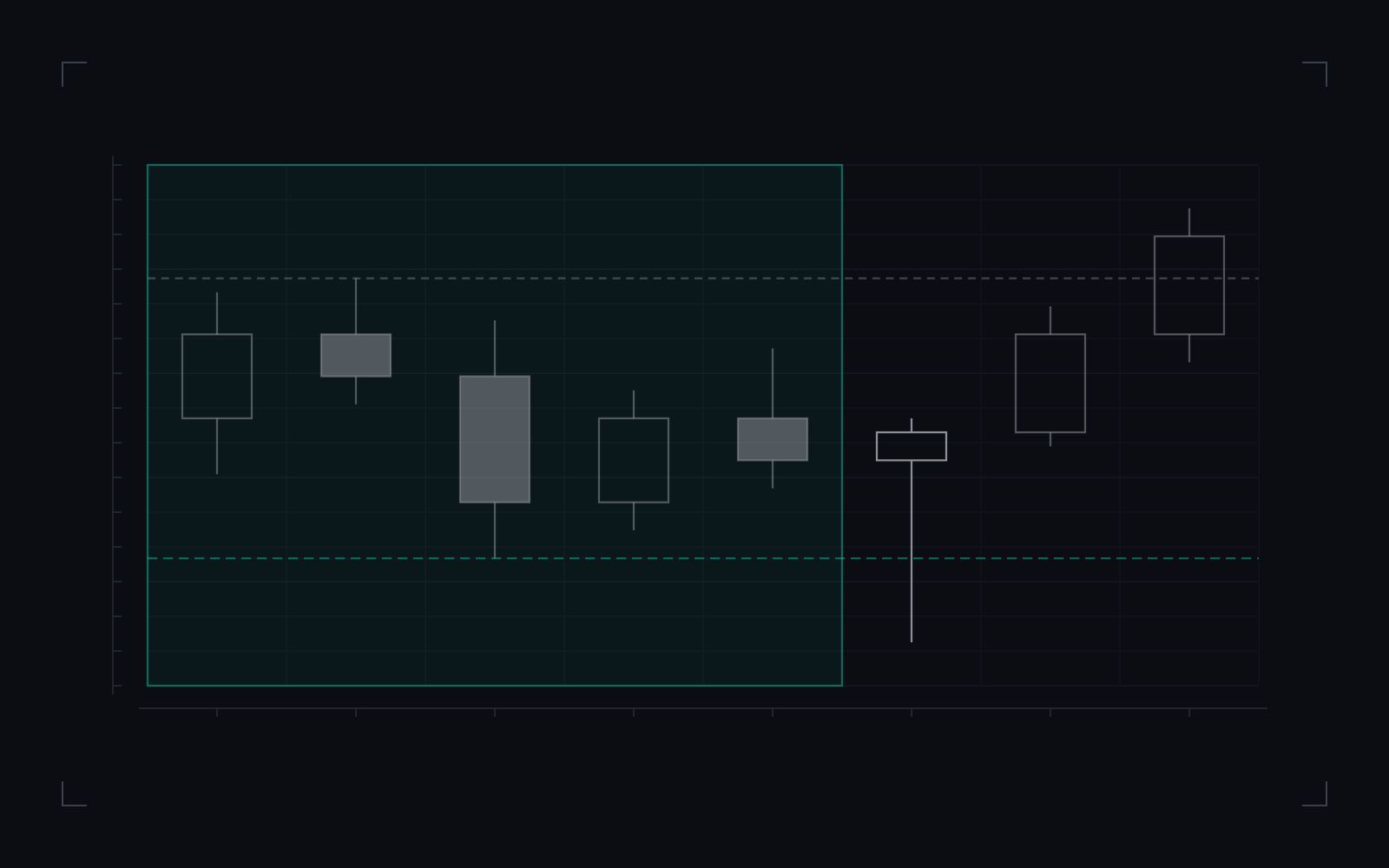
- The window: 20:00 to midnight New York time in the convention this glossary uses. Other guides draw other windows, and each gives a different range.
- The range high: the highest price traded inside the window, carried into the day.
- The range low: the side traded through first in this drawing.
- Rising candles, inside the window and after it.
- Falling candles inside the window.
- The trade-through: a candle after midnight runs beneath the range low and closes back inside the range.
The Asian range as teaching draws it: a high and a low taken from the candles inside the New York evening window and carried forward, one side traded through after midnight and closed back inside, and the day then moving toward the other side.
The drawing establishes how the range and a trade-through of one side are measured. It does not establish how often a side is traded through, whether a break closes back inside, or where the day’s extremes form.
Asian range: what the definition states, in full.
| Element | What the definition states |
|---|---|
| WindowOther guides start at 18:00 or 19:00, or end at 02:00. | 20:00 to midnight New York time, in this glossary’s convention. |
| Range | The highest and lowest prices traded inside the window. |
| Wicks or bodiesBodies draw a tighter box than wicks on the same night. | election pending |
| Feed | Stated, because spot currency brokers print different evening prices. |
| Trade-through and reclaim | A trade beyond one side, then a close back inside within a stated number of candles. |
| Not established | How often a side is traded through, whether the break closes back inside, or where the day’s extremes form. |
Commonly confused with
Neighbouring concepts that get used interchangeably, and the distinction that actually separates them.
- Asian session
The Asian session is a block of market hours, when the Tokyo and Sydney markets are active, and session tables disagree about its boundaries. The Asian range is a price measurement: the high and low inside one stated window, four hours in the convention this glossary uses, that falls within those hours.
- Central bank dealers range
The dealers range is measured from 14:00 to 20:00 New York time, usually on candle bodies, and projected in multiples of its own height. The Asian range starts at 20:00, where the dealers range ends, and runs to midnight. Taught daily profiles use the two together, which is why they are mixed up.
- Asian kill zone
The Asian kill zone is the same four hours as a label on the clock, and it contains nothing but time. The Asian range needs the window and the prices traded inside it: the kill zone says when to look, and the range is what was found there.
- Judas swing
The Asian range supplies levels; the judas swing is an event that may happen at them. After the midnight New York or London open, a first push that trades through a qualifying high or low and then gives way to a move the other way is the judas swing, and the Asian range's high and low are the pools it typically runs.
- Asian range breakout
The breakout strategy, taught outside ICT, enters when a candle closes beyond the range and holds the position in the direction of the break. ICT teaching reads the same trade-through the other way, waiting for a close back inside and trading against the break. Drawn on the same window, the box is the same; the expectations are opposite.
How to measure it in your own data
A definition you cannot test is a definition you have to take on trust. This is the shortest honest route from the concept to a number you computed yourself.
- Records you need
Intraday data converted to New York time through the tz database; the window, stated, since guides disagree about both its start and its end; the wick-or-body election; the feed, because spot currency brokers print different evening prices; and the calendar, for Sunday evenings and holidays.
- What you compute
Each day, take the highest and lowest prices in the window. After midnight, record which side is traded through first and when, whether the break closes back inside within a stated number of candles or holds beyond, and where the day's high and low form relative to the range. Build the same counts from four-hour windows at other hours on the same days, and compare.
- What the answer tells you
A narrow box across the late New York evening, with its high and low carried into the London and New York mornings. One side traded through and reclaimed, then a move the other way, is the taught picture. A quiet window tends to leave a narrow box, and a narrow box needs only a small move to break, which is why the break alone shows little and what follows it has to be counted.
Questions and answers
What is the Asian range in ICT?
The high and low price traded in a stated window of the New York evening: 20:00 to midnight in the convention this glossary uses, and 19:00 to midnight on one ICT tutorial's Asian range page. ICT teaching marks both and carries them into the London and New York sessions, reading the high as buy-side liquidity and the low as sell-side liquidity, and expects the day to trade through one side before making its move.
What time is the Asian range?
From 20:00 to midnight New York time in the convention this glossary uses. That is 01:00 to 05:00 UTC while New York is on standard time and 00:00 to 04:00 UTC while it is on daylight time; in India, 06:30 to 10:30 or 05:30 to 09:30. Other guides start the window at 18:00 or 19:00, or end it at 02:00, and each draws a different range.
What is the difference between the Asian range and the Asian session?
The session is a block of market hours and the range is a measurement. Session tables disagree about when the Asian session opens and closes; the Asian range is the high and low inside one stated window, 20:00 to midnight New York time here, which falls inside those hours.
How is the Asian range traded in ICT?
As taught: set a daily bias first, mark the range, and wait for London or early New York to trade through the side against the bias and close back inside. A lower-timeframe market structure shift is taken as confirmation, the entry comes on a retracement, the stop sits beyond the shift's swing, and the target is the next pool. That describes the practice, not its results.
Does price sweep the Asian range every day?
No definition can say every day. Whether a day trades through one side, which side goes first, and whether the break closes back inside or holds are counts to make under a stated window and a stated reclaim rule. Because a narrow range needs only a small move to break, those counts mean something only beside the same counts from windows at other hours.
Related terms
Derived from the links this entry makes and the entries that link back to it.