03 / 97
Anchored VWAP
Working definition
The volume-weighted average price computed from a chosen starting event forward — the session VWAP's generalisation, where the anchor is an election and the line is only as meaningful as the anchor's case.
Every average is an argument about what deserves to count, and VWAP’s argument is that volume votes.
The arithmetic is one line: from the anchor forward, cumulative price-times-volume divided by cumulative volume. Where time-weighted average price lets every interval vote equally, VWAP weights each price by the business actually done there. A frantic half-hour outvotes a dead afternoon. The anchored variant generalises the start: instead of the session open’s convention, the accumulation begins at any elected event — an open, a release, a swing extreme — and the line becomes the average price paid per unit of volume since that event, the cost basis of everyone who has participated from the anchor forward. Price above the line says the average post-anchor buyer is in profit; below, underwater. That restatement is the tool’s entire factual content.
The anchor is therefore the whole claim, and it carries the same hindsight hazard this glossary flags on reference legs and session boundaries: the chart offers unlimited anchors, and a line that fits can always be found after the fact. An anchored VWAP is checkable exactly when its anchor rule is named in advance — anchored at what class of event, every time — and decorative otherwise. Bands at declared multiples of a declared deviation measure are further elections, carried with the line or the line is untestable.
Two provenance notes complete the honest picture. Volume weighting in FX means one feed’s volume: no consolidated tape, so the same hours draw a different line on a different book, the family caveat inherited from volume profile and its relatives. And the tool’s chart use has drifted from its origin: VWAP began as an execution benchmark — did a fill beat the day’s volume-weighted price, the question execution cost analysis still asks — and the anchored chart line borrows that arithmetic for a forecasting job the benchmark never claimed.
Whether price respects the line beyond what matched arbitrary averages would show is, as with every object in this family, a measurable proposition under a stated rule, and the two lenses hold the cost-basis fact apart from the support-and-reversion story told on top of it.
The shape, drawn
The smallest arrangement the definition admits. It is a drawing of a rule, not a reading of a market — nothing here is measured, and the table below it is the authoritative version.
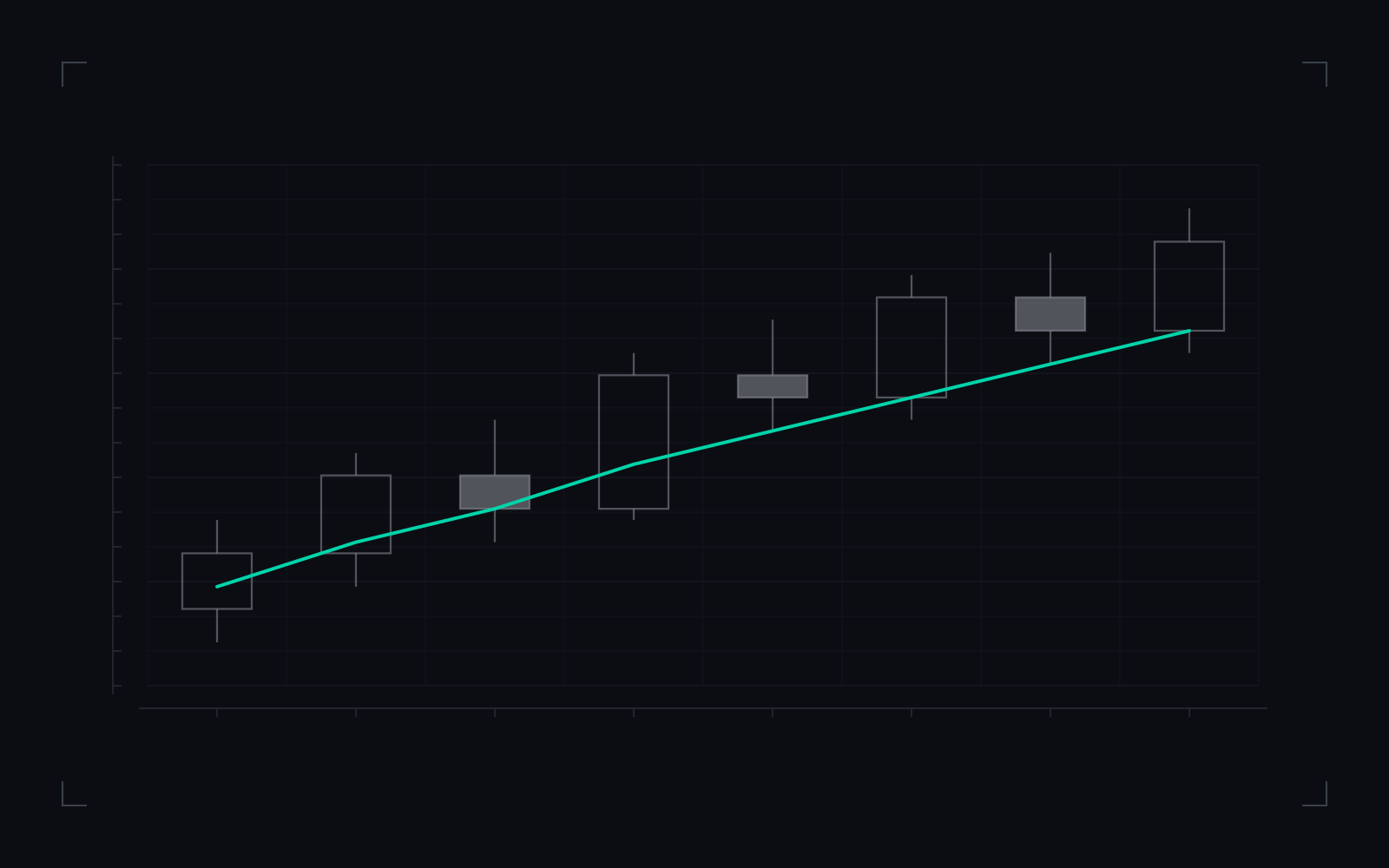
- The anchored line: the volume-weighted average of everything traded since the anchor. It starts at the anchor and nowhere else.
- The tape it averages. The line lags the tape by construction — it is a memory of the whole window, not a reading of the last bar.
A volume-weighted average line computed from a chosen starting event forward. The line is drawn; the anchor — its left end — is the election, and a different anchor draws a different line from the same tape.
Drawing the line establishes what an anchored average is. It does not establish that any anchor’s line acts as support, resistance, or anything else.
Anchored VWAP: what the definition states, in full.
| Element | What the definition states |
|---|---|
| Computation | Volume-weighted average price from the anchor forward. |
| The anchorA session open, a news event, a swing extreme — the anchor is an election, and the line is only as meaningful as the anchor’s case. | election pending |
| Not established | That price respects any anchored line, or that one anchor’s line outperforms another’s. |
Commonly confused with
Neighbouring concepts that get used interchangeably, and the distinction that actually separates them.
- Session VWAP
The session VWAP is an anchored VWAP whose anchor is the session open — one conventional choice institutionalised. Anchoring generalises the start to any event, which is the tool's power and its hindsight hazard in one move.
- Time-weighted average price
TWAP weights each interval equally; VWAP weights each price by the volume that traded there. A quiet hour moves TWAP as much as a frantic one, while VWAP barely notices it — the volume weighting is the entire difference, and in FX it imports the feed-dependence that comes with volume.
- A moving average
A moving average drags a fixed-length window forward, forgetting as it goes; an anchored VWAP accumulates from a fixed start, forgetting nothing. One is a rolling summary, the other a growing average of everything since the anchor — they converge on nothing and answer different questions.
- An execution benchmark
VWAP began as a benchmark — did an execution beat the day's volume-weighted price — and the chart tool borrows the arithmetic for a different job. Benchmarking needs the tape's VWAP; the chart line is a feed's VWAP from an elected anchor, and the two uses should not be graded against each other.
How to measure it in your own data
A definition you cannot test is a definition you have to take on trust. This is the shortest honest route from the concept to a number you computed yourself.
- Records you need
Per-trade or per-bar prices and volumes from the anchor forward — with the feed identified, because volume weighting in FX means one book's volume, and a different feed draws a different line from the same hours.
- What you compute
Cumulative sum of price times volume from the anchor, divided by cumulative volume — bar typical prices standing in where per-trade data is absent. Optional bands at declared multiples of a declared deviation measure are separate elections carried with the line.
- What the answer tells you
The line is where the average unit of volume has traded since the anchor; price above it means the post-anchor buyer is, on average, in profit. Every reading beyond that restatement — support at the line, reversion to it — is an expectation whose evidence is not supplied by the definition.
Questions and answers
What is anchored VWAP?
A volume-weighted average price whose accumulation starts at a chosen event — a session open, a news release, a swing extreme — rather than at a fixed session boundary. From the anchor forward it is the running average price paid per unit of volume, on the feed being measured.
What is the difference between VWAP and anchored VWAP?
Only the start. A session VWAP anchors at the open by convention; the anchored variant makes the start an explicit election. The arithmetic is identical, which is why the choice of anchor carries all of the meaning the tool has.
Why does the anchor choice matter so much?
Because the same chart offers unlimited anchors, and a line that fits can always be found after the fact. An anchored VWAP is checkable only when the anchor rule is named in advance — anchored at what class of event, always — which is the same discipline this glossary applies to reference legs and session boundaries everywhere.
Does price respect the anchored VWAP?
Sometimes visibly, which is how the tool earns screenshots. Whether it does so beyond what matched arbitrary averages would show, under a stated anchor rule, is a measurable proposition — and the definition supplies the line, not the verdict.
Related terms
Derived from the links this entry makes and the entries that link back to it.