74 / 97
Propulsion block
Working definition
An order block that forms while price is trading back into an earlier order block: the candle that revisits the older zone, holds it and drives price away. ICT treats it as a continuation zone whose midpoint is expected to hold.
Some order blocks form on open ground and some form on top of an earlier block, and ICT gives the second kind its own name.
The block, stated
Begin with an order block under a stated rule: in the bullish case, the last down-closing candle before a qualifying move up, its zone drawn from its body or full range. Some time later price comes back into that zone. The candle that trades into it, the last opposing candle of the revisit, meets two conditions: the older zone holds under a stated respect rule, and price then leaves in the zone’s direction. That candle is the propulsion block. It is an order block in its own right, with its own zone and its own mean threshold, and it sits stacked on the zone it revisited.
Every condition is an election. What counts as trading into the older block: a wick touch, a close inside it, or reaching its mean threshold. What counts as holding: no close through the far edge, or no close beyond the midpoint. Whether the propulsion block is one candle or may be a short group. Each choice changes which propulsion blocks exist on the same chart.
Bullish and bearish
A bullish propulsion block forms in a bullish order block. Price dips back into the earlier support zone, a down-closing candle enters it without breaking it, and price rallies away; the down candle becomes a new support zone above or inside the old one. A bearish propulsion block is the mirror, formed in a bearish order block during a rally back into it.
A worked case, with constructed numbers. A bullish order block’s body runs from 1.0800 to 1.0815, so its mean threshold is 1.08075. Two days later price falls back into it: a down candle opens at 1.0822, trades to 1.0809 and closes at 1.0811, inside the older block but above its midpoint. The next candles rally to 1.0860, through the last swing high. The down candle is the propulsion block. Its body runs from 1.0811 to 1.0822 and its own mean threshold is 1.08165, a second, narrower zone stacked on the first.
Where it sits in the block family
The block family in this vocabulary is a set of biographies for one kind of zone. The order block is the parent. A breaker block is a block consumed after a sweep and a structure break and reused in the flipped role. A mitigation block is a block that failed from a failure swing. A rejection block is drawn from a wick rather than a body. The propulsion block is the one that records success: the older zone was revisited and held, and the candle that showed it holding is kept. The order block indicator carries propulsion and reclaimed variants with their own marks, on the same rules as the parent blocks.
Why stacking appeals
The attraction is layered evidence. A zone that has already been revisited and held looks stronger than one that has not, and a second zone formed on the revisit looks like the market confirming the first. That is also the difficulty. Selecting zones because they held once is a selection on an outcome, and zones chosen that way can look reliable for no reason except the way they were chosen.
What the stack owes
The claim under the name is that propulsion blocks hold more often than ordinary order blocks. The comparison is available on the same data: returns into propulsion blocks against returns into ordinary blocks of the same size and age, under the same touch and respect rules, with the selection effect above accounted for. The row for propulsion blocks in the claims ledger is where that comparison’s verdict renders. The two lenses keep the stack, a selection rule anyone can apply, apart from the reliability attached to it, which only a count can support.
Where it sits in the ICT sequence
The ICT vocabulary in the order the method is taught, with a step for each kind of object.
- Step
- 06 of 08 Blocks: the candles that mark a return zone, and what became of them
- Also at this step
- Order block, Breaker block, Mitigation block, Rejection block
- Before it
- Rejection block
- After it
- PD array
The shape, drawn
The smallest arrangement the definition admits. It is a drawing of a rule, not a reading of a market — nothing here is measured, and the table below it is the authoritative version.
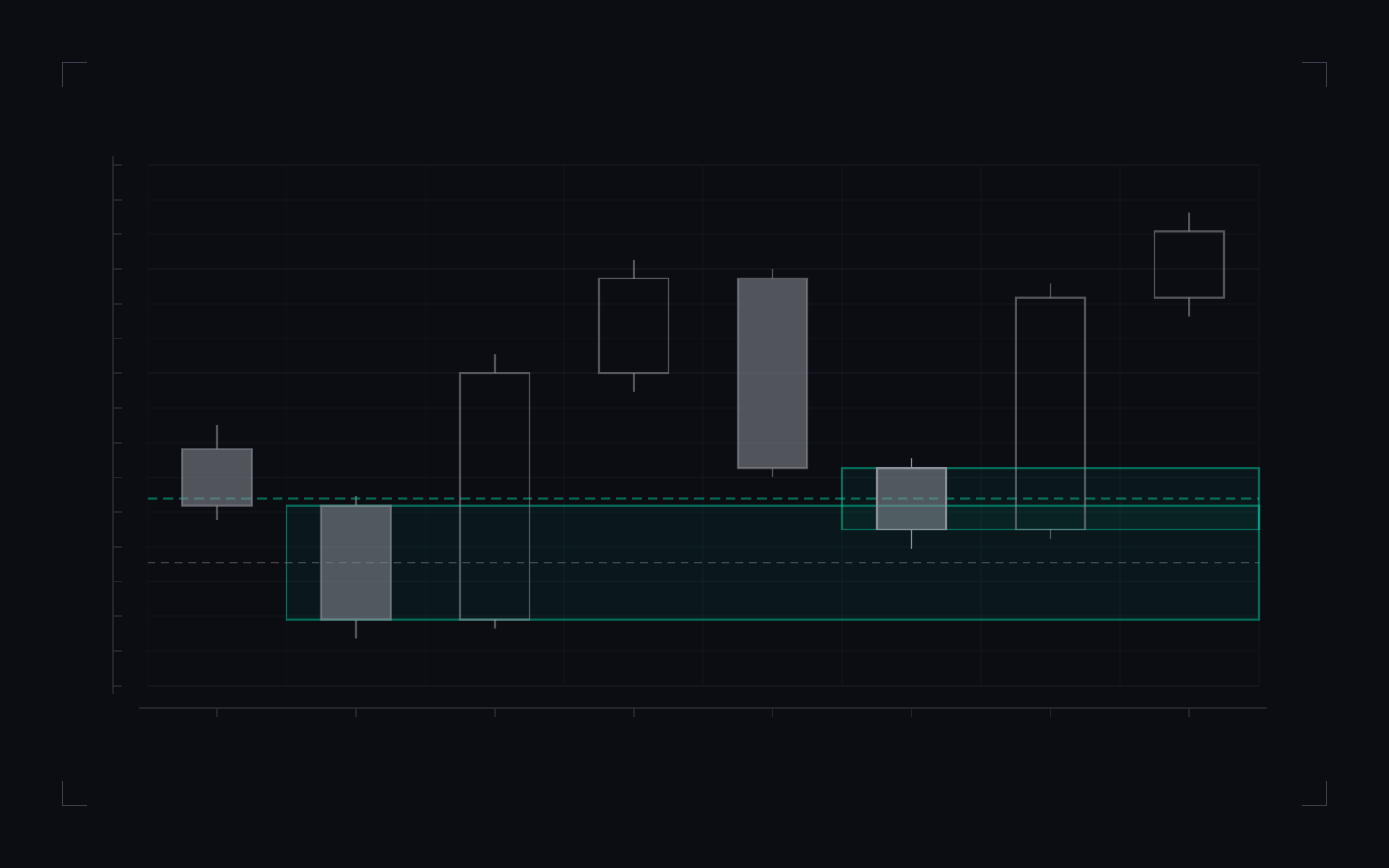
- The earlier order block, 10.4 to 12.8, and the propulsion block’s own zone stacked on it, 12.3 to 13.6.
- The candle that trades back into the earlier block and holds it: the propulsion block.
- The earlier block’s mean threshold, 11.6, which the revisit did not reach.
- The propulsion block’s own mean threshold, 12.95.
- The move away that shows the revisit held.
An order block, a revisit into it that holds above its midpoint, and the candle of that revisit kept as a second zone stacked on the first.
Drawing the stack establishes which candle the rule selects. It does not establish that a stacked zone holds more often than a single one.
Propulsion block: what the definition states, in full.
| Element | What the definition states |
|---|---|
| Parent | An order block under the stated rule, with its rung and boundary election. |
| RevisitA wick touch, a close inside the block, or reaching its mean threshold. Each admits different candles. | election pending |
| HoldNo close through the far edge, or no close beyond the midpoint. | election pending |
| Propulsion block | The revisit candle, with its own zone and mean threshold. |
| CandlesOne candle, or a short group when the revisit takes more than one. | election pending |
| Not established | That stacked zones hold more often than ordinary order blocks of the same size and age. |
Commonly confused with
Neighbouring concepts that get used interchangeably, and the distinction that actually separates them.
- Order block
Every propulsion block is an order block. What sets it apart is where it forms: inside an earlier order block, on a revisit, so the new candle's zone is stacked on an older one. An order block needs only the move after it; a propulsion block also needs the block beneath it.
- Mitigation block
A mitigation block is an order block that failed, re-registered after a failure swing broke through it. A propulsion block records the opposite outcome: the earlier block held, and the candle that showed it holding becomes a zone of its own.
- Breaker block
A breaker block is a block consumed after a sweep and a structure break and reused in the flipped role. A propulsion block keeps the original role and adds a second zone pointing the same way.
- A retest of support
A retest is a revisit to any prior level. A propulsion block is a specific candle selected by rule during a revisit to an order block, with its own boundaries and midpoint carried forward.
How to measure it in your own data
A definition you cannot test is a definition you have to take on trust. This is the shortest honest route from the concept to a number you computed yourself.
- Records you need
Candle data at a declared timeframe; the order block rule, with its validation rung and boundary election; a rule for what counts as trading into a block, whether a wick touch, a close inside or reaching its mean threshold; and the respect rule used on later returns.
- What you compute
Maintain order blocks under their stated rule. When a candle trades into an existing block, the block holds by the respect rule, and price then leaves in the block's direction, mark that candle as a propulsion block with its own zone and midpoint. Record later returns into propulsion blocks and compare their outcomes with returns into ordinary order blocks of the same size and age.
- What the answer tells you
An order block price comes back to, a candle that dips into it without closing through, and a strong move away that leaves that candle as the last opposing candle of the revisit. The taught reading is a continuation zone with a midpoint that should hold; the count that matters is whether stacked zones hold more often than single ones.
Questions and answers
What is a propulsion block in ICT?
An order block formed on a revisit to an earlier order block. Price comes back into the older zone, a candle trades into it and holds, and price is driven away in the original direction. That candle is the propulsion block, and teaching treats it as a continuation zone of its own.
What is the difference between a propulsion block and an order block?
Where it forms. An order block can form anywhere a qualifying move begins. A propulsion block forms only inside an earlier order block, during a revisit that held, so it is an order block with a second, older zone underneath it.
How do you identify a propulsion block?
Mark order blocks under a stated rule. Wait for price to trade back into one. If a candle enters the zone, the zone holds under the stated respect rule, and price then leaves in the zone's direction, that candle is the propulsion block. Its zone and midpoint are drawn from its own range or body.
What is a bullish propulsion block?
One formed in a bullish order block. Price dips back into the earlier support zone, a down-closing candle trades into it without breaking it, and price then rallies away. The down candle becomes a new zone expected to act as support, stacked on the old one. The bearish form is the mirror.
What is the mean threshold of a propulsion block?
The midpoint of its body. Teaching treats a close beyond it as the block failing, which is why propulsion blocks are described as zones whose midpoint should rarely be violated. The line is exact; whether it holds more often than any other interior price is what a count would show.
Can a propulsion block be more than one candle?
Some versions allow a short group of candles when the revisit into the earlier block takes more than one candle; stricter versions keep to a single candle. The choice is an election, and it changes which zones exist.
What are OB and BB in ICT trading?
OB is an order block and BB a breaker block, two members of the block family in the ICT vocabulary. The propulsion block belongs to the same family: an order block formed on a revisit to an earlier one that held.
Related terms
Derived from the links this entry makes and the entries that link back to it.
Where the term is in build
Detector datasheets whose concepts include this term, or whose published copy uses it. Each one states the build state it has reached and the parameters it exposes, and carries no measured verdict.