Order Block Indicator
The last opposing candle, selected by a stated validation-ladder rung — reproducibly.
The order block’s literature has a reproducibility problem: the same chart yields different blocks in different hands, because the selection rule is usually a feeling. This instrument makes the rule the product.
What it draws
Blocks selected by the stated rung of the validation ladder — the last candle closing against a move that then qualified, where qualified means exactly what the rung says: nothing further, or a structure break, or a fair value gap printing in the move, or a prior sweep of an extreme.
Each block carries its zone under the stated boundary convention, its mean-threshold midline, and its live status at the declared touch rule. When a block fails, it does not disappear: consumed after a sweep and a break it re-registers as a breaker, consumed from a failure swing as a mitigation block, each labelled with the history that renamed it — the taxonomy’s own grammar, rendered instead of narrated. Propulsion and reclaimed variants carry their own marks, so the whole block family reads off one chart with one set of rules, and a zone’s biography is visible at a glance rather than reconstructed from memory.
The ladder is the honesty mechanism
Every rung marks a different population of blocks, which is why results quoted across unstated rungs are not comparable and why this indicator prints its rung on the chart.
Two users on the same configuration see the same blocks, always — the property the hand-drawn version of this vocabulary has never had. What the ladder cannot do is answer whether revisits react, and this line does not blur that boundary. This estate has actually run one version of that question on its own data and published the result with its hash-verified artifact — the research is linked from this page, and it says what it says, including what it could not establish. The indicator draws a reproducible object; the drawing is not the evidence, and the evidence is not the drawing. Buyers deserve to know which one they are paying for, and here it is stated plainly: this is the instrument, and the measurement rides alongside it, not inside the marketing.
The object it looks for
The frozen definition, drawn. This is the geometry the detector is built to find — not a capture of the instrument running, and not a result. A drawing that implied otherwise would be the one thing this line exists to refuse.
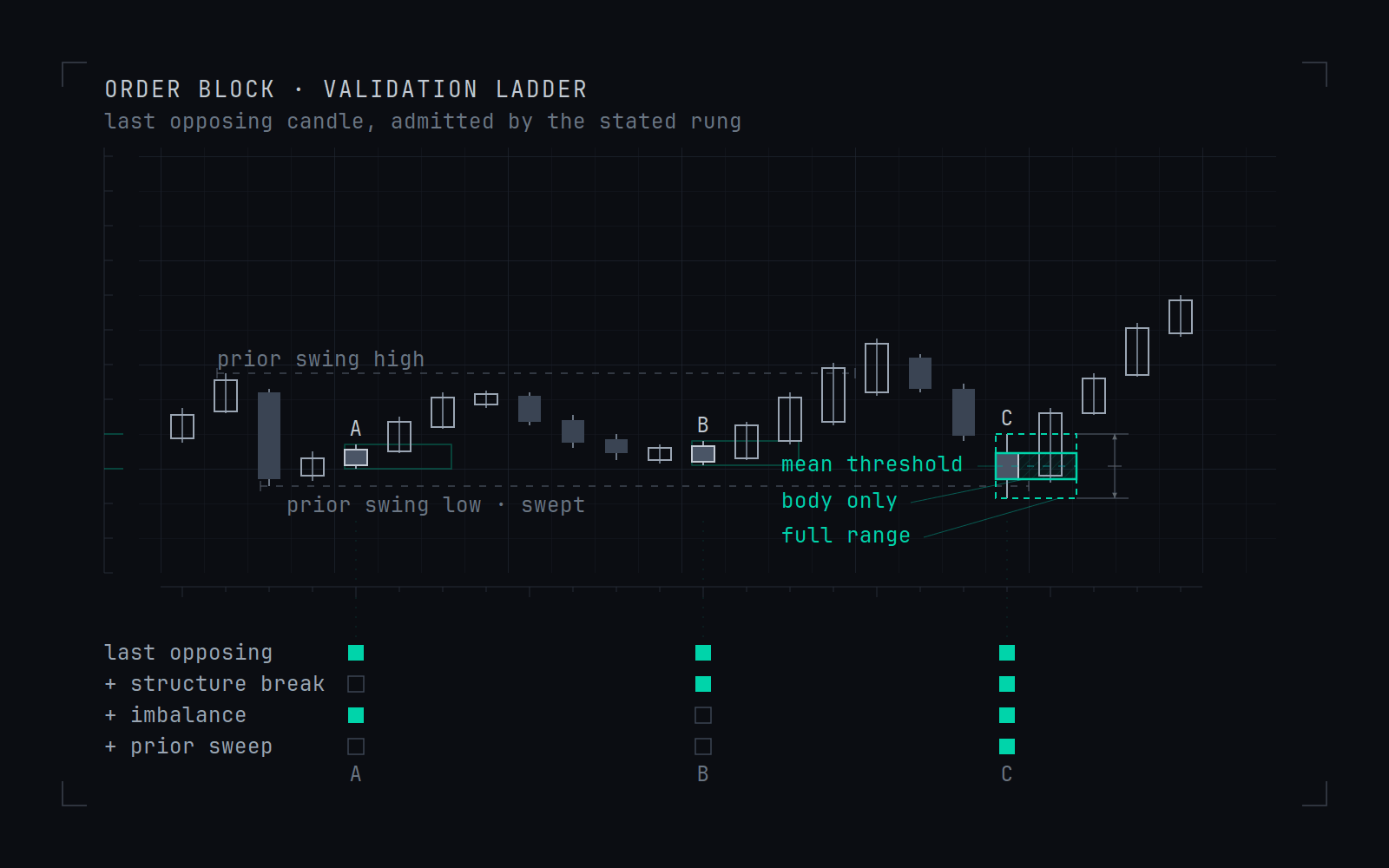
The candle the rule selects, and the elections that selection still carries: which of the down-closing candidates qualifies depends on the rung applied, and the zone is either the candle’s full range or its body alone.
Selecting a candle establishes which object the rule names. It does not establish that the zone holds, or that price reacts to it at all.
Order Block Indicator: what the frozen definition states, in full.
| Element | What the definition states |
|---|---|
| Selection | The last opposing candle before a move that qualifies under the validation rung in force. |
| ZoneTwo conventions are in circulation and they enclose different areas: the candle’s full range, or its body only. | election pending |
| Mean threshold | The midpoint of the block candle’s body, whichever zone convention is elected. |
| Validation rungLast-opposing alone, plus a structure break, plus an imbalance, or plus a prior sweep. The rungs do not nest — a structure break and an imbalance admit different candidates, so the choice changes the population rather than narrowing it. | election pending |
| InvalidationWick-through versus close-through is an election, not a fact. | election pending |
| Not established | Whether the zone holds, how often it is revisited, or what a revisit is worth. |
The definition in full, with the terms it uses, is at the glossary entry.
The parameters, in the open
Every threshold is a named parameter with its shipped state visible. Where a default reads election pending, the calibration run has not yet frozen it, and this page says so instead of inventing a number. Presets populate editable fields; they never lock them.
Order Block Indicator: every threshold it exposes, and the state each one is in.
| Parameter | Shipped state | What it decides |
|---|---|---|
| Validation rung | election pending | Which qualifier admits a block: last-opposing alone, plus a structure break, plus an imbalance in the move, or plus a prior sweep. |
| Zone boundary | election pending | Full candle range versus body only — the two conventions draw different zones from the same candle. |
| Mean threshold line | on | The block body's midpoint, rendered as the interior reference the taxonomy grades revisits against. |
| Failure tracking | breaker and mitigation, labelled | Consumed blocks re-register under their taxonomy name — swept-then-broken as breaker, failure-swing as mitigation — rather than vanishing. |
| Respect rule | election pending | Wick-versus-close test that marks a revisit respected or violated. |
The calibration certificate
Every instrument in this line ships with its report: the reaction and state statistics for its objects, computed on this estate's own recorded data under the campaign's measurement design, with the vintage's hash and date printed — and a refusal state when the vintage ages past its declared cadence. The report ships whatever it says.
This instrument's certificateNOT YET COMPUTED
The campaign's entry bar is the reason: no driver takes a live reading before it recovers a planted effect through the measurement harness, and the harness comes before every certificate. The drafting instrument is in build for the platforms above. Nothing is purchasable yet, here or anywhere.
What this instrument does not do
It makes no claim that its objects predict anything, and it ships no signals. It draws defined geometry under stated parameters; whether that geometry carries information is the measurement layer's question, answered against stated nulls and published either way. No performance figures appear on this page because none have been computed — and when they are, they arrive as the certificate above, not as marketing.
The research on the claim it draws
The objects drawn by the Order Block Indicator are taught with a claim, and one research note on this site examines that claim; none tests the indicator itself.
Questions and answers
How does the Order Block Indicator decide which candle is an order block?
It takes the last candle that closed against a move and admits it only if the move qualified under the rung of the validation ladder in force: nothing further, a structure break, a fair value gap printing in the move, or a prior sweep of an extreme. Each rung marks a different population of blocks, so the rung is printed on the chart, and two people on the same configuration see the same blocks. Which rung ships as the default waits on the calibration run.
What happens to an order block after price breaks through it?
It stays on the chart under the name its failure earns. Consumed after a sweep and a break, a block re-registers as a breaker block; consumed from a failure swing, it re-registers as a mitigation block. Each carries a label naming the history that renamed it, and propulsion and reclaimed variants carry marks of their own, so a zone's biography reads off the chart instead of being reconstructed from memory.
Does the zone cover the full candle or only its body?
Either, and the Zone boundary parameter says which, because the two conventions draw different zones from the same candle. The mean threshold line sits inside the zone at the midpoint of the block candle's body, the interior reference a revisit is graded against, and the respect rule decides by wick or by close whether that revisit held.
Does order block trading work?
The indicator makes no claim that it does: it draws a reproducible object, and the drawing is not the evidence. The research note asking whether order blocks predict anything tests the most natural price-derived version of the idea, a recency-weighted measure of rejection and dwell at a level. Under control for recent momentum it added nothing out of sample and made the held-out model marginally worse: the measure was redundant, not underpowered.
Where this sits
This instrument's concepts are defined in the glossary: order block · breaker block · mitigation block · propulsion block · break of structure · liquidity sweep. Its drivers sit in the claims ledger (W2.1, W2.2, W2.3, W2.4, W2.5) with their verdicts rendered honestly until computed.
Also in this line: Fair Value Gap Indicator · Liquidity Sweep Indicator · Market Structure Indicator · Displacement Indicator · Session & Killzone Clock · Liquidity Pools Indicator · Premium-Discount & OTE Indicator · Opening Gap Indicator · Judas & Silver Bullet Models · SMT Divergence Indicator · Candle Range Theory Indicator.
Standing policy
- No promise of profit, ever. Hadal makes no performance claims and carries no implied edge. Past measurements describe instrument behaviour — never future returns.
- You own risk management. Hadal cannot control it and does not insure it. Good tools do not fix bad discipline — and this site says so.
- Analytical tools, for discretionary use. Nothing here is investment advice or a recommendation to trade. Every decision, and every outcome, is yours.
The same statement stands in the footer of every page.Terms Privacy